
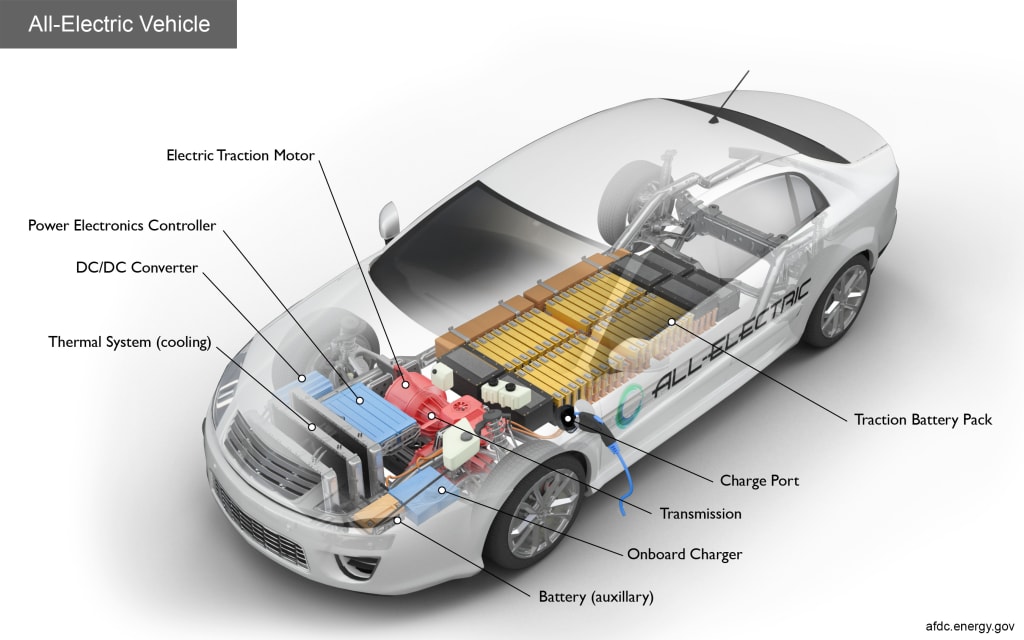
Electric vehicles, or EVs, are a type of vehicle that runs on electricity rather than gasoline or diesel fuel. They are becoming increasingly popular due to their eco-friendliness and low operating costs. In this article, we will explore what electric vehicles are and how they work.
What is an Electric Vehicle?
An electric vehicle is a type of vehicle that is powered by an electric motor rather than an internal combustion engine. This means that it does not require gasoline or diesel fuel to operate. Instead, it is powered by a battery that is charged by plugging the vehicle into an electrical outlet.
There are two types of electric vehicles: battery electric vehicles (BEVs) and plug-in hybrid electric vehicles (PHEVs). BEVs are powered entirely by electricity and have a range of around 100 to 300 miles on a single charge. PHEVs, on the other hand, have both an electric motor and a gasoline engine. They can run on electricity for a certain distance before the gasoline engine takes over.
How does an Electric Vehicle Work?
An electric vehicle works by converting stored electrical energy in its battery into mechanical energy to power the vehicle's wheels. The process involves three main components: the battery, the electric motor, and the power electronics.
The Battery
The battery is the most important component of an electric vehicle. It stores electrical energy that is used to power the vehicle's electric motor. Most electric vehicles use lithium-ion batteries, which are lightweight and have a high energy density.
When the vehicle is plugged into an electrical outlet, the battery is charged by an onboard charger. The charger converts the AC power from the outlet into DC power that can be stored in the battery. The charging time varies depending on the battery size and the charging rate.
The Electric Motor
The electric motor is responsible for converting electrical energy into mechanical energy. It is located in the vehicle's drivetrain and is connected to the wheels via a transmission.
The electric motor operates in a similar way to a gasoline engine. When the driver presses the accelerator pedal, it sends a signal to the motor controller to increase the amount of electrical current that is sent to the electric motor. The motor then spins, which powers the wheels.
One of the advantages of electric motors is that they can provide instant torque, which means that they can accelerate quickly. This is because they do not have to wait for the engine to rev up before delivering power.
The Power Electronics
The power electronics are responsible for controlling the flow of electrical current between the battery and the electric motor. They also convert the DC power from the battery into AC power that can be used by the motor.
The power electronics consist of several components, including the motor controller, the DC-DC converter, and the inverter. The motor controller regulates the amount of electrical current that is sent to the motor based on the driver's input. The DC-DC converter converts the high-voltage DC power from the battery into a lower voltage that can be used by the vehicle's auxiliary systems, such as the lights and the air conditioning. The inverter converts the DC power from the battery into AC power that is used by the electric motor.
Benefits of Electric Vehicles
There are several benefits of electric vehicles that make them an attractive alternative to gasoline-powered vehicles:
Environmentally Friendly
Electric vehicles produce no emissions while they are driving, which makes them much better for the environment than gasoline-powered vehicles. They also produce less greenhouse gas emissions than gasoline-powered vehicles, even when you take into account the emissions from the power plants that generate the electricity.
Lower Operating Costs
Electric vehicles are much cheaper to operate than gasoline-powered vehicles. The cost of electricity is much lower than the cost of gasoline, which means that you can save money on fuel costs. In addition,
About the Creator
Keep reading
More stories from Click & Learn and writers in FYI and other communities.
What is Chatgpt
ChatGPT is an artificial intelligence-based chatbot developed by OpenAI. It is a state-of-the-art language model that can understand and respond to human queries in natural language. ChatGPT is based on the GPT (Generative Pre-trained Transformer) architecture, which is a deep learning model trained on a large corpus of text data.
By Click & Learn3 years ago in FYI
A Failed Artist, A Disillusioned Poet, An Underpaid Game Show Host
I took my son and niece to Gori, a small town in Georgia where Joseph Stalin was born. They talked me into visiting the Stalin's Museum, the largest in the post-Soviet space. I had resisted going there because I just can't stand the monster and know enough about him, or so I thought.
By Lana V Lynx19 days ago in FYI



Comments
There are no comments for this story
Be the first to respond and start the conversation.