
What If Earth Isn’t Solid After All? Exploring the Strange Clues Behind the Hollow Earth Theory
A deep dive into forgotten discoveries, bizarre legends, and the strange possibility that our planet might hide an entire world within its walls.

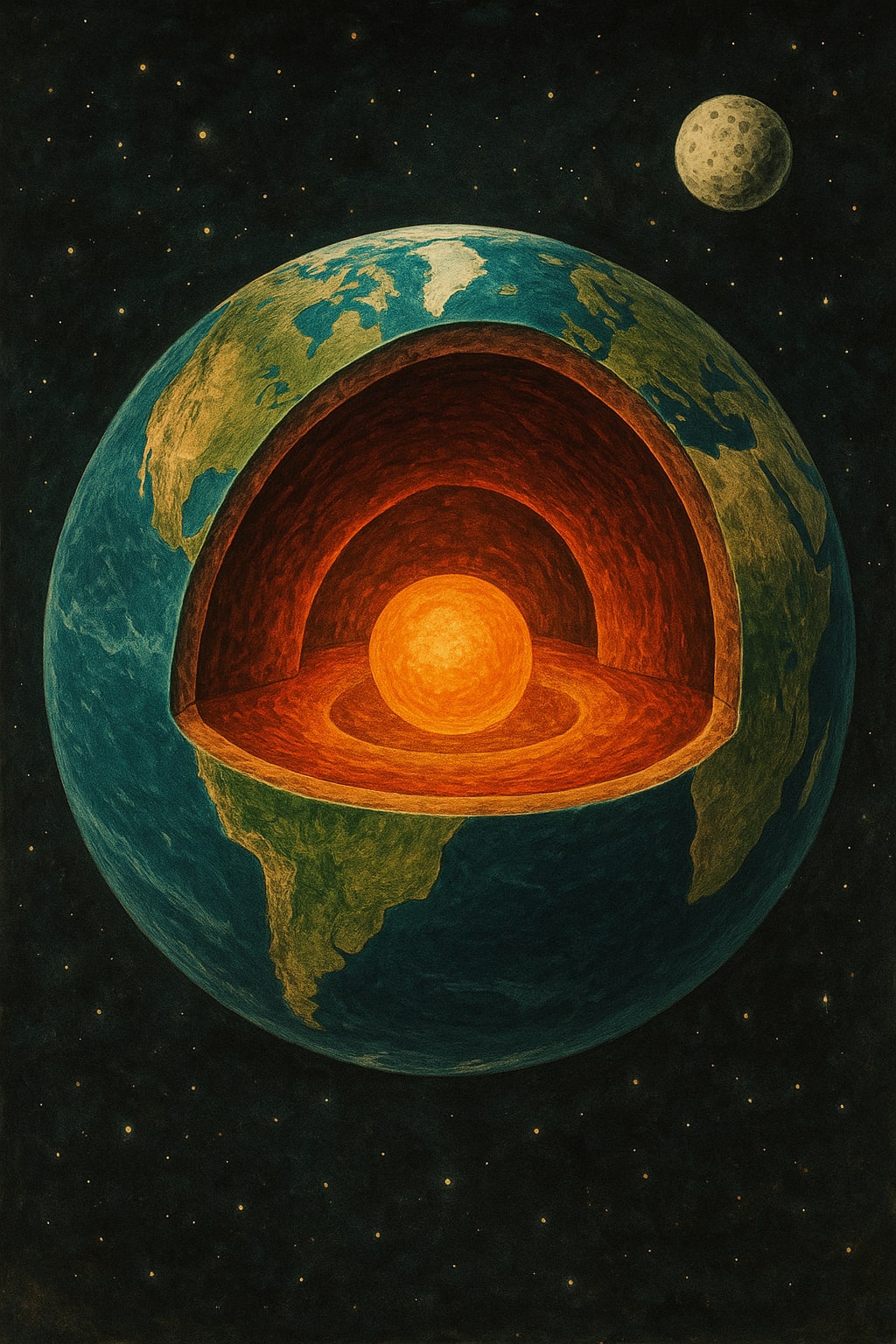
When most of us picture the inside of Earth, we automatically think of that neat little diagram from science class, the one that slices the planet like an onion. Crust, upper mantle, lower mantle, outer core, inner core. Simple, right?
Well… not exactly.
For all our modern technology and scientific achievements, the truth is we’ve barely scratched the surface of our own planet. Literally, humanity has only dug about eight miles down, which is nothing compared to the nearly 4,000 miles it would take to reach the core. So, despite the diagrams we confidently draw, much of what we “know” about Earth’s interior is still based on theoretical models, not direct observation.
That’s why the Hollow Earth theory, as wild as it sounds, continues to fascinate people even today. And once I started digging into the history behind it, I found myself surprisingly intrigued.
Here are some of the most interesting clues, stories, and scientific oddities that have fueled the idea that Earth might be hiding far more than we think.
1. A Hidden Ocean Deep Beneath Our Feet
In 2014, an international team led by Professor Graham Pearson made a discovery nobody expected, all thanks to a cheap, brownish diamond found in Brazil.
Inside the diamond was a mineral called ringwoodite, which had water trapped inside it, about 1.5% of its weight. That may not sound like much, but scientists believe that if enough ringwoodite exists in the Earth’s “transition zone” (about 250 miles underground), it could contain as much water as all the oceans on the surface combined.
It doesn’t prove a Hollow Earth, of course. But it does show there are massive, mysterious environments deep below us that we’ve barely begun to understand.
2. Edmond Halley’s Strange Geophysical Model
You know Edmond Halley, the scientist who predicted the orbit of Halley’s Comet. But fewer people know that Halley also believed Earth wasn’t solid at all.
He suggested that the planet was made of multiple inner shells, each spinning independently. According to him, the unpredictable shifts in Earth’s magnetic field were caused by these inner spheres.
Halley even believed that each inner layer could support life, illuminated by a faint atmospheric glow. Not bad for a 17th-century astronomer.
3. Leonhard Euler’s Central Sun
Leonhard Euler is widely considered one of the greatest mathematicians in history. And yes, he also believed Earth was hollow.
Euler theorized that the planet had a 600-mile-wide sun sitting right in the center, providing warmth and light to vast civilizations inside the hollow interior. He also proposed that openings at the North and South Poles served as entrances.
It sounds like pure fantasy, but the fact that some of history’s brightest minds seriously explored the idea is fascinating in itself.
4. Admiral Byrd’s Mysterious Polar Flight
The Hollow Earth theory blew up again in the 1940s thanks to Admiral Richard E. Byrd, a decorated U.S. naval officer and the first person to fly over the South Pole.
According to accounts (and a controversial diary), Byrd reported flying through an opening near the North Pole and entering a land filled with lakes, rivers, forests, and even a living mammoth. He claimed he interacted with advanced beings concerned about humanity’s use of nuclear weapons.
The story is heavily debated, but it remains one of the most legendary pieces of Hollow Earth lore.
5. The Green Children of Woolpit
One of the strangest stories comes from 12th-century England, where villagers reported finding two children with green skin who spoke a completely unknown language.
They refused to eat any food except freshly harvested beans. The boy eventually died, but the girl survived, learned English, and explained that they came from a twilight world called St. Martin’s Land, where the sun never shone, and everyone lived underground.
Folklore? Possibly. But it adds another thread to the web of stories hinting at worlds below.
Other Legends and Oddities
All around the world, cultures have passed down stories about inner worlds, hidden civilizations, and underground realms:
- The Makushi people of the Amazon describe a 13–15-day journey inside the Earth to reach a land of giants.
- Rumors from the early 1900s suggest German U-boats searched for openings into inner-earth regions.
- Various myths across Asia, Europe, and the Americas point to hidden kingdoms beneath mountains, deserts, and oceans.
Not all of these claims can be verified, but their existence shows just how deeply the idea of an inner Earth is embedded in human imagination.
So… Could Earth Be Hollow?
Before researching all this, I thought we knew a lot more about our planet’s interior. Turns out, much of what we consider “fact” is still based on interpretation, models, and educated guesses.
The more I learned, the more I realized how important it is to keep an open mind. There’s still so much we don’t know about our oceans, our planet, space, or even ourselves.
The Hollow Earth theory may sound far-fetched, but the mysteries beneath our feet are very real.
What do you think? Could there be more to our planet than we’ve been taught?
About the Creator
Areeba Umair
Writing stories that blend fiction and history, exploring the past with a touch of imagination.
Keep reading
More stories from Areeba Umair and writers in FYI and other communities.
The CIA Just Dropped a Trove of UFO Files, And Some of Them Are Seriously Wild
Suppose you’ve ever felt that familiar shiver watching late-night reruns of The X-Files. Today feels a little bit like coming full circle. The CIA has quietly released hundreds of declassified documents, some dating back to the late 1940s and early 1950s, detailing investigations into unidentified flying objects.
By Areeba Umairabout a month ago in FYI
Miss Persephone's Manual to a Seemingly Ordinary Life
Miss Persephone was found at the dining table, her blue eyes swollen, her tears arriving and retreating like the tides of the ocean. Earlier that day, her family had visited her in the retirement home where she had lived for eight years. It was her eightieth birthday.
By Imola Tóth3 days ago in Fiction


Comments
There are no comments for this story
Be the first to respond and start the conversation.