
Welcome To The Information Dumping Ground
The history and science of the Republic of Null Island

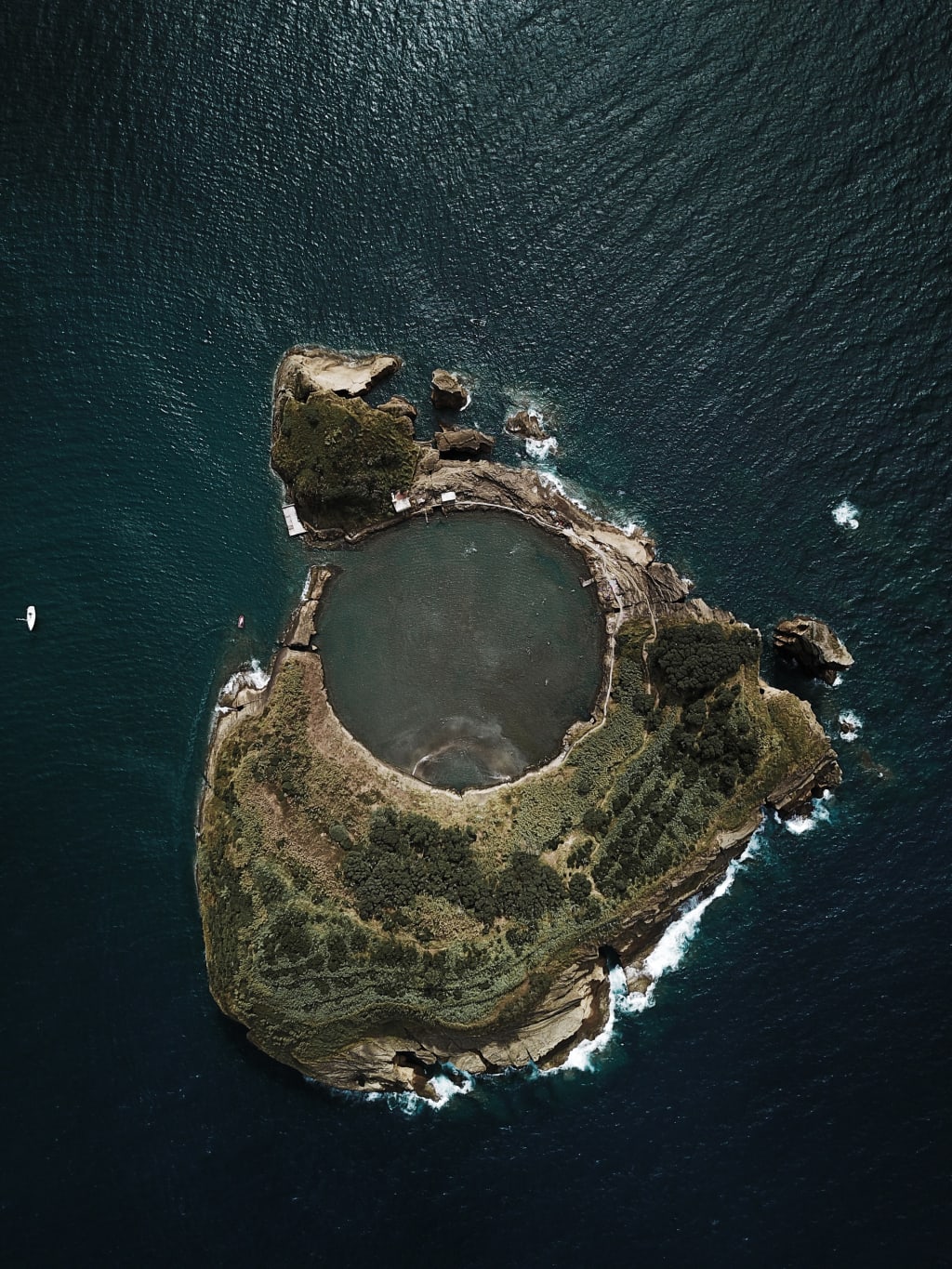
Planning your next family holiday or travel adventure?
Then why not consider a trip to an island in the South Atlantic, just off the west coast of the African continent, some 354 miles (570 km) from Ghana. There you’ll (supposedly) find a small community, estimated population of four thousand (but with millions of tourists every year), the world’s highest per capita Segway users, and home to some of the most diverse landmarks imaginable.
It’s called Null Island, and you are invited to come anytime. In fact, you may have already been and not realised. No Visa, COVID passport or inoculation required, just bring a compass. Coordinates 0 by 0. There’s no airport, so you have to come by sea.
A whistlestop tour
But when you get there aboard your rubber dingy, with your suitcase and camera ready, you’ll be greeted by nothing more than a lonely old buoy bobbing up and down in the sea, code named Station 13010-Soul, surrounded by endless nothing as far as the eye can see.
Take a photo nonetheless, you need something for your Instagram account.
But this buoy isn’t here for show, to give directions, or to help any hopeful tourist, it’s actually a joint venture between the US, Brazil and France to study ocean atmosphere data. Called PIRATA for short (Prediction and Research Moored Array in the Tropical Atlantic), it’s one of many buoys containing observation equipment used to assist in the understanding of climate and weather forecasting.
And that’s all well and good, you might say, but what about my damn holiday? If all that you see is a boring little buoy, what’s with all those photos and all those Google map pins pointing here? Where is the island itself? Is this like the island from Lost with timetravelling and shit?
Unfortunately, not. There is no island. It doesn’t exist.
Much ado about Null
So here’s the science bit:
Null Island is the result of a geocoding system either misinterpreting data, being given incorrect data to start with, or simply glitching when receiving it, and inputting said data as null. When it comes to location, this null becomes coordinates.
The system used in this geocoding is the World Geodetic System 1984 (WGS84), used as a global reference system and to help with the global position system (GPS).
Null means, essentially, the absence or lack of something, such as data. If you access an app and upload a photo, for example, and if the coding within said app is so poor it cannot read your location, it may enter your coordinates as null — meaning no data. It doesn’t have the data of your location, and leaving a field blank is saying the data is “null”. Fair enough.
The problem, of course, is in the interpretation of “null.” How do you show this? Well, usually with a zero, right? Sure, but if your software isn’t smart enough, it may take those zeros literal.
In other words, latitude unknown and longitude unknown, becomes latitude zero degrees longitude zero degrees — the point on earth where the equator meets the prime meridian — the geographical centre of the planet: Welcome to Null Island.
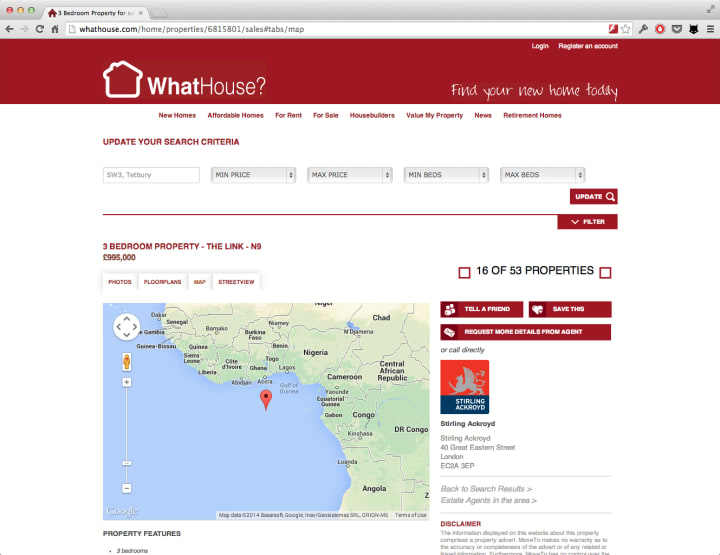
The confusion between no data and literal data as zero is how someone uploading a selfie of the Eiffel Tower in Paris, or as in the example below, how a £995,000 north London property for sale online, can both appear to be on some island off the West coast of Africa:
Null island has since been subject to artists interpretations, a flag, and a tongue-in-cheek republic being created.
And this null error doesn’t just affect locations and numerical fields. There are stories of individuals out there with the surname Null who, when attempting to enter their details online when, for example, trying to pay taxes, register to vote, or book a holiday, they get repeated problems.
Why? In a way, it’s the reverse of the Null Island problem. There, no data or an error with data reverted coordinates to 0,0. But with the name Null, the software is taking that actual data, which is correct, and mistaking it for a lack of data — it sees a field with the word “Null” written in it and unhelpfully pops up saying “please enter name to continue.”
We have to go back, Kate!
Unfortunately, when it comes to Null Island, it isn’t the land of wonder you were hoping for. As systems become more advanced, this is becoming less of a problem in recent years, but it still happens. As for your holiday? Maybe turn back in your boat and have that week in Mallorca instead.
Ultimately, these software systems have to make some interpretation of the data they receive, and a decision has to be made when that data is either missing, incorrect, or confusing. All data has to go somewhere, and if it gets lost, you can guarantee it’ll wash up upon the shores of Null Island — the data dumping ground of the world wide web.
* * *
About the Creator
R P Gibson
British writer of history, humour and occasional other stuff. I'll never use a semi-colon and you can't make me. More here - https://linktr.ee/rpgibson
Keep reading
More stories from R P Gibson and writers in FYI and other communities.


Comments
There are no comments for this story
Be the first to respond and start the conversation.