
United States Agricultural Machinery Market Poised to Hit US$ 67.80 Billion by 2033: Automation, Sustainability, and Precision Farming Fuel Growth
The U.S. agricultural machinery industry is revolutionizing modern farming through automation, sustainability, and digital precision — propelling farmers into a new era of productivity and efficiency.


United States Agricultural Machinery Market Overview
According to Renub Research, the United States Agricultural Machinery Market is projected to reach US$ 67.80 billion by 2033, rising from US$ 40.20 billion in 2024, growing at a CAGR of 5.98% during 2025–2033.
This growth highlights the nation's accelerating adoption of advanced agricultural equipment designed to increase productivity, reduce labor dependency, and promote sustainable farming. The demand is being driven by farmers’ pursuit of higher efficiency and precision in agricultural operations.
Agricultural machinery encompasses a broad range of tools — from tractors and ploughs to harvesters, seeders, sprayers, and irrigation systems. These machines simplify every step of farming, including soil cultivation, planting, watering, and harvesting, while minimizing labor intensity and operational costs.
Recent technological innovations — such as GPS-guided systems, automation, and IoT-based monitoring — have transformed farming practices across the U.S., helping farmers optimize land use, boost yields, and reduce environmental impact. The result is a smarter, data-driven, and more sustainable approach to agriculture that aligns with global food security and climate goals.
Market Dynamics and Key Drivers
1. Sustainable Farming Practices
The growing emphasis on environmentally friendly agriculture has become a major growth driver for the U.S. agricultural machinery market. Farmers are increasingly investing in machinery that conserves resources, lowers emissions, and enhances soil health.
Technologies such as precision farming tools, GPS-guided tractors, and smart irrigation systems enable farmers to apply fertilizers and pesticides more accurately, reducing waste and runoff. Innovations in no-till farming and renewable energy-powered machinery are further enhancing soil quality and reducing carbon footprints.
In a market where sustainability meets profitability, eco-conscious farmers are finding that modern equipment not only complies with environmental regulations but also improves operational efficiency and long-term yield stability.
2. Rising Food Demand
With the global population steadily increasing, food security has emerged as a key priority. The U.S. agricultural sector, known for its large-scale operations, is under pressure to produce more food efficiently with limited arable land.
This challenge is accelerating the adoption of advanced machinery like automated tractors, combine harvesters, and precision planters that allow farmers to cultivate larger areas with reduced manpower.
Mechanization is essential for meeting food demand while maintaining quality and sustainability — making agricultural machinery an indispensable part of the nation’s food production ecosystem.
3. Technological Advancements
The rapid integration of automation, robotics, and artificial intelligence (AI) is reshaping the U.S. agricultural machinery landscape. Farmers can now use autonomous tractors, smart sensors, and AI-powered drones to monitor soil, detect crop diseases, and manage water usage efficiently.
For instance, in December 2022, CNH Industrial expanded its AgTech capabilities in Phoenix, Arizona, unveiling advanced Automation and Autonomy Solutions. Supported by brands like Case IH and New Holland, the company introduced Driverless Tillage Systems and Driver Assist Harvest Solutions, providing farmers with smart, self-operating tools that improve yield accuracy and reduce downtime.
These innovations not only improve efficiency and output but also address labor shortages — a persistent challenge in American agriculture.
Challenges Facing the Market
1. High Initial Costs
While automation and precision farming technologies offer tremendous benefits, their high upfront costs remain a barrier for small and mid-sized farms.
Purchasing modern tractors, robotic harvesters, or GPS-guided planting equipment requires significant capital investment, limiting widespread adoption.
Although these technologies promise long-term savings, many farmers find it difficult to justify the immediate financial burden without external support or financing assistance.
2. Maintenance and Repair Expenses
The growing complexity of agricultural machinery has also increased maintenance and repair costs.
Modern machines often require specialized parts and skilled technicians — adding to operational expenses. Equipment failures can cause delays during critical farming periods, impacting productivity.
Rural areas, in particular, face shortages of qualified repair professionals, compounding the problem and highlighting the need for better support infrastructure in the agricultural machinery ecosystem.
United States Agricultural Machinery Market Segmentation
By Machinery Type
Irrigation Machinery
Tractors
Ploughing and Cultivation Machinery
Harvesting Machinery
Haying and Forage Machinery
Planting Machinery
Sprayer
Each of these categories plays a crucial role in transforming traditional farming into a high-efficiency, technology-driven industry.
Irrigation Machinery
Efficient irrigation remains vital for ensuring consistent crop yields.
Gravity Irrigation
Micro-Irrigation
Sprinkler Systems
These solutions help minimize water wastage and ensure uniform distribution across fields, addressing both environmental and cost-efficiency concerns.
Tractors by Engine Power
Less than 40 HP – Popular among small-scale farms for versatile use and affordability.
41 to 100 HP – The most widely used range, balancing power and cost for medium farms.
More than 100 HP – High-performance tractors for large-scale operations and advanced tasks.
Tractors remain the backbone of U.S. agriculture, witnessing steady demand as farms expand and upgrade to meet growing output needs.
Ploughing and Cultivation Machinery
Cultivators and Tillers
Harrows
Ploughs
Others
Modern ploughing equipment enhances soil preparation, allowing for efficient nutrient distribution and weed control, leading to improved crop productivity.
Harvesting Machinery
Combine Harvesters
Harvesting Robots
Self-Propelled Forage Harvesters
Automation in harvesting is a game-changer, ensuring precision, reducing losses, and saving time. The emergence of AI-driven robotic harvesters is setting new benchmarks in efficiency and quality control.
Haying and Forage Machinery
Mowers
Balers
Tedders and Rakes
Forage Harvesters
These machines are essential in livestock farming, enabling farmers to efficiently cut, dry, and store hay and forage crops — critical components of animal feed.
Leading Companies in the U.S. Agricultural Machinery Market
The U.S. market is dominated by established players who continuously innovate to enhance productivity and sustainability.
John Deere – A global leader known for its precision agriculture and automation technologies.
CNH Industrial – Pioneering autonomous machinery and smart farming solutions.
AGCO Corporation – Offers advanced machinery under brands like Massey Ferguson and Fendt.
Kubota Corporation – Specializes in compact tractors and eco-friendly equipment.
Titan Machinery Inc. – One of the largest U.S.-based dealers and distributors of agricultural machinery.
CLAAS – Renowned for cutting-edge harvesting solutions and smart automation tools.
Lindsay Corporation – A leader in irrigation technology and precision water management.
Alamo Group Inc. – Provides a broad range of agricultural and infrastructure maintenance equipment.
Each company focuses on innovation, durability, and sustainability to stay competitive in a rapidly evolving landscape.
Future Outlook: Smart, Sustainable, and Connected
The future of the U.S. Agricultural Machinery Market lies in digitally connected, autonomous, and eco-friendly systems.
Artificial intelligence, machine learning, and real-time analytics will enable farmers to make data-driven decisions, optimizing inputs and maximizing yields. Moreover, government incentives, agritech startups, and collaborations between technology firms and traditional manufacturers will further fuel market expansion.
With automation becoming integral to farm management, and sustainability at the heart of agricultural reform, the next decade promises a technologically advanced and resilient farming ecosystem.
Final Thoughts
The United States Agricultural Machinery Market is more than just an industrial segment — it’s a reflection of how innovation can transform one of humanity’s oldest professions. As farmers face mounting challenges like climate change, labor shortages, and rising food demand, modern machinery provides a pathway toward sustainable, high-yield farming.
By 2033, with the market valued at US$ 67.80 billion, American agriculture will stand as a benchmark for efficiency and technological integration — where machines not only till the soil but also pave the way for a greener, smarter future.
Source: Renub Research – United States Agricultural Machinery Market Report (2025–2033)
About the Creator
Janine Root
Janine Root is a skilled content writer with a passion for creating engaging, informative, and SEO-optimized content. She excels in crafting compelling narratives that resonate with audiences and drive results.
Keep reading
More stories from Janine Root and writers in FYI and other communities.
Spectrum Analyzer Market Outlook 2025–2033: Precision, Performance, and Global Expansion
According to Renub Research Latest Report global spectrum analyzer market is entering an era defined by innovation, connectivity, and precision. According to Renub Research, the market will expand from US$ 1.35 billion in 2024 to US$ 2.28 billion by 2033, growing at a CAGR of 5.98% between 2025 and 2033. This strong trajectory reflects the rapid evolution of telecommunications, defense modernization, aerospace advancements, and the expanding landscape of 5G and IoT applications.
By Janine Root 3 months ago in FYI
Europe Commercial Greenhouse Market Size and Forecast 2025–2033
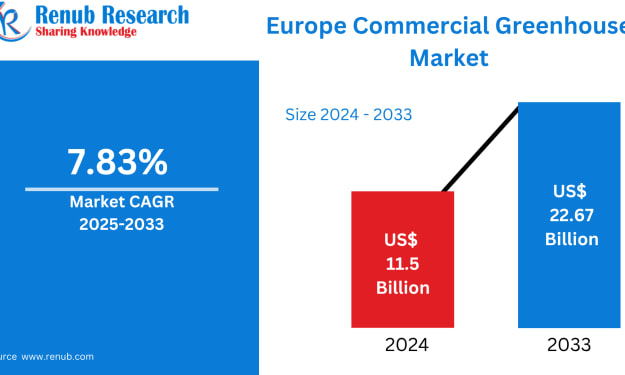
The Europe Commercial Greenhouse Market is set for dynamic expansion over the coming decade, reflecting the region’s accelerating transition toward sustainable, technology-driven agriculture. According to Renub Research, the market is projected to reach US$ 22.67 billion by 2033, rising from US$ 11.5 billion in 2024, at a robust CAGR of 7.83% during 2025–2033. This growth is being driven by increasing demand for year-round crop production, the rapid adoption of Controlled Environment Agriculture (CEA), and a strong policy push toward climate-resilient and resource-efficient farming.
By Renub Research3 days ago in FYI



Comments
There are no comments for this story
Be the first to respond and start the conversation.