
Underwater Ruins in the Bermuda Triangle
Traces of Civilization Beneath the Depths

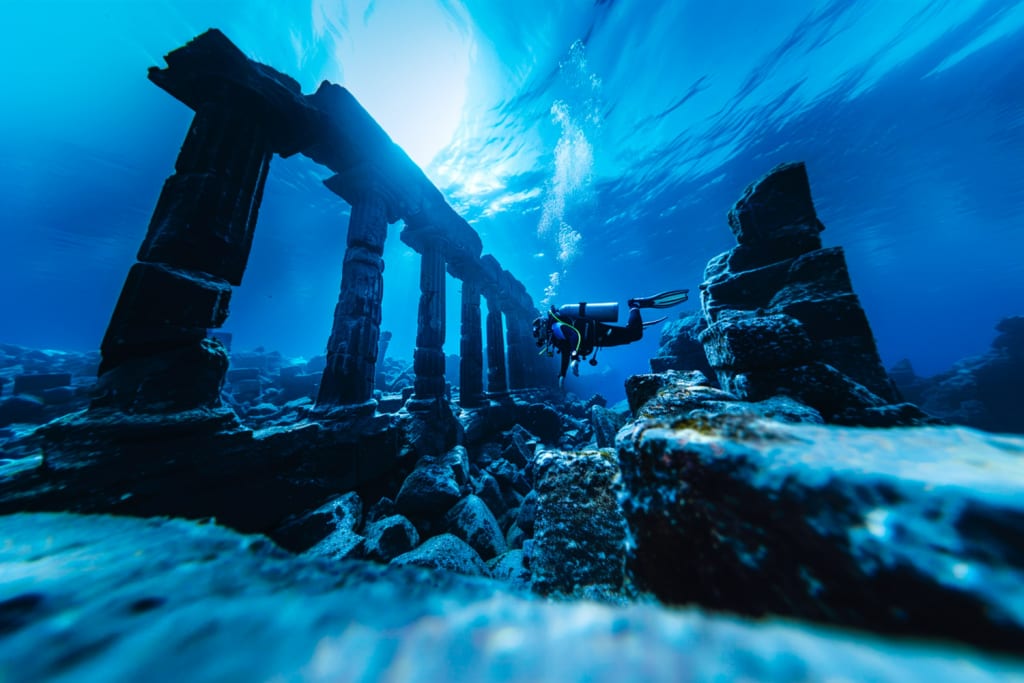
Few regions on Earth are surrounded by as many legends as the Bermuda Triangle, also known as the Devil's Triangle. The region in the western Atlantic is home to many fascinating formations along the shallow waters of the Bermuda Reefs.
Since World War II, many pilots searching for the traces of planes and ships that vanished in the Bermuda Triangle have flown over the islands and surrounding waters. Numerous pilots of scheduled flights and charter planes have reported seeing walls and roads beneath the water. Other pilots flying at low altitudes believe that the formations they observed resemble the tops of sunken buildings.
There are other examples along the reefs of the Bahamas as well; some of the remnants form stone circles, similar to Stonehenge in England. Others are linked to existing islands through underwater walls or roads, while some rise around fresh water springs, creating circular formations. Far below the surface, a series of straight lines and intersecting grid patterns can often be seen on the ocean floor. These ancient constructions near the Bahamas, which are highly convincing, have been studied by many researchers.
There are vast caves here that contain carved rocks depicting animals and show signs of prolonged submersion. All of these suggest that these caves, which are now located well above sea level, were once submerged and later uplifted, likely due to the periodic sinking and rising of the Atlantic Ocean coastlines.
The entire region of the Bahamas was above sea level during the last ice age and only became submerged with the subsequent rise in sea levels. Researchers have identified 30 areas where human-made remains are likely to be found either on the seafloor or beneath it. At certain points, a regular network of straight lines can be observed, intersecting at right, obtuse, or acute angles. These resemble a complex urban planning or development layout.
But what could that mysterious civilization have been, whose traces can still be found in the region today? According to some hypotheses, the ruins may preserve the remnants of ancient Atlantis, suggesting that the vanished land could have been a real continent and fell victim to the notorious Bermuda Triangle, just like the countless ships and airplanes since then.
The legend of Atlantis, the lost empire, has stubbornly held on in the collective memory of humanity for millennia, without a clear scientific explanation being provided.
The legendary sunken island of Atlantis first appeared in the dialogues of Plato’s two works, written around 360 BC. According to the Greek philosopher, the island kingdom existed 9,000 years ago and has since been sought by numerous adventurers. The ancient world's supposedly greatest naval power was mysteriously swallowed by the sea in a single day and night under unknown circumstances. Over the centuries since Plato, many writers, geologists, scientists, historians, archaeologists, and explorers have tried to trace the lost island. Some clearly disputed its existence, but many theories have emerged regarding the former location of the mysterious kingdom. Once there was a continent that was simply flooded by the "shifting" oceanic masses of water.
Plato fairly accurately described where this lost world is located: beyond the Pillars of Hercules (which most likely refers to the Strait of Gibraltar), about six thousand stadia away from Egypt (approximately 1500 kilometers). The philosopher was probably mistaken about the measurements, as even the direct air distance between Gibraltar and Cairo reaches 3500 kilometers.
After the birth of modern oceanography and plate tectonics (the science of drifting oceanic and continental plates), this view remained dominant for a long time.
So, we still cannot be certain that the Bermuda Triangle marks the former location of Atlantis, but it is certain that some human civilization must have existed, and it is also quite clear that the area is surrounded by an intriguing, mystical haze.


Comments