
Uganda’s Elections are a Critical Flashpoint. Here’s What to Know
Uganda’s 2026 Election, State Repression, and the Risk of a Youth-Led Uprising

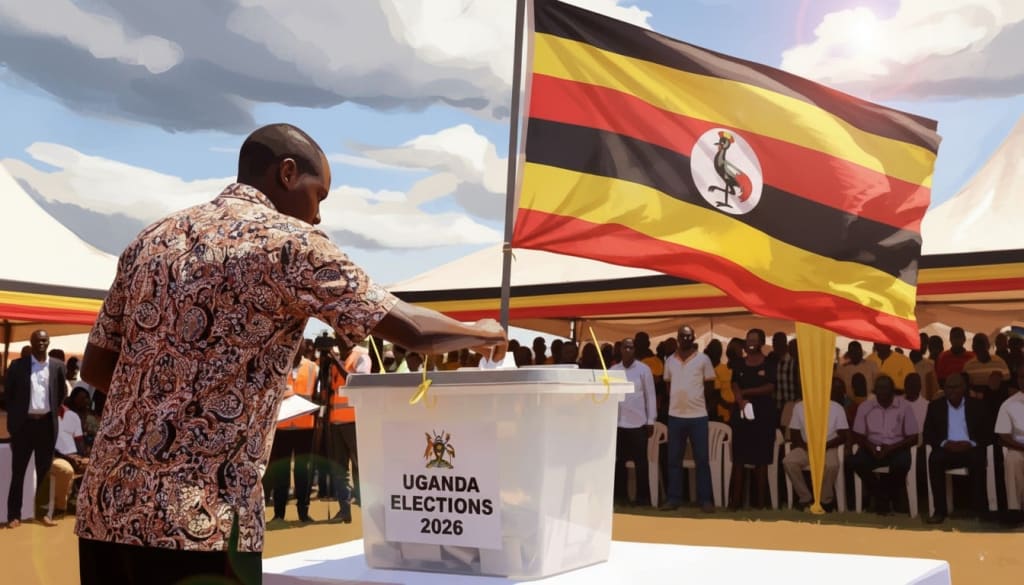
On January 15, 2026, Uganda will hold a nationwide general election. The contest will once again pit the country’s long-serving strongman, Yoweri Museveni, against prominent opposition figure Bobi Wine, reprising their 2021 showdown. After decades of uninterrupted rule and multiple re-elections, Uganda’s opposition believes—perhaps more out of necessity than optimism—that this could finally be the year Museveni is forced from power.
Few observers expect the campaign to unfold peacefully. Ugandan and international rights groups have warned repeatedly that the election season is likely to be marked by violence and repression. Just days ago, Bobi Wine was beaten with a cane alongside members of his campaign team and supporters, in an assault he alleges was carried out by security forces. The legacy of Uganda’s 2021 election offers little reassurance: voter intimidation, harassment of political opponents, suppression of the media, and even lethal violence were all documented during the last cycle.
More broadly, developments across Africa and beyond suggest that voters—especially younger ones—may be increasingly willing to respond when they believe elections have been manipulated or stolen. In nearby Kenya, Tanzania, and Madagascar, as well as in countries like Bangladesh and Nepal, young, disenfranchised populations have shown a growing readiness to confront entrenched power, even at severe personal risk.
Uganda now stands on the brink of a fiercely contested and potentially explosive election at a moment when heavily managed or fraudulent votes have increasingly sparked prolonged unrest. With only weeks remaining until polling day, there is a genuine possibility that Uganda could become the first major international crisis of 2026. What follows is an overview of the key dynamics shaping the vote.
Uganda in Focus
Compared to many of its neighbors in sub-Saharan Africa, Uganda’s relative stability over recent decades is striking. South Sudan, to the north, remains one of the world’s poorest and most fragile states. To the west, the Democratic Republic of the Congo is once again mired in civil conflict. Uganda, by contrast, has avoided large-scale collapse. That stability, however, has come at a steep political cost.
Yoweri Museveni has ruled Uganda continuously since January 1986. If re-elected in 2026, he will surpass forty years in power within days of the vote. Internationally, he is widely regarded as an authoritarian leader presiding over a system defined by repression. Under his rule, the press has been brought firmly under state control, lawmakers have attempted to legitimize extreme punishments against LGBTQ Ugandans, and security forces have repeatedly been deployed against peaceful political opposition. Corruption is deeply embedded within the ruling elite, reinforced through patronage networks that extend from the national government down to local communities.
Museveni’s inner circle is tightly bound by loyalty and shared interests. His son, General Muhoozi Kainerugaba, is widely viewed as his chosen successor and has built a reputation of his own for repression at home and incendiary rhetoric abroad, including threats of regional military action. Together, Museveni’s allies control nearly every meaningful lever of power in the Ugandan state.
By most conventional definitions, Museveni’s system resembles a classic entrenched dictatorship: a leader with no meaningful term limits, extensive use of state resources to entrench authority, clear plans for dynastic succession, and institutions incapable of independently challenging executive power. Against that backdrop, it may seem surprising that Uganda holds elections at all—or that opposition figures like Bobi Wine are allowed to contest them.
That contradiction is intentional. Under Museveni, Uganda has evolved into what might best be described as a system of concealed authoritarianism. The appearance of elections serves a practical function. Periodic votes provide an outlet for public frustration, allowing citizens to express dissent without immediately resorting to open rebellion. They also encourage continued hope that change can occur through civic means, rather than through violent resistance.
This carefully managed opposition has helped Museveni deflect societal anger that might otherwise have led to his removal years ago. Election results appear tightly controlled, yet Museveni typically allows opponents to post relatively substantial vote totals. In 2016, opposition leader Kizza Besigye was credited with more than 35 percent of the vote. In 2021, Bobi Wine received a similar share. Museveni emerged victorious each time, but the acknowledgment of opposition support—however manipulated—has served as a stabilizing pressure valve.
There is little evidence, however, that opposition figures themselves are complicit in this arrangement. By the assessments of international election monitors and human rights organizations, Bobi Wine is a genuine challenger. Born Robert Kyagulanyi Ssentamu, Wine is a musician, activist, actor, and lawyer who has become one of Museveni’s most visible critics. He has cultivated strong ties within global pro-democracy networks and consistently challenged the regime’s policies and cultural stances.
Still, Museveni may not view Wine as an existential threat. Instead, Wine functions as a credible vessel for public anger—one that has thus far been unable to overcome the state’s coercive machinery. That dynamic was made clear during the 2021 election.
During that campaign, international observers documented widespread abuses. Human Rights Watch reported killings by security forces, mass arrests, beatings of journalists and supporters, the disruption of opposition rallies, and a nationwide internet shutdown. Wine himself was beaten and temporarily blinded by security forces roughly two months before the vote. More than one hundred of his supporters were reportedly killed during subsequent crackdowns. His personal bodyguard was struck by a military vehicle, and after Wine alleged election fraud, he was placed under house arrest before ultimately leaving the country for an extended period
From Museveni’s perspective, the lesson appears clear: even with significant public backing, Wine cannot prevail against a fully mobilized security state. When Wine announced his intention to run again in 2026, he faced initial resistance from electoral authorities but was ultimately permitted to proceed. With the election now imminent, both Museveni and Wine are expected to appear on the ballot.
Fears of Repression
As the campaign has progressed, international concern has intensified. According to UN human rights chief Volker Türk, the United Nations has received credible reports that at least 550 opposition members and supporters have been arrested since the beginning of 2025. Roughly 300 of those arrests occurred after the official campaign period began in September, and many detainees remain in custody.
Observers on the ground report a heavy security presence at rallies and political gatherings. Armed police and military units routinely attend opposition events, often less to maintain order than to intimidate participants. According to Türk, security forces have deployed tear gas, batons, whips, water cannons, and chemical irritants against civilians. In at least one incident, live ammunition was used, leaving three people injured and one dead.
Beyond public crackdowns, opposition figures allege the use of torture, enforced disappearances, and extrajudicial detention. Detainees are reportedly transported in unmarked vehicles to secret facilities—commonly referred to as “safe houses”—where they are held without access to legal counsel or family. Some released prisoners bear visible signs of abuse; others refuse to speak about their treatment, likely out of fear.
Pressure has also intensified against civil society as a whole. State institutions have increased surveillance of NGOs, media outlets, and legal organizations, using investigations, harassment, and intimidation to suppress dissent. Public resources have been mobilized to benefit Museveni’s campaign, while patronage networks are used to coerce workers and community leaders into compliance. Declining foreign aid has further reduced incentives for restraint, allowing corruption and electoral manipulation to proceed with fewer external consequences.
High-profile opposition figures have been singled out as warnings. In a December 6 incident in northern Uganda, Wine reported being beaten during an attack by individuals he described as police officers, leaving several supporters hospitalized. Earlier in the year, his bodyguard Eddie Mutwe was abducted and later publicly humiliated by Museveni’s son, who circulated images of Mutwe in detention and made explicit threats against him. When Mutwe eventually appeared in court, UN officials noted visible signs of physical abuse.
Repression has extended beyond Uganda’s borders. Former opposition leader Kizza Besigye was reportedly abducted in Kenya in late 2024 and secretly returned to Uganda on treason charges. Activist Sam Mugumya has been missing since August after his alleged abduction by security forces.
Ugandan authorities have also taken an increasingly confrontational stance toward international critics. The government has accused the European Union of financing Wine’s movement following diplomatic meetings that raised concerns about torture and disappearances. In response, senior officials issued thinly veiled threats against foreign diplomats. Security cooperation with Germany was suspended shortly afterward, and public mockery of European officials followed.
Taken together, these actions suggest a regime confident that it can suppress dissent without serious repercussions. Given Museveni’s history of electoral victories, 2026 appears, on paper, to be another foregone conclusion. More troubling is the likelihood that repression will intensify further in the weeks ahead, potentially including voter intimidation, ballot destruction, and overt manipulation of results.
The Gen-Z Element
There is, however, one variable that may complicate Museveni’s calculations: the rise of a global youth-led protest movement.
Beginning with mass mobilizations in 2023 and 2024—such as Iran’s protests following the death of Mahsa Amini, Kenya’s demonstrations over proposed tax hikes, and Bangladesh’s uprising that forced longtime leader Sheikh Hasina from power—youth-driven movements have since emerged across dozens of countries. While some have failed or been suppressed, others have achieved meaningful change. Nepal ousted its government in 2025. Timor-Leste and Mongolia enacted major reforms. Protests in Serbia, Indonesia, the Philippines, and elsewhere continue to produce incremental victories.
These movements share common traits. They are predominantly led by young people, particularly those born after the late 1990s. They are decentralized, organized through social media, and resistant to traditional repression strategies because they lack clear hierarchies. They also share symbols and tactics that cross national boundaries.
Their grievances are similarly consistent. While each movement has its own trigger, the underlying frustrations are long-standing: corruption, inequality, unemployment, rising living costs, and bleak long-term prospects in the face of climate change and institutional stagnation.
By these measures, Uganda is particularly vulnerable. Corruption is pervasive. Youth unemployment is far higher than official figures suggest. Climate-driven droughts and floods are already undermining livelihoods. Uganda’s population is overwhelmingly young, increasingly connected online, and acutely aware of global protest movements. A disputed election, especially one marked by violence, could serve as a powerful catalyst.
Recent events in neighboring Tanzania offer both a warning and a blueprint. After authorities there claimed a landslide victory widely viewed as implausible, Gen-Z-led protests erupted nationwide. The government responded with internet blackouts, social media bans, and military deployments. Opposition groups allege that hundreds were killed, though the true toll remains unclear. Ugandan officials reportedly coordinated with Tanzanian counterparts during that unrest, suggesting close attention to both the threat and the methods used to contain it.
Uganda now appears headed toward a similar reckoning. Even if Museveni secures another victory through state power, there is no guarantee the public will accept the outcome quietly. As 2025 demonstrated across the globe, younger generations are increasingly willing to confront entrenched authority. In the opening weeks of 2026, Uganda’s election may provide the conditions for a comparable uprising.
Defeating a leader like Museveni at the ballot box remains unlikely. But history suggests that when faith in elections collapses, the struggle often moves elsewhere—and Uganda’s people may yet decide that they are no longer willing to wait.
SOURCES
https://www.journalofdemocracy.org/articles/ugandas-fraudulent-election/
https://www.hrw.org/news/2021/01/21/uganda-elections-marred-violence
https://www.csis.org/analysis/ugandas-2026-elections-rising-authoritarianism-and-declining-us-engagement
https://democracyinafrica.org/heightened-militarisation-and-repression-ahead-of-ugandas-2026-general-elections/
https://allafrica.com/view/group/main/main/id/00095028.html
https://www.theafricareport.com/400877/uganda-whos-who-in-the-power-network-driving-musevenis-bid-to-stay-in-power/
https://democracyinafrica.org/beyond-the-ballot-ugandas-elections-and-the-politics-of-late-musevenism/
https://news.un.org/en/story/2025/12/1166504
https://www.aa.com.tr/en/world/un-rights-chief-deplores-intensifying-repression-in-uganda-ahead-of-january-election/3761138
About the Creator
Lawrence Lease
Alaska born and bred, Washington DC is my home. I'm also a freelance writer. Love politics and history.
Keep reading
More stories from Lawrence Lease and writers in FYI and other communities.
Yemen is Dead. Here's What Will Replace It
If you look at a map of Yemen dated December 1, 2025, it’s already wrong. In just two weeks, a separatist group called the Southern Transitional Council (STC) has upended nearly a decade of assumptions about the country’s balance of power. Through a rapid, coordinated lightning offensive, the STC seized Yemen’s southern coastline, its most valuable oil fields, and the overwhelming majority of the territory once governed by the Cold War–era state of South Yemen.
By Lawrence Lease28 days ago in FYI



Comments
There are no comments for this story
Be the first to respond and start the conversation.