
Top Factors To Consider When Buying Knife Suitable For Survival
factors to consider
Whether hiking remote trails, navigating unforeseen emergencies abroad, or preparing for potential disasters at home, experienced outdoors people understand the vital importance of packing the right survival tools.
Chief among those essentials is a field-worthy fixed-blade knife—a versatile extension of your hands ready to take on any challenges mother nature might present.
However, with the overwhelming variety of knife styles, sizes, materials, and manufacturers, selecting your perfect survival blade partner can feel daunting.
This detailed guide will break down the seven most critical factors to consider when shopping for a knife to see you safely through any ordeal.
1. Blade Material
The steel composition forms the foundation for the core attributes of a survival knife. Stainless steels like D2 tool steel offer improved rust prevention while maintaining hardness for lengthy sharpness between field sharpening sessions.
However, stainless steel lacks the hardness of carbon steel. Carbon steels like 1095 are extremely hard-wearing but require additional oiling care to prevent rust.
For balanced performance, look for partial stainless blades combining corrosion resistance near the tip with carbon steel further up the spine. This provides the best of both worlds: hardness and edge retention from carbon steel combined with rust resistance from the stainless portion.
Budget steels like basic 440C will dull frustratingly fast under heavy tasks and need edge retention. When stuck in a survival situation, you don't want to constantly sharpen a dull knife. Steels like D2 and 1095 that hold an edge longer are better options because you won't need to stop and sharpen as frequently. This allows you to focus your energy on more essential survival tasks.
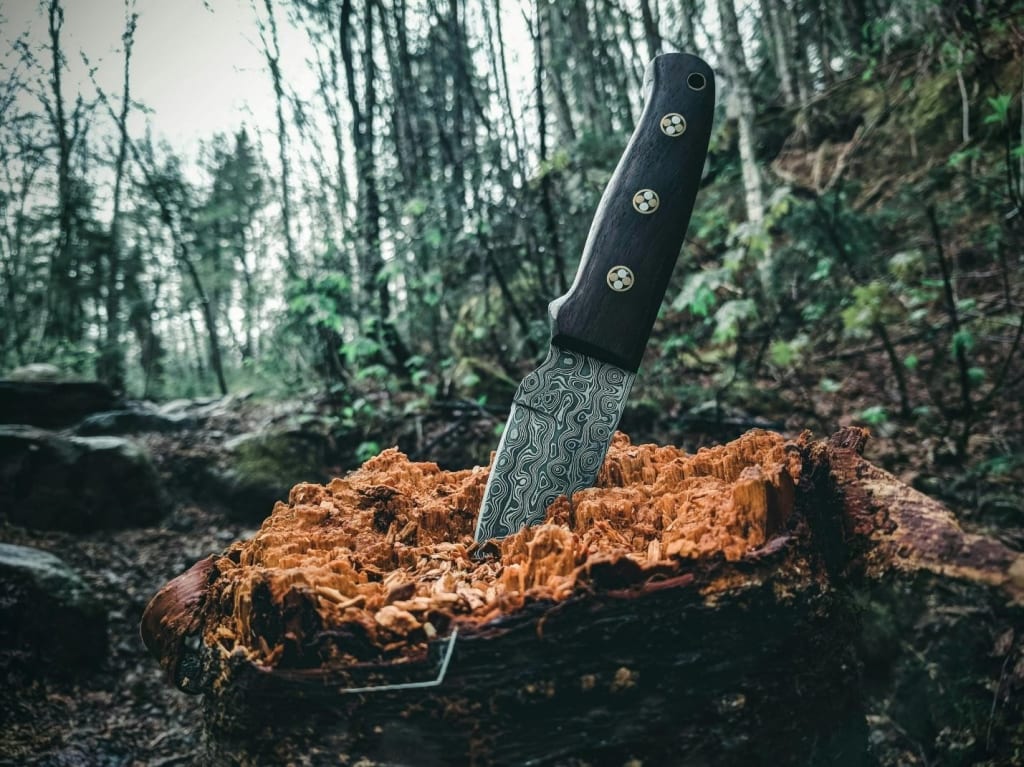
black handled knife on brown log
Image source
2. Blade Length
A longer blade allows for increased chopping power but presents a greater risk of snagging underbrush and weighs more to pack. Yet a knife too short struggles with preparing kindling, slicing food, or carving wood. Most experts recommend a blade between 3 and 4 inches for optimum versatility in typical situations. For general camp craft tasks, a 3-4 inch blade can handle most jobs without being too long or too short.
Larger survivalists may prefer an overall stouter knife around 5 inches, while lightweight backpackers can make do with a trimmer 3-inch design. It's essential to test different lengths in person to see what feels best for your intended use cases and hand size.
A small dagger-like blade may work better for some, while others need a larger belt knife. Blade length is very personal.
3. Full Tang Construction
When survival hinges on your knife's reliability, a one-piece complete tang design transfers force from handle to tip most efficiently without risk of failure. Bolted or glued handles can detach under demanding tasks like batoning or prying.
Full-tang knives also shed water faster than partial or half-tang designs and avoid decay, which are important bonuses in wet climes. Their solid integration inspires greater confidence in stressful environments away from replacement options. You don't want to be stuck in a survival situation with a knife handle that could break off from the blade.
4. Blade Thickness
A thicker blade is better at splitting wet wood or pounding tent stakes, while too thin risks bending during heavy use. As a general rule, aim between 1/8 and 3/16 inches thick for a balance of strength and lightweight ease.
Lighter backpackers may opt for thinner, while heavier choppers appreciate beefier stock. Consider your build and expected conditions. A thicker blade is more durable and heavier, whereas a thinner blade is lighter but may not stand up to harder tasks. Choosing the right thickness comes down to your needs.
5. Sharpness and Edge Retention
No tool becomes more useless faster than a dull knife. Beyond initial sharpness, specific steel compositions maintain an edge exponentially longer in the field. Higher hardness resists rolling that plagues softer stainless.
Blade grinds also impact life, with straight spines proving more straightforward for touch-ups. A sharp companion knife boosts morale as much as functionality in trying scenarios away from honing systems. Nothing is more frustrating than a dull knife when needed most, so edge retention is critical.
6. Handle Material
Your grip handling treacherous tasks demands a non-slip, weatherproof surface. Micarta, G-10, and aluminum scales shed water, collect less debris, and avoid cracking in damp or salty conditions, far surpassing wood at maintaining traction.
Textured grooves enhance control, while larger butt swells fit all hand sizes. Full tang integration affords additional durability reassurance. Hydrophobic materials like G10 are best for wet conditions as they shed water quickly and don't absorb moisture like wood handles.
Image source
8. Versatility
Beyond emergencies, a true outdoorsman’s blade handles dual roles, from food prep to kindling to simple toolmaking. Look for a drop, clip, or bushcraft point that can slash and pierce and safely do tasks like gutting small game.
Carving notches or a gut hook assist field dressing without undue bulk. A flat grind further simplifies feather sticking, and one packable tool exceeds that of any specialty knife. Versatility is critical to saving space in any survival kit or bag.
Final Thoughts
Carefully considering factors like these will guide you toward a survival knife that can perform any task necessary to prevail until rescue arrives.
Beware of gimmicky specialty knives - a simple, robust, full-tang design focused on a balance of strength, sharpness, and lightweight functionality presents the best chance of returning home safely.
When properly maintained, the right bushcraft or camp knife will serve faithfully for decades, providing peace of mind on even the most remote adventures.
Choose your knife wisely - it could end up saving your life.
About the Creator
Keep reading
More stories from Rebecca Siggers and writers in FYI and other communities.
7 Most Ideal Ways to Plan Your Honeymoon
There is no better way to spend quality time with your spouse than going on your honeymoon. It is also the only place where you get to reboot and refresh yourself after the stress you have had the past couple of days. You should, however, keep in mind that the only way you will have a great time on your honeymoon is if you plan it well. Here are the seven most ideal approaches to prepare for your honeymoon.
By Rebecca Siggers6 years ago in Wander




Comments
There are no comments for this story
Be the first to respond and start the conversation.