
Top 5 Tools Compared for Mobile App Test Automation
Compared for Mobile App Test Automation


Developing a flawless mobile application is only half the battle. Ensuring that it runs smoothly across devices, operating systems, and networks is equally critical. That’s where mobile app test automation steps in. As mobile environments grow increasingly complex, relying solely on manual testing just doesn’t cut it anymore.
The good news? There are several powerful automation tools designed specifically to streamline mobile testing. But with so many options out there, how do you decide which one fits your needs? To simplify your decision-making process, here’s a deep dive into five of the most reliable and efficient tools for mobile app test automation. Each one has its strengths, limitations, and ideal use cases-and one of them might just be your team’s next favorite testing companion.
Appium: The Veteran of Cross-Platform Automation
When it comes to open-source mobile test automation, Appium often tops the list-and for good reason. Appium allows testers to automate native, hybrid, and mobile web applications on both Android and iOS using the WebDriver protocol.
Why Appium Stands Out:
- Cross-platform support: Write once, run anywhere.
- Works with multiple languages: Java, Python, JavaScript, Ruby, etc.
- Integrates with CI/CD pipelines and popular frameworks like TestNG and JUnit.
- No need to recompile or modify the app code.
Appium's architecture is built on simplicity and flexibility, making it a go-to choice for QA engineers who value language freedom and cross-platform compatibility. However, it does come with a learning curve and can sometimes lag behind native testing solutions in speed.
Testevolve: The Unified Platform for Modern QA Teams
Testevolve offers a modern approach to automated mobile testing by combining test creation, execution, and reporting into a single cohesive platform. Unlike traditional tools that require heavy scripting or fragmented toolchains, Testevolve’s focus is on streamlining the entire QA workflow.
Highlights of Testevolve:
- Intuitive visual test creation for both technical and non-technical users.
- Supports real device and cloud-based mobile testing.
- Seamless CI/CD integration and native support for parallel testing.
- Built-in analytics dashboards for clear test result visualization.
What makes Testevolve unique is its adaptability. Whether you’re a startup seeking speed or an enterprise dealing with scale, its codeless test creation and hybrid execution environment can significantly cut testing cycles without compromising accuracy.
Testevolve Is Ideal For:
- Teams aiming for low-code or no-code automation.
- Organizations that prioritize scalability and easy onboarding.
- QA workflows requiring unified test management and reporting.
Espresso: Google's Native Testing Framework for Android
Espresso, developed by Google, is a purpose-built automation framework for Android UI testing. It’s deeply integrated with the Android development ecosystem and is often favored by Android developers who want tight control over their tests.
Espresso Key Strengths:
- Fast execution speeds due to in-app test execution.
- Syncs with UI threads to avoid flaky tests.
- Direct access to the Android SDK and robust tooling in Android Studio.
- Excellent documentation and community support.
Espresso works best for Android teams who want precise, native-level testing. However, it doesn’t support iOS or cross-platform testing, which makes it less versatile in mixed-device environments.
XCUITest: Apple’s Official UI Testing Framework
When testing iOS applications, XCUITest stands as the gold standard. Provided by Apple, this tool is built directly into Xcode and integrates naturally with Swift and Objective-C projects. It allows developers and testers to write UI tests that can be run as part of a continuous integration setup.
Benefits of XCUITest:
- Native performance with minimal external dependencies.
- Seamless integration with Xcode and Apple’s testing suite.
- High reliability for complex gesture-based or animation-heavy tests.
- Rich debugging tools for iOS-specific issues.
While XCUITest is extremely reliable for iOS testing, it is inherently limited to Apple’s ecosystem. For teams working on both Android and iOS platforms, maintaining separate test frameworks can increase effort and complexity.
Detox: Best for React Native and End-to-End Testing
What Makes Detox Effective:
- Tailored for React Native applications.
- Automated waiting mechanism reduces test failures.
- Simulates user behavior in real devices or emulators.
- Supports integration with CI tools like Jenkins and CircleCI.
Detox Is Best For:
- React Native development teams wanting tight integration.
- Apps requiring deterministic UI testing at scale.
- Developers who prefer writing tests in JavaScript.
While Detox is fantastic for end-to-end testing in React Native, it’s not the best choice for native Android or iOS apps built with other technologies.
Comparison Snapshot: Key Features at a Glance
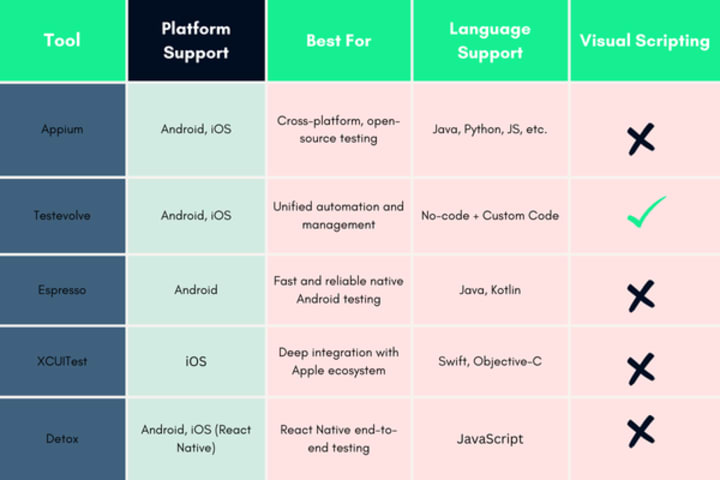
How to Choose the Right Tool for Your Team
Selecting the right mobile app test automation tool depends on several factors. Consider these guiding principles:
- Project Type: Native vs hybrid vs cross-platform.
- Team Skills: Coding vs low-code/no-code preferences.
- Maintenance Needs: Long-term test script upkeep and scalability.
- Device Coverage: Emulators vs real devices vs cloud-based labs.
- Integration Needs: CI/CD pipeline compatibility and reporting.
Ultimately, no tool is universally best. Instead, weigh your specific needs against each tool’s strengths to find the right fit.
In Nutshell
Mobile app test automation is no longer optional-it’s the backbone of delivering stable, responsive applications. Tools like Appium, Espresso, XCUITest, Detox, and Testevolve each bring something distinct to the table. Whether you’re optimizing for speed, cross-platform support, simplicity, or collaboration, there's a tool perfectly aligned with your goals.
Testevolve, in particular, deserves attention for teams seeking a seamless testing lifecycle-from creation to execution to insights-all under one roof. As mobile apps continue to evolve, your testing tools should evolve too.
About the Creator
Leeanna marshall
Hello, I'm Leeanna Marshall, an ardent enthusiast of all things automation and a passionate blogger. visit my blog
Keep reading
More stories from Leeanna marshall and writers in FYI and other communities.
Why Your Website Looks Fine Locally But Breaks Live – Visual Regression Testing Can Help
There’s nothing more frustrating than crafting a pixel-perfect website that behaves beautifully on your local development machine-only for it to fall apart when viewed live. You double-checked the code, validated your CSS, and tested responsiveness. Everything looked great. But once the site was pushed to production, elements shifted, fonts broke, layouts glitched, and now your users are sending screenshots of UI disasters you can’t even replicate locally.
By Leeanna marshall10 months ago in FYI
A Planetary Alignment will coincide with Mercury Retrograde
Double phenomena in the heavens Some people say in jest that the planets have aligned in their favor when life works the way they desire. Were you aware that there are seasons when things do line up in the heavens? There will be a planetary alignment AKA a planet parade, on February 28, 2026.
By Cheryl E Preston19 days ago in FYI
How NSN Systems Improve Interoperability Among Allied Forces
Modern military operations increasingly rely on cooperation between allied nations. Joint missions, multinational exercises, and coalition defense operations require seamless coordination not only at the strategic level but also within logistics and supply chain systems. One of the most important tools that supports this cooperation is the National Stock Number (NSN) system. Developed to standardize the identification and classification of military components, the NSN system enables allied forces to share equipment resources, maintain operational readiness, and streamline procurement processes.
By Beckett Dowhan3 days ago in FYI




Comments
There are no comments for this story
Be the first to respond and start the conversation.