
"They Took One for the Team": Why Loving the Attack on Bonnie Blue Says More about Us Than Her
The ugly applause, the double standards, and why women joining in on violence against a woman should horrify us


On the night of 19 September 2025, South Yorkshire Police were called to Onyx Nightclub in Sheffield after reports of a disturbance. Adult content creator Bonnie Blue, who was appearing there as part of her “Bang Bus Freshers Tour,” was punched in the face by a woman in the crowd. Witnesses say the blow landed squarely on her jaw after she had been inside the club for about forty minutes. Although Bonnie reportedly did not suffer lasting injuries, the incident was serious enough that police detained a woman before releasing her. The nightclub had marketed the event as a safe space where no sexual behaviour would take place, and yet Bonnie left with a violent reminder of how fragile women’s safety really is.
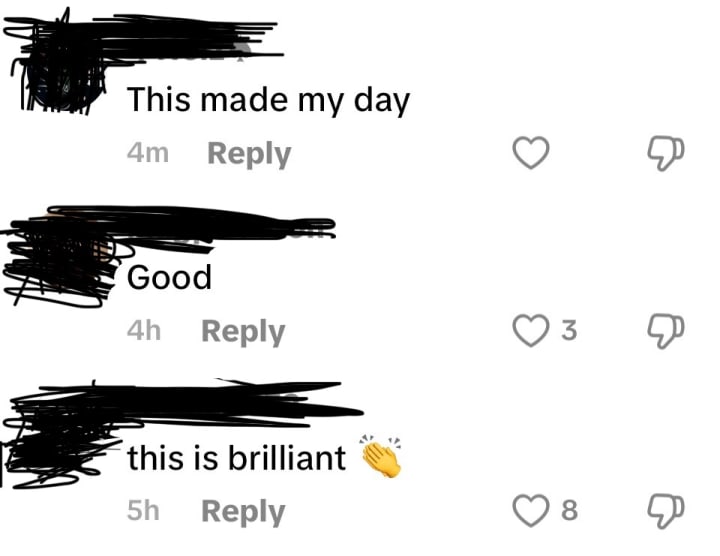
This should have been a simple story: a woman was physically assaulted in public, and that act was condemned. But what followed online made it much more complicated. On TikTok, Instagram, and X, comment sections filled with messages applauding the attack. Some even claimed the attacker had “taken one for the team” by hurting her. What disturbed me most was not just the applause itself, but who it came from. So many of the comments were written by women.
That detail matters. When women themselves applaud violence against another woman, it says something about the culture we live in and the misogyny we’ve internalised. The attack on Bonnie Blue was one punch, but the cheering that followed was a collective act of harm that echoes far beyond Sheffield.
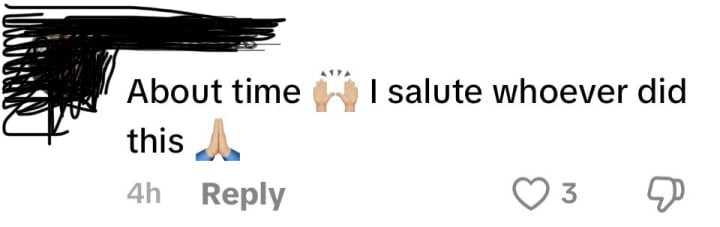
It’s tempting for some people to justify their reactions by arguing that Bonnie isn’t a “good victim.” She built her persona on provocation. She profits from controversy. She embodies sexuality in a way many find uncomfortable. But here’s the uncomfortable truth: none of that matters. Violence is violence. The moment we decide someone deserves to be attacked because we dislike her choices, we step onto a dangerous slope that has claimed the lives of countless women around the world.
That slope begins with moral judgment. Many of the comments I saw used language like “she’s set feminism back” or “she’s degrading women.” That is the same logic that underpins so-called honour killings: when a woman’s choices are branded immoral, someone believes they are justified in punishing her. Around the world, women are beaten, attacked, and murdered for being seen as dishonourable. Sometimes that dishonour is as small as speaking to a man, refusing an arranged marriage, or dressing differently. The Bonnie Blue comments may look harmless compared to murder, but they share the same foundation: the belief that violence is acceptable when a woman fails to conform.
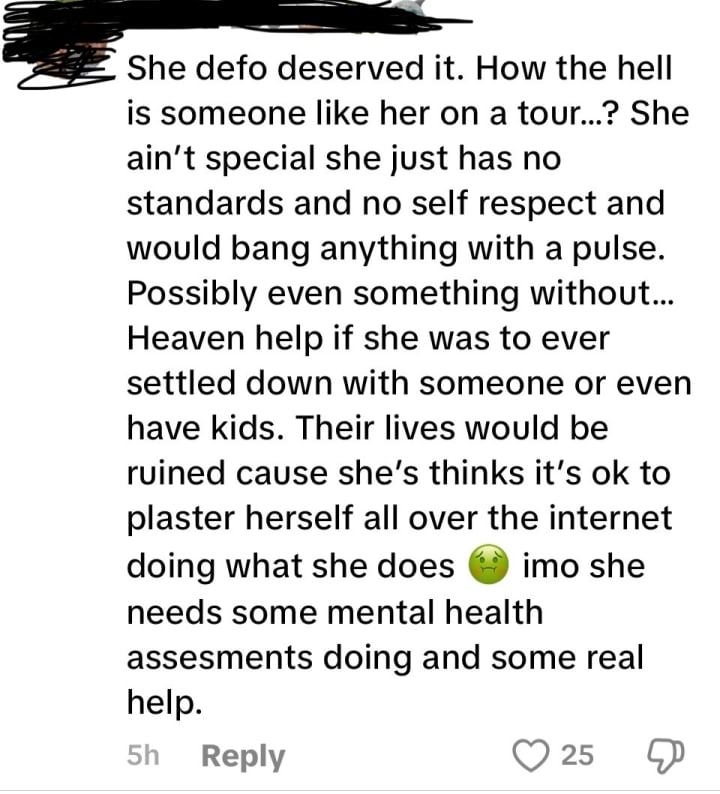
This links directly to victim blaming. In rape trials, women are asked what they were wearing, whether they had been drinking, or how many people they’d slept with. The implication is always that if she stepped outside the bounds of respectability, she was responsible for what happened to her. Seeing women make the same arguments about Bonnie was gutting. They may think they’re just criticising someone they dislike, but what they’re really doing is repeating the logic that silences victims everywhere.
Consider Rebecca Goodwin, an OnlyFans creator from Derby. Earlier this year, she was raped. She even had seven minutes of video evidence of her attack. She went public about it, bravely speaking out about how the justice system had failed her, how her attacker was still walking free, and how she had to carry the weight of both her trauma and the state’s indifference. Public reaction to Rebecca was largely sympathetic. People were outraged at the police and at the courts. They demanded justice. That is the reaction any survivor deserves.
Now compare it with Bonnie Blue. She was assaulted in public. Yet instead of outrage, she got mockery. Instead of sympathy, she got told she deserved it. The difference? Respectability. Rebecca Goodwin fit society’s idea of a victim we can sympathise with. Bonnie Blue does not. That hypocrisy should shame us all.
And I cannot talk about this without linking it to my own life. In August, I was sexually assaulted by a man I had previously consented to. I said no at the time. I made it clear I did not want what happened. But afterwards, all I could think about was how people might blame me. That fear silenced me. I felt as though if I spoke up, someone would say, “Well, you’d already been with him before, so what did you expect?” That thought filled me with shame and made me hesitate to take action.
This is what victim blaming does. It plants doubt in survivors’ minds. It tells us that our “no” doesn’t matter if we once said “yes.” It tells us that our pain is invalid if we are not perfect victims. Watching people celebrate Bonnie’s assault reminded me of those fears. If they can cheer for a punch, how easily would they say that what happened to me was my fault?
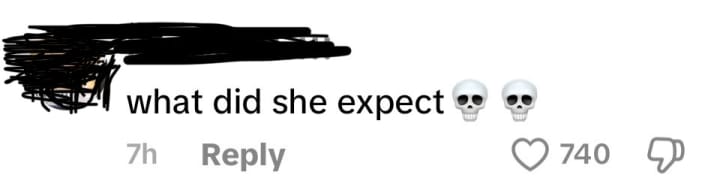
When women join in on this, it cuts even deeper. We should be the ones standing together, rejecting violence, and insisting that every “no” matters. Instead, too often, we become the enforcers of the very system that oppresses us. Some women seem to believe that by condemning others—by saying, “she deserves it”—they protect themselves. But they don’t. Because once violence is justified against one woman, it can be justified against any of us.
This is why I am calling on people to feel uncomfortable. If you typed “took one for the team,” you should be embarrassed. If you laughed at Bonnie being punched, you should cringe at your own cruelty. Because what you applauded wasn’t justice, and it wasn’t bravery. It was misogyny dressed up as moral superiority.
And here is the truth that connects Bonnie Blue, Rebecca Goodwin, and me: none of us deserved what happened to us. Bonnie did not deserve to be punched because people dislike her work. Rebecca did not deserve to be raped because of who she is or what she does. I did not deserve to be assaulted because I had once said yes before. Violence is never justified by morality, and consent cannot be undone by the past.
The reactions to these cases should force us to ask hard questions. Why do we still divide women into “good” victims and “bad” ones? Why do we still think violence can ever be deserved? Why do some women believe tearing others down makes them safer? If we are serious about ending violence against women, we have to challenge these instincts in ourselves and in each other.
Because if we don’t, the next victim will face the same silence, the same shame, the same mockery. And maybe next time it won’t just be a punch. Maybe it won’t even stop at rape. That is the slope we are on when we normalise violence against women, and it should terrify us.
Bonnie Blue’s assault in Sheffield may have lasted only seconds, but the echoes of it—amplified by every comment that applauded the punch—will last far longer. It is on us to drown out those echoes, to say clearly and without hesitation: violence against women is never acceptable. Not when we dislike her. Not when she is controversial. Not when she has said yes before. Not ever.
About the Creator
No One’s Daughter
Writer. Survivor. Chronic illness overachiever. I write soft things with sharp edges—trauma, tech, recovery, and resilience with a side of dark humour.
Keep reading
More stories from No One’s Daughter and writers in FYI and other communities.
Trump & Epstein: How Close Were They Really? A Verified Timeline of Their Relationship
Introduction Donald Trump has long downplayed his ties to Jeffrey Epstein. Yet the public record — magazine profiles, photographs, court filings, and even congressional disclosures — tells a more complicated story. Trump and Epstein moved in the same elite circles for years, appearing together at parties, sharing social networks, and even praising one another publicly.
By No One’s Daughter4 months ago in FYI


Comments
There are no comments for this story
Be the first to respond and start the conversation.