
These Landmarks Hide Secrets Guides Won’t Tell You About
Hidden Secrets

If the original plan had been followed, the Washington Monument would look quite different today. The designer, Robert Mills, envisioned a temple-like structure featuring 30 tall stone columns and statues of significant American historical figures, including a statue of George Washington on horseback, with a 600-foot tall Egyptian-style obelisk at its center.
The monument's first stone was laid in a grand ceremony attended by thousands, including a young, uncelebrated Abraham Lincoln, in 1848. Although construction began, it halted in 1854 due to a lack of funds when the monument had only reached 150 feet. It wasn’t until 22 years later, when President Ulysses Grant allocated federal money, that the project resumed. By then, design preferences had shifted, so they opted not to construct the temple portion.
The stone colors also differed due to the lengthy pause, resulting in a lighter lower section. Upon completion, the Washington Monument became the tallest structure globally, but soon lost that title to the Eiffel Tower just five years later. Before JFK Airport was established, the Empire State Building was meant to function as an airport. Interestingly, the building’s iconic antenna was intended not for King Kong to scale but as a mooring mast for large airships. Alfred E. Smith, leading the investment group behind the construction, imagined that passengers could disembark onto New York streets within just seven minutes.
However, the captain of the famous airship Graf Zeppelin doubted this would be feasible, noting the complexities of landing a dirigible, which required many ground workers and long ropes for securement. In September 1931, a dirigible attempted to dock at the Empire State Building, circling the top for three minutes amid strong winds of 40 mph, causing street traffic to halt as spectators watched. Mount Fuji has come to represent Japan, but it is actually made up of three peaks.
According to legend, it was formed overnight by an earthquake in 286 BCE, although geologists believe it is much older. The first peak started forming around 700,000 years ago, successfully integrating two ancient mountains, while the volcano recognizable today emerged between 11,000 and 8,000 years ago. Compared to other volcanoes, Fuji is still considered relatively young and active, despite its last eruption occurring over 300 years ago. Each time a significant earthquake strikes the area, there is a possibility of another eruption, yet thousands climb it every year.
Gustav Eiffel designed the Eiffel Tower to include a private apartment at the top for himself, decorated with warm wallpaper, fine wooden furniture, and even a grand piano. Nowadays, only two mannequins—one of Eiffel and another of the renowned inventor Thomas Edison, who visited frequently—occupy the apartment. Visitors can catch a glimpse of this unique space through a window if they go to the top of the tower. Similarly, the Statue of Liberty conceals a hidden room within its torch, which is 29 feet long and built of copper supported by a steel framework also designed by Eiffel.
However, access to the torch has been forbidden since 1916, though a camera was installed there in 2011 to provide live panoramic views. In Trafalgar Square, London, the city’s smallest police station is somewhat inconspicuous, tucked away beneath a lamp post inside an ornamental light fitting. This placement in the 1920s allowed police officers to stay close to the public rallies that frequently occurred in the area. Rumor has it that it once had a direct line to Scotland Yard, but today it serves as a cleaning station, offering little to see beyond some mops.
Mount Rushmore took 14 years to complete, featuring the carved faces of four American Presidents: George Washington, Thomas Jefferson, Abraham Lincoln, and Theodore Roosevelt. Records suggest an unfinished secret room lies behind Lincoln's face, intended to be the Hall of Records to house significant historical artifacts, including the Declaration of Independence and the Constitution. However, funding was redirected to prioritize completing the presidential carvings, leaving this secret room incomplete and inaccessible to visitors.
About the Creator
Keep reading
More stories from Tom Omondi and writers in FYI and other communities.
Using Food As Medicine
At a global level, we are currently facing a pressing issue that demands our attention: the impact of dietary risks on public health. This concern was underscored in a significant publication from last year, supported by The Gates Foundation and published in the prestigious journal, Lancet. According to a study on the global burden of disease, it was revealed that a staggering 11 million deaths are linked to dietary risk factors, particularly stemming from the insufficient intake of essential food groups such as fruits, vegetables, nuts, legumes, and whole grains.
By Tom Omondiabout a year ago in Humans
A Failed Artist, A Disillusioned Poet, An Underpaid Game Show Host
I took my son and niece to Gori, a small town in Georgia where Joseph Stalin was born. They talked me into visiting the Stalin's Museum, the largest in the post-Soviet space. I had resisted going there because I just can't stand the monster and know enough about him, or so I thought.
By Lana V Lynxabout a month ago in FYI
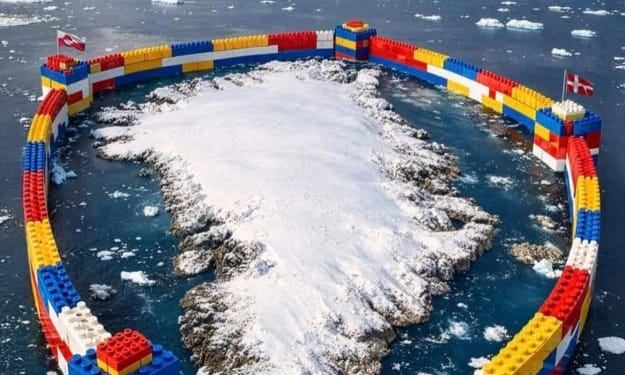
How much would it cost to buy Greenland? Trump's dream of "the biggest real estate deal in history"
For more than a hundred years, American politicians have occasionally cast covetous glances toward Greenland, the world's largest island, which occupies a strategically important position between North America and Europe due to its location. But it was only U.S. President Donald Trump who revived this idea with unprecedented vigor. He first mentioned it in 2019 during his initial term, but after his re-election in 2024, he elevated it to the level of a national security priority. The Trump administration presents it as a necessary step against Russian and Chinese influence in the Arctic, access to critical minerals, and defense of the northern border.
By Elvira Diggory6 days ago in FYI



Comments
There are no comments for this story
Be the first to respond and start the conversation.