
The West Philippines Sea
A David versus Goliath story

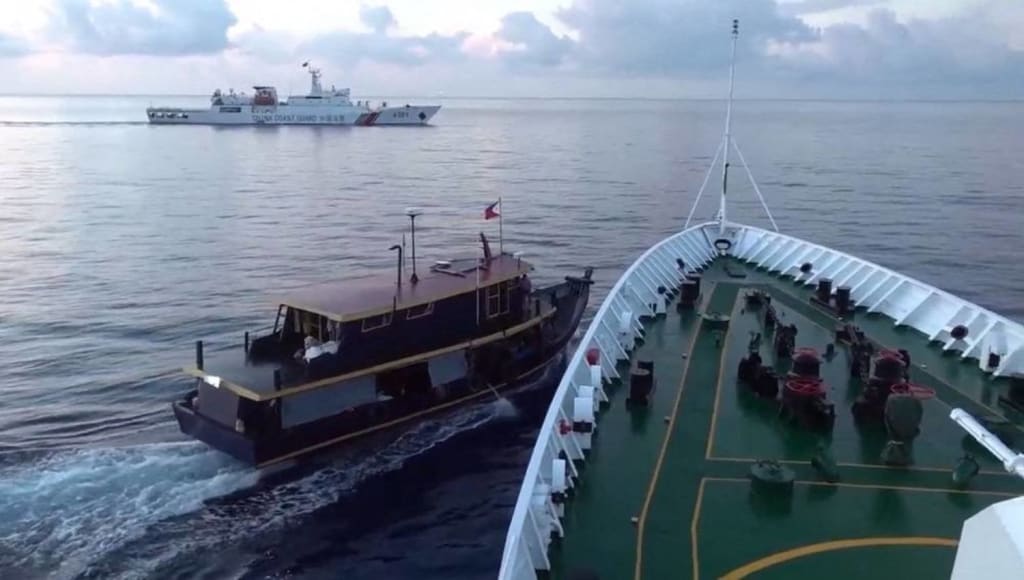
Off the coast of the Philippines, there have been frequent clashes with China, which Philippine officials describe as a situation akin to David versus Goliath.
The external security environment is growing increasingly complex and unpredictable.
The escalating tensions between the two countries have significant implications for the United States and have created an opportunity for a greater U.S. military presence in the Philippines. As a mutual defense treaty partner, the United States is committed to coming to the aid of the Philippines in the event of an attack. This commitment is straightforward and unwavering. Now, let's delve into the reasons why the Philippines is gaining importance for global superpowers, major players in the Pacific, and neighboring countries in the South China Sea. Firstly, the Philippines is situated within a network of U.S. allies and partners that Washington is relying on to counter China's influence. To the west lies the South China Sea, a crucial international shipping route that Beijing claims almost entirely.
To the north lies Taiwan, a democratic island, and a significant trading partner of the West. China has expressed its intention to forcefully acquire Taiwan. To gain a deeper understanding of the increasing strategic significance of the Philippines, we must go back in April 2023. During this time, there was a largest-ever joint military exercises between the United States and the Philippines. During these exercises, various formidable weapons such as Stingers, Patriots, and HIMARS were utilized for target practice over the South China Sea. This body of water has been a focal point for China's efforts to establish control. Additionally, troops stationed in the northern region conducted air assaults from a Navy ship, targeting islands located merely 100 miles away from Taiwan. It is worth noting that Taiwan is renowned as the world's leading producer of advanced semiconductors, and China has made explicit threats to forcefully seize it.
The Philippines has recently strengthened its ties with the United States under the leadership of President Ferdinand Marcos Jr. This was evident during a major live fire event, which was attended by a president for the first time. The event was significantly different from previous years. This shift in alliance comes after the previous president, Rodrigo Duterte, attempted to improve relations with Beijing. However, China has continued to assert its claims near the Philippine coast, causing concern about its continued provocation.
For assistance in safeguarding its sovereignty, Manila has entered into a significant base agreement with Washington this year, resulting in an increase in U.S. access to Philippine military bases across the nation from five to nine. Furthermore, discussions are underway to potentially expand this access even further. These developments have provoked discontent among Beijing officials, who have expressed opposition to the unchecked expansion of military alliances and have accused the U.S. of attempting to restrain China. The Chinese embassy in Manila did not provide any comments in response to requests for this story. Both China and the U.S. hold significant trading partnerships with the Philippines. However, this year, Manila and Washington have taken measures to enhance economic cooperation, with the U.S. committing to invest in various sectors, including 5G networks and critical mineral production throughout the country.
It is crucial for certain nations to maintain their sovereignty, which is of mutual importance to both them and us. Our aim is to assist them in achieving this goal. The Philippines has been forging closer ties with U.S. allies in the Pacific, such as Australia, Japan, and South Korea, with some of these countries even training alongside Filipino troops. Under Marcos' leadership, these nations have taken steps to improve their relations with Manila, and this elevation is a significant symbol of our strong partnership and shared commitment to collaborate further. These Pacific powers, concerned about China's increasing militarization of the region, acknowledge that the Philippines is at the forefront of the fight against Beijing. China's narrative is distorted to suit its own agenda.
China's maritime claims have been widely expanded using the nine-dash line, which is thought to have originated from maps utilized by the Republic of China in 1947. The areas within these lines have been taken over by Beijing, who have transformed reefs and islands into military outposts. To maintain their control, Chinese ships frequently engage in the harassment of Philippine vessels using water cannons, signs, and military-grade lasers.
China's actions have incited considerable discontent among a significant portion of the populace, while the Philippines, under Marcos' leadership, has been actively resisting. To counteract China's behavior, the Coast Guard has implemented a fresh approach of publicizing confrontations with Chinese vessels and openly criticizing Beijing for disregarding an international ruling that nullified China's claims regarding the nine-dash line. This serves as a clear demonstration of China's longstanding disregard for international law.
Beijing's disregard for the international ruling and its assertion of the legality and justification of its actions have prompted Pacific powers such as Australia and Japan to collaborate with the Philippines in conducting joint patrols. This collaborative effort aims to exert pressure on Beijing and ensure the continued accessibility and freedom of the waters that hold significant importance to their respective economies and national security. The presence of supportive allies and partners like you is deeply appreciated, as it serves as a source of encouragement to persist on this path. However, it is important to acknowledge that the Philippines still faces significant challenges in safeguarding its borders and aiding its people.
The country's economy is projected to grow by 6% in 2023, according to the World Bank. Despite having abundant natural resources and a young, expanding population, a significant number of citizens migrate for work. Over 15% of the population lives in poverty, and the rising cost of living has had a severe impact. Inflation for rice, the country's primary food staple, rose to 8.7% this summer, leading the government to impose price controls. Additionally, fish stocks, another essential food source, have been dwindling. The country faces challenges such as a limited number of military assets, weak power grids, and congested roads. The government is also striving to explore alternative energy sources as its primary gas field, Malampaya, is expected to deplete within ten years. However, Reed Bank, a crucial energy source, is at the center of a dispute with China.
Victor Dindo Manhit, a pollster who conducts surveys on topics such as China's activities in the South China Sea, explains that the Filipino people's support for aligning with the United States and its allies is rooted in their desire to address the challenges they face. While some may argue that time has been lost, Manhit believes it is not too late to forge partnerships with other nations. The Philippines is now moving towards collaboration with other countries, and there is a willingness among these nations to work with them. For the Filipino people, the solution is simple: this is our path forward.
About the Creator
Rajiv Mabasa Singh
I navigate the endless landscapes of imagination. My stories are like keys that unlock doors to worlds both known and unknown. Join me on an odyssey of dreams and realities, where every tale is a new adventure waiting to be discovered. 🚀✨
Keep reading
More stories from Rajiv Mabasa Singh and writers in FYI and other communities.
Signs You are Suffering The Cinderella Syndrome!
Let's talk about the Cinderella complex today. Have you ever heard of it? It's a term that's been around since the 50s, and it refers to women who may have powerful jobs but still want to be rescued in their personal relationships. They don't necessarily want to be weak, but they want to be taken care of sometimes. If this sounds interesting to you, let's explore it together. Do you ever feel like you want to be rescued in your relationship? Maybe you're a big wig at work and don't want to make all the decisions at home. That's understandable. Let's go through some things that might indicate a Cinderella complex and see if it resonates with you. Remember, not everyone feels this way, but it's worth exploring if you do.
By Rajiv Mabasa Singh2 years ago in Confessions
The algorithm behind Instagram reels is explained in detail, along with how to make it work for you.
The algorithm behind Instagram reels is explained in detail, along with how to make it work for you. Instagram Reels did not suddenly become popular. The Instagram Reels algorithm is the driving force behind every viral Reel, every sudden increase in views, and every creator who blew up overnight.
By Farida Kabir4 days ago in FYI



Comments
There are no comments for this story
Be the first to respond and start the conversation.