
The Vale of Shadows
Let's turn the world Upside Down

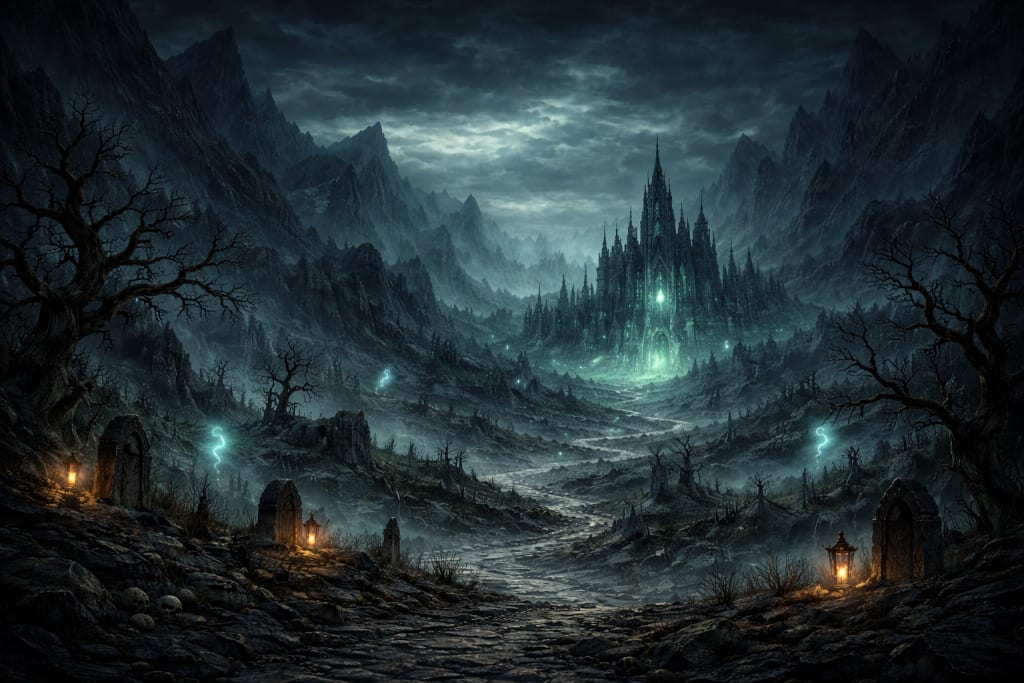
From Niflheim to the Upside Down, humans have been screaming into the void for thousands of years. Re-telling and repackaging the same stories of a shadowed realm throughout the ages.
Why? Why do we keep telling the same story, adapting it through the generations? Could the Vale of Shadows, the void, the Upside Down be real? A world just like ours, but much darker and colder?
1. Myths and Sagas
No matter what myth you may dive into, you'll always find one that covers the realm of the dead. Whether that's the Nordic realm of Niflheim or the Underworld of Hades, to the sandy planes of the Egyptian Duat.
To our ancestors, the void meant to pass from one space to another; the very act of dying is transitional. Liminiality as a concept has kept society in an uncanny chokehold since the belief in the veil.
Although we may compare Niflheim as the Christian alternative to Hell, Niflheim or Hel is more of a void, a temporal space that is dim, misty and vastly cold. The very deepest layer. It is not a place of divine judgement like Hell, but a balancing of the scales the universe requires.
There is no torture nor torment, no redemption narrative, no reunion. People feared Nilifhelm not because it was shameful, but because it was thought that to be forgotten (fade into the cold) was a second death.
Even Hel (the daughter of Loki and a giantess) stands with one foot in life, the other in death, belonging to neither. She represents the visceral truth of the temporary, the liminal, the void.

According to Nordic lore, if the dead left unfinished business, or they died suddenly, or even brutally, they may become dragur.
In the Grettis Saga, the Icelandic tale of a shepherd named Glàmr died violently while tending the sheep in a remote valley. His death was sudden and unresolved.
Glàmr returns to the valley as a dragur. After which, the valley was said to have grown darker even in the daylight. Visitors claimed to feel exhaustion and dread.
The saga treats Glàmrs death as a contamination on the land. This implies the idea that a violent and sudden death can leave a scar, or in this case, cast a shadow on the land.
2. The Natural Landscape
Across cultures, valleys and other natural spaces are considered liminal. The medieval mind saw valleys as a passage carrying you through from one space to another. A space where the lands are naturally lower and slightly dimmer.
They were often sites for battles, ambushes, and executions. Travellers would avoid the routes at night, as the valley is difficult to navigate and escape once it fills with mist and fog.
"Even though I walk through the valley of the shadow of death, I will fear no evil."
-Psalm 23:4
In this instance, the shadow represents the presence that stands between you and the life force (God). The valley represents the transitional, "I walk through", clarifying the concept of the liminal.
Glen Coe in Scotland is believed to be cursed after the Glen Coe Massacre. The violation of hospitality, betrayal and blood tainted the land. Animals tend to avoid gazing in particular areas, and the weather is known to shift suddenly.
In Welsh legends, the real-life figure Owain Glyndŵr, who openly rebelled against English rule, disappeared without a trace. His 'death' is shrouded in mystery and legend; the immortal rebel is said to sleep in the valleys, caves, and mountains of Wales. Believing he will return when his country needs him most.
Owain's story implies that the state between living and death is sleep. His choice of environment highlights how liminality meets the temporal. He, like Hel, stands on the veil, belonging to neither the land of the living nor the realm of the dead. His story reflects the balance of both.
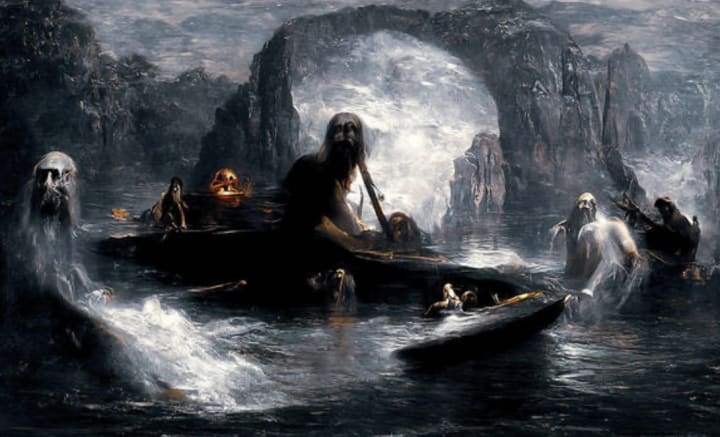
Similar to valleys, water, like oceans and rivers and deserts, is also considered a transitional or liminal zone. Moving you from one place to another.
The Duat is a dangerous and temporary terrain. Failure of the crossing will result in dissolution, not torment. Success would lead you to the Field of Reeds. The River Styx is another crossing from the world above (the living) to the world below (the dead), and once crossed, you can never return.
3. Liminality and Back Room Culture
In the modern sense, the shadow realm is a strange liminal rabbit hole we accidentally find ourselves in. Whether it's the backrooms or the mall world, the liminal space transitions with us. The storytellers.
Corridors, stairwells, hospitals, alleyways, hotels, restaurants, and pubs are also considered liminal spaces, taking you from one place to another. Even your own hallway that is always way creepier at night for no reason whatsoever, right?
The liminal zone reflects the balance. It is not a place you dwell in. That's why the backrooms and mallword fit into this; it is a modern interpretation of what our ancestors believed. Only now it has been stripped of myths of the underworld and instead dressed in architecture, physics and psychology.

4. The Shadowed Self
The Jungian school of thought believed that every psyche contains a shadowed self. Think Peter Pan and his shadow; they are presented as separate, and Peter has to sew his shadow back on. This is the internal balance that many philosophers and psychologists alike talk about.
For Jung, rather than a presence, our shadow is our flaws, our inner toxicity, the things we hate about ourselves and then project onto others. The old skeletons piling up in the dirty closet, the inner demons we refuse to tame.
The shadowed self is not evil but requires internal balance. Acceptance of the shadow is that balance. If it goes unacknowledged or repressed, it will express itself indirectly, perhaps through dreams or even Dinoysian forces. Therefore, the shadow self is inseparable, linked and entangled with who we are.
5. Quantum Entanglement
Modern physics offers a new language for old ideas, which, although it gives us a concrete theory and conceptual understanding, cannot be classified as fact, as it can not provide solid answers. Hence why it sits in the realm of sci-fi.
The concept of parallel worlds, wormholes, alternative dimensions and different universes is nothing new to us. Most of us can comprehend the idea of a multiverse, going so far as to label the multiverse narrative as lazy writing. It's the 21st-century version of "it was all a dream."
What Carl Jung labels as sychronities (although that concept sits more in mysticism rather than psychology or science), physics calls quantum entanglement. This is where two or more particles are created or interact in states that become linked, making them inseparable.

Think of how pixels, although individuals form one whole image that are linked. Or an analogue TV in between the channels, displaying the white noise with black specs jumping around the screen. At the very deepest level, we know that reality cannot be divided into separate things; it is entangled.
Entanglement shows us reality is not isolated, but inter-connected, linked even when the connection is unobserved. Although the medieval mind did not have a complete understanding of this, they did have comprehension that events are linked to transitional spaces that could linger even as time had passed.
The Upside-down is the latest version of this concept, only this time it's presented as a wormhole, a void parallel to another dimension, not the mythical underworld.
The concept of the liminal, the vale of shadows, shadowed psyche and entanglement, is really the idea of balance and reflection. Both within ourselves and the reality we interact with. The message is to keep moving forward even when the road may grow dark.
"As above, so below; as within, so without; as the universe, so the soul"
- The Emerald Tablet
Strangely, it is the same discomfort that has followed our species through the ages, changing its language and transforming through time.
So I have to wonder, given the powers of technology, our phones that allow windows into other worlds, maybe there is some form of a shadow realm out there.
What do you think?
______________________________________________
Thank you for taking the time out of your day to read my work. If you like what I do, then don't forget to leave a like and subscribe. A tip is always humbly appreciated.
If there is a mystery, myth, urban legend or strange things you want me to take a look at, head over to the story walker community on Skool:
I am also on YouTube for those who can't be bothered to read:
Follow me on Threads:
About the Creator
Reader insights
Nice work
Very well written. Keep up the good work!
Top insights
Compelling and original writing
Creative use of language & vocab
Easy to read and follow
Well-structured & engaging content
Excellent storytelling
Original narrative & well developed characters
Masterful proofreading
Zero grammar & spelling mistakes
Keep reading
More stories from Rosie J. Sargent and writers in FYI and other communities.
A Failed Artist, A Disillusioned Poet, An Underpaid Game Show Host
I took my son and niece to Gori, a small town in Georgia where Joseph Stalin was born. They talked me into visiting the Stalin's Museum, the largest in the post-Soviet space. I had resisted going there because I just can't stand the monster and know enough about him, or so I thought.
By Lana V Lynx5 days ago in FYI
Why Are Gemstones Still Expensive if We Can Grow Them in a Lab?
The world of fine jewelry is currently in the middle of a massive identity crisis. For centuries, the value of a diamond or a ruby was tied directly to its rarity and the immense effort required to pull it from the earth. But today, we live in an era where scientists can grow a perfect, high-quality diamond in a plasma reactor in just a few weeks. These stones are not "fakes." They are chemically, physically, and optically identical to the ones formed under the Earth's crust billions of years ago.
By John Ammerlane6 days ago in FYI


Comments (1)
Some great musings here Rosie. Maybe this is the land of death and reincarnation