
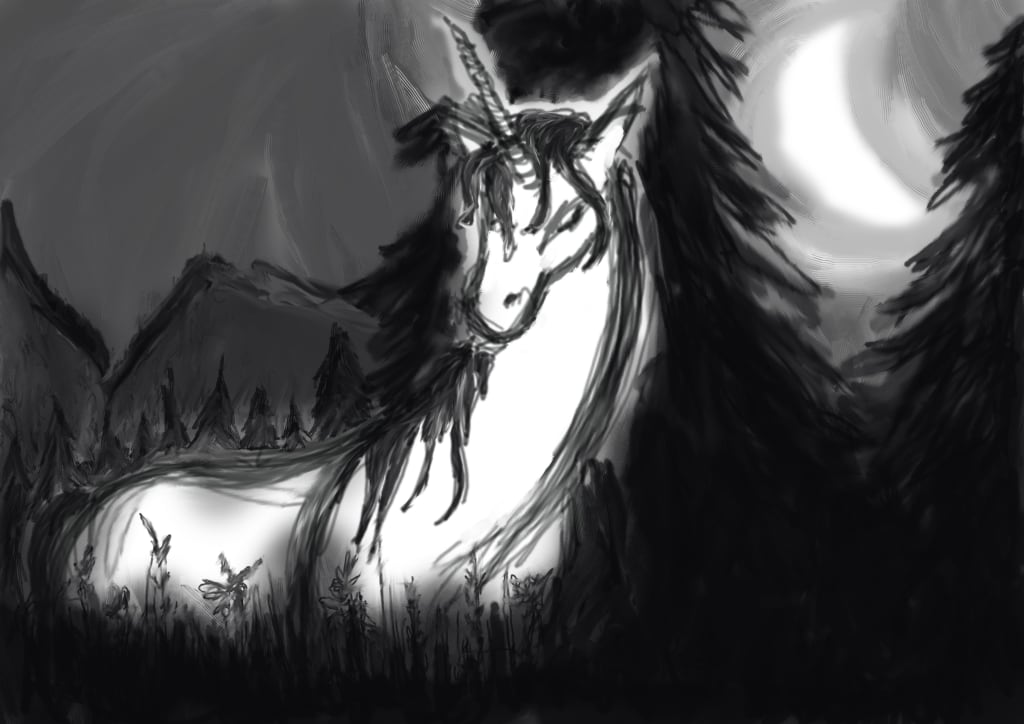
The hills, rivers, and wild forests of Scotland have been filled with mythical lore for centuries. Stories of ghosts and vampires, spirits and sea monsters have remained an intrinsic part of Scottish culture to this day. While the superstitious fascination with witchcraft and the supernatural has largely diminished, one mythical creature remains as more than a story to the nation. The Unicorn has been Scotland's national animal since the 12th century.
The Unicorn is often portrayed as a gentle creature, pure and innocent. In Celtic mythology, it was the most pure of all creatures that walked the earth; so pure that no dirt or blood could taint it's white coat. The single horn on its head was believed to have the most potent healing properties and was often sought after on behalf of the sick or wounded. It is a creature of grace and beauty.
Like many of the mythical creatures of Scotland however, Unicorns had a more fearsome side to them.
While purity is a noble character for the symbol of a nation, Unicorns were notoriously wild, untamable, powerful creatures. Like the hearts of the Scottish people, the Unicorn could not be won over. Independence was as true to its nature as its innocence. The Unicorn was a creature of power that held the balance of ferocity and gentleness, courage and intelligence, beauty and wildness. A creature more graceful than a doe, but more ferocious than a lion. Elegant, regal, and dangerous, the Unicorn was the kind of creature that demanded fear and awe. It was William I who first aspired to brand Scotland with these attributes by putting the Unicorn on the Scottish royal coat of arms. The king spent his life fighting for the independence of Scotland, both from the English monarchy as well as the English church. The Unicorn became his symbol for that independence, a declaration that the Scots would not be tethered and chained.
This passion and fierce pursuit of freedom was carried through the centuries by Scots such as William Wallace, Robert the Bruce, and David Leslie. Men who embodied the wild heart of Scotland and longed to see it free. The Unicorn, a picture of righteous power, pure in motive, but fierce in nature, became less of a myth and more of a symbol with every revolution.
As hard as William I and the Scots after him fought for their freedom, Scotland was eventually captured and subjugated to England in 1296. However, this did not keep the hearts of the Scots from maintaining their wild and courageous hearts. For centuries, the Scots demonstrated their Unicorn-like spirits, remaining proudly set apart from the rest of Great Britain, both in ferocity and hospitality. Originally, the gold chain that is depicted on the Unicorn in the Scottish royal coat of arms was an illustration of the Scottish kings' power to tame even a Unicorn, it came to represent the belief that Scotland, while tethered was not tamed.
Many Scots today hold to that belief and view the Unicorn as a true symbol of the heart of their country. It is a bold and fierce pride that brings people together. A symbol that reminds the people of their strength, their freedom, and their love for their home.
Unicorns were rarely sighted, even at the height of superstition and mythology. Fittingly, Scotland is a rare and beautiful place. Rain and mist create haunting scenes in deep green forests. Serenity stretches for miles across rolling fields of grass and wildflowers. The land itself seems to flow with a fierce, yet gentle spirit, and when you find a town, you will find the people's hearts are pure, their hospitality brings healing, and their wildness brings life and joy.
About the Creator
Clifton Arnold
I fell in love with writing through reading literary artists such as Tolkien, Austen, and Neil Gaiman. The worlds and stories that they created gave me an sanctuary in difficult places and seasons. I hope my writing does the same for you.
Keep reading
More stories from Clifton Arnold and writers in FYI and other communities.
Edge of the Apocalypse
The dull thud of the pickaxe slamming into the frozen ground jarred Malcolm all the way up his arms, into his shoulders. He grunted with effort, anger, and bitter determination as he pulled the pick free of the icy dirt and raised it over his head. Again and again he raised the tool and returned it to the ground with all the force he could muster. His hands hurt. His arms hurt. His back hurt, but he did not care. With every swing he saw the face of his Mother, his sister, Naomi,and his friends. He saw their faces, not as he would remember them later, full of life and laughter, but as he had seen them the night before, cold, empty, dead.
By Clifton Arnold5 years ago in Fiction
The Pentagon’s Secret Videos: Are UFOs Finally “Official”?
For decades, the idea of Unidentified Flying Objects (UFOs) was relegated to the fringes of late-night talk shows and sci-fi conventions. Believers suspected the military was hiding the truth, while the "powers that be" remained silent.
By Areeba Umair6 days ago in FYI



Comments
There are no comments for this story
Be the first to respond and start the conversation.