
The Theory of Six Degrees of Separation
How Everyone in the World is Connected

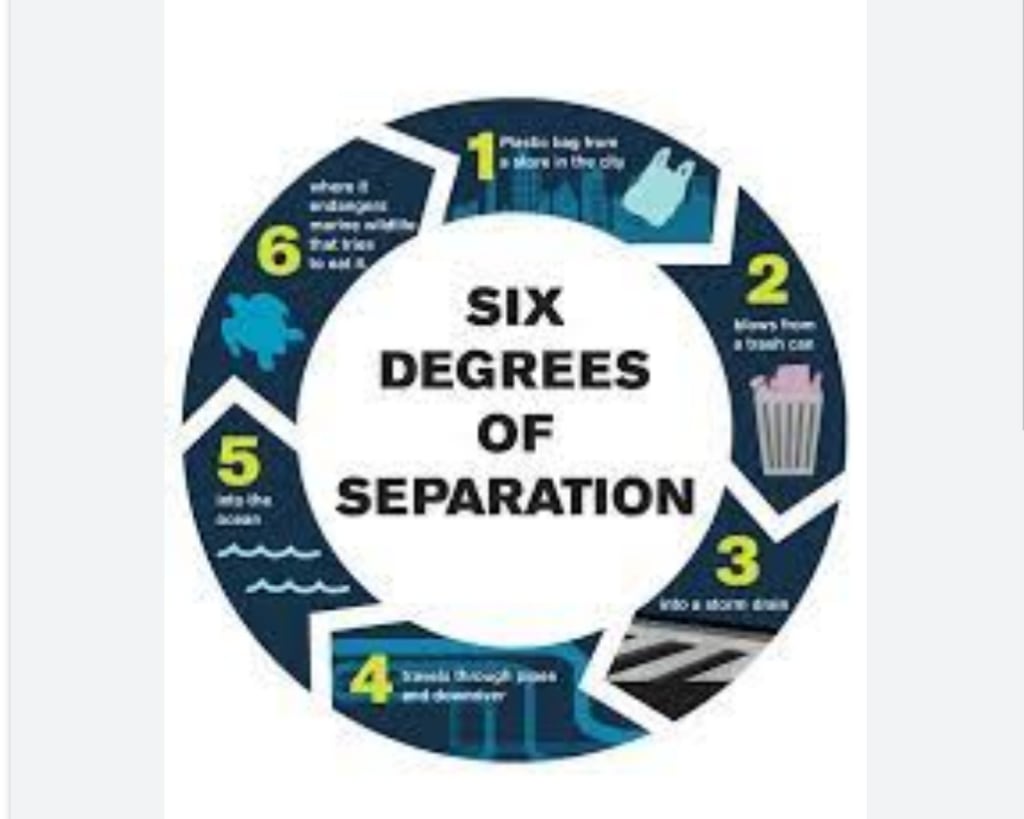
The concept of six degrees of separation is a theory that suggests that everyone in the world is connected to each other through a chain of no more than six people. This theory originated in the field of social network analysis and has since become a popular concept in pop culture and everyday conversation.
The idea of six degrees of separation is based on the premise that people are more interconnected than we realize. The theory suggests that, for any two people in the world, there are no more than six degrees of separation between them. In other words, if you were to trace the connections between any two people, you would find a chain of no more than six people linking them together.
The concept of six degrees of separation was popularized by a social psychologist named Stanley Milgram in the 1960s. Milgram conducted a now-famous experiment in which he asked people in the United States to send a package to a person in Boston whom they did not know. The participants were instructed to send the package to someone they knew personally who they thought might be more likely to know the recipient. This process continued until the package was delivered to its intended recipient.
Milgram found that the average number of intermediaries involved in delivering the package was approximately six. This led him to conclude that everyone in the world was connected to each other through a chain of no more than six people.
The theory of six degrees of separation has since been supported by various studies and experiments. In 2003, for example, researchers at Columbia University conducted an experiment in which they used email chains to connect people from around the world. The researchers found that the average number of intermediaries involved in connecting any two people was just over five.
The concept of six degrees of separation has become a popular cultural phenomenon, and has been the subject of numerous books, films, and TV shows. One notable example is the movie "Six Degrees of Separation," which tells the story of a young man who claims to be the son of Sidney Poitier and convinces a wealthy New York couple to take him in. The title of the movie refers to the theory that everyone in the world is connected to each other through a chain of no more than six people.
The concept of six degrees of separation has also had important implications for social network analysis and the study of human behavior. Social network analysis is the study of how people are connected to each other and how these connections influence their behavior. The theory of six degrees of separation suggests that these connections are more numerous and complex than we might initially think.
The theory of six degrees of separation also has important implications for fields like marketing and advertising. By understanding the social networks that connect people, companies can target their advertising and marketing efforts more effectively. For example, by identifying key influencers in a social network, companies can leverage their influence to reach a wider audience.
Despite its popularity, the theory of six degrees of separation has also been subject to criticism. Some argue that the theory oversimplifies the complexity of human relationships and social networks. Others argue that the theory is based on a narrow understanding of what constitutes a connection between people.
Regardless of these criticisms, the concept of six degrees of separation remains a powerful idea that has captured the imagination of people around the world. It has had important implications for social network analysis, marketing, and our understanding of human behavior. At its core, the theory of six degrees of separation reminds us that we are all connected to each other in ways that we may not always recognize.
About the Creator
Keep reading
More stories from Tsar Banks and writers in FYI and other communities.
The Bermuda Triangle
The Bermuda Triangle is a region of the western part of the North Atlantic Ocean where numerous ships and planes have disappeared under mysterious circumstances. The triangle is roughly bounded by Miami, Bermuda, and Puerto Rico, and it is estimated that over 1,000 lives have been lost in the area in the past century. Despite extensive investigation, no definitive explanation has been found for the strange occurrences in the Bermuda Triangle, which has led to speculation that the area is a paranormal hotspot.
By Tsar Banks3 years ago in FYI
The Evolution of Data Connectivity in Aerospace Systems
The aviation industry has always relied on communication to ensure safe and efficient operations. In the early years of flight, data connectivity was extremely limited. Aircraft relied mainly on analog radio systems that allowed pilots to communicate with air traffic control through voice signals. These systems were simple but essential, helping pilots receive navigation instructions and share flight information with ground personnel.
By Beckett Dowhanabout 3 hours ago in FYI
The Forsyth House Fire
Since 1851, Forsyth House has stood on the corner of Union Street and Gordon Street in the heart of Glasgow. Its iconic, or was... because on Sunday 8th of March, 2026, a fire broke out in a small, seemingly un-named shop in the building and tore all that history down. As I write, the rubble is still unsettled and the street is still blocked off. Central Station is quiet on the upper level, and around 30 small businesses have quite literally gone up in smoke.
By S. A. Crawford3 days ago in The Swamp



Comments
There are no comments for this story
Be the first to respond and start the conversation.