
The Roman Shrine That Kills (and 4 other Ancient Wonders)
Only the Romans would turn a gas-spewing fissure into a temple!


At the ancient city of Hierapolis, worshipers would watch sacrificial animals keel over and die at the shrine of Pluto without any human involvement. Trust the Romans to turn a gas-spewing fissure into a temple!
Here we look at five ancient wonders, including:
- The Subterranean City of Derinkuyu
- The Plain of Jars
- The Great Bath of Mohenjo-daro
- Qanat Firaun - Canal of the Pharaohs
- The Ploutonion at Hierapolis
The Subterranean City of Derinkuyu: A good place to hide can save your life - and the builders of Derinkuyu in Turkey put a lot of effort into their hidden city.
Derinkuyu sits around 85m below the surface of Cappadocia, a volcanic area of Turkey studded with chimney-stack rock formations. The subterranean settlement features eighteen levels of tunnels and could house 20,000 inhabitants (along with livestock) in times of strife, potentially making it the biggest underground city on Earth.
The earliest accounts mentioning the city date back to 370BCE. It seems to have served as a bastion for thousands of years, playing host to everyone from the Hittites and Phrygians thought to have built it to the Byzantine Christians, only being abandoned by the Cappadocian Greeks in 1920. The city was rediscovered in 1963, allegedly when a farmer kept losing his chickens into a crevasse exposed as he remodeled his home!
Derinkuyu was built with defense in mind - though it may have been modified and expanded by each subsequent set of occupants. The low and narrow passages meant that any invaders had to shuffle forwards single-file - a poor position to attack from. If any invaders made headway, the residents could roll circular stone doors into place and cut off a level.
The city featured a protected well and multiple ventilation shafts, preventing besiegers from cutting off or poisoning the air and water. It also had livestock pens near the surface (where gas could easily escape) while the residents used sealed clay-pots as lavatories and had specific rooms for human remains. The builders also recognized that life needed to go on even in the face of a siege - the city was equipped with a school, chapel, pantries and even wine presses.
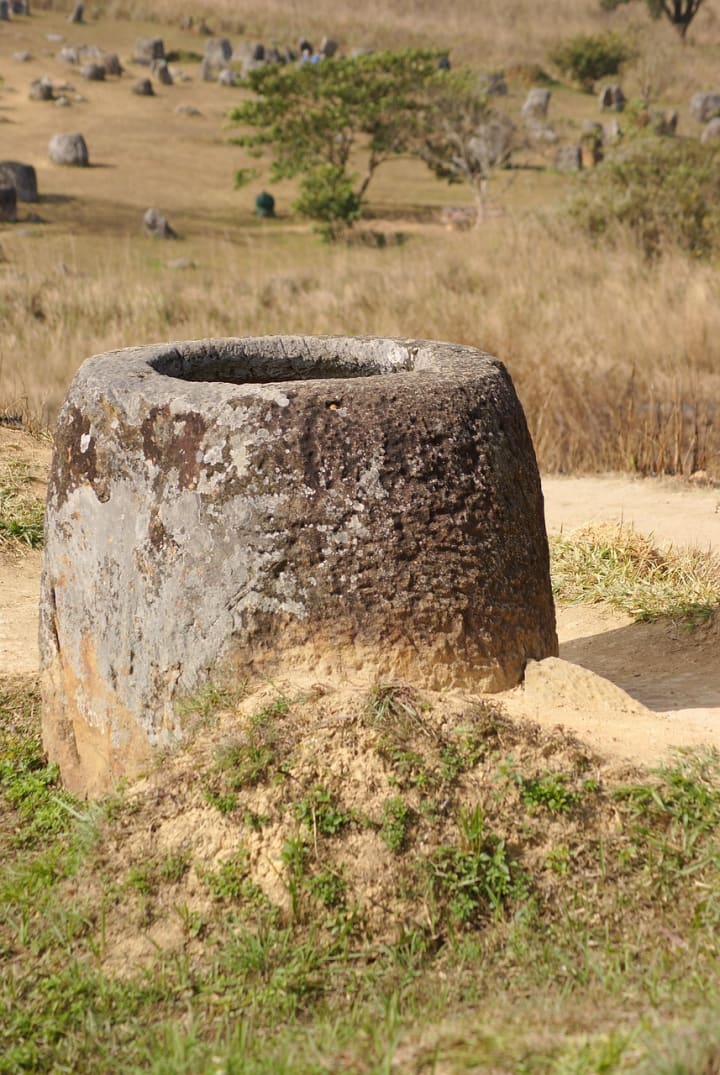
The Plain of Jars: Pots can be handy things to have around, but the Plain of Jars in Laos takes things to the extreme - Xiengkhuang Plateau in central Laos hosts over two-thousand stone urns dating to between 500BCE and 500CE.
The jars are not small things - some reach 3m in height and 1m in width, which would have made them rather awkward to transport from a quarry. They also serve as one of the few markers of a civilization that seemingly disappeared at the same time as the jars stopped being made.
It's not entirely understood what the jars were used for, but the dominant theory amongst archeologists is funerary rites - a suggestion supported by graves found in the same location. The urns may have been used to contain remains or ashes like a sarcophagus, or perhaps to store a body awaiting cremation or burial. This idea has some weight as the jars seem designed to support lids and large stone discs have been found in the same area. Local folklore does offer an alternative to this morbid theory - there is a legend that giants used the urns to brew or store massive batches of alcohol!
As if a giant plain covered in megalithic jars wasn't strange enough by itself, the region was used as a dumping ground for cluster bombs by the US military during the Vietnam war. The area is the most bombed place in the world per capita, with a great deal of unexploded munitions buried in shallow soil.
If I was a conspiracy theorist, I'd wonder if the US government knew something that spurred the saturation-bombing of the urn-filled plains!
The Great Bath of Mohenjo-daro: Did you know that the earliest public pool may be 4500 years old?
Linked to the Indus civilization in the 3rd millennium BCE, the Great Bath of Mohenjo-daro covers 83m² with a depth of around 2.5m - putting it far beyond the scale of a hot-tub. Researchers believe that it may have been used for rituals - and a building near the bath is thought to have been a training area for priests.
Perhaps the most impressive thing about the bath is the construction. Built using a double layer of fine bricks set with gypsum-based mortar, the middle of the resulting "sandwich" was filled with bitumen sealer. Since we still use bitumen for waterproofing today, it would have been an excellent choice to keep the water in!
The bath was fed from a nearby well, though rainwater may have been collected for the same purpose. Either way, the bath is thought to have been used for ritualistic cleansing - the prevalence of small baths and an extensive sewage system suggests the residents of Mohenjo-daro put a lot of emphasis on cleanliness.
Qanat Firaun - Canal of the Pharaohs: How much effort do you think it would take to bring fresh water into the heart of an ancient desert?
Though Qanat Firaun means Canal of the Pharaohs, the Gadara Aqueduct was actually the work of Rome. The system began in an ancient Syrian swamp (that has since dried up) and travelled 64 kilometers on the surface and 106km below it. The destination for this liquid bounty was Gadara, a city that formed part of the Roman-Hellenistic Decapolis.
Gadara was an important place to the Romans, part of a major trade route and a link to the Orient. There was something that the Romans hated about it though, and that was the comparative lack of water. In 90CE, Imperial Rome began an ambitious plan to fix this failing - a 170km canal that would bring all the water the region could need.
While a cement-based channel worked well enough for the earlier sections of the canal, the uneven rocky terrain of Jordan made continuing on the surface impractical. In search of a solution, the engineers began to dig instead.
Carving a tunnel from stone by hand was a slow (and poorly ventilated) process. The longest stretch below the ground was 94km and the legionnaires digging could only break 10cm per day - you can probably see the problem. The engineers marked the route from the surface and dug shafts down every 20-200m, making a series of mini-tunnels that would eventually connect into a large one. This also meant that each mini-tunnel could have a work gang in it, allowing far more manpower to be in action at once - though it still took 120 years to complete.
Mineral deposits suggest that 300-700 liters of water passed through the functioning canal each second, but the final result wasn't quite what the engineers had wanted - the final height of the canal was too low to feed a high reservoir. Not content with defying nature and bringing flowing fresh water 170km through the desert, they had wanted to use water pressure to power fountains throughout the city!
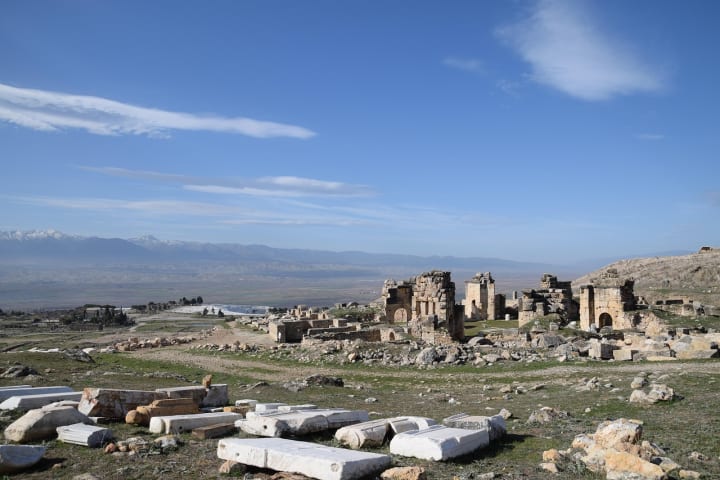
The Ploutonion of Hierapolis: In the ancient spa-city of Hierapolis, worshipers could watch a god personally snuff the life out of sacrifices... or so they thought.
The Pamukkale region of Turkey is famous for the hot springs and limestone terraces that colour it white. The city of Hierapolis was built to take advantage of the eerie landscape, acting as both a spa and place of worship.
One of the rather unique features of the town was the Ploutonion, or Pluto's Gate. This small Greco-Roman style temple featured a grotto into which animals and priests would enter - resulting in the animals dying and the priests seemingly emerging unscathed. This grotto was said to be a gate to the underworld, with the animals being taken as a sacrifice by Pluto. The truth is a little more complicated.
The grotto is actually part of a seismic fault that vents carbon dioxide, reaching concentrations around 53% near the ground... and researchers have found much weaker concentrations can rapidly knock out a human. Since the four-legged livestock would naturally be breathing air much closer to the ground than the priests, the hapless beasts would take in much more of the heavy gas. The contemporary Greek Strabo even noted that the priests appeared to hold their breath as much as possible during these rites, suggesting they were well aware of the toxic atmosphere.
Though the site fell into disrepair thousands of years ago, the cave remains dangerous - archeologists from a 2013 expedition to the area reported seeing several birds perish after getting close to the mouth!
Sources and Further Information:
Turkey's underground city of 20,000 people
Megalithic Jar Sites in Xiengkhuang – Plain of Jars
The Great Bath, Mohenjo-daro, Sindh province, southeastern Pakistan
Interesting Facts About The Great Bath, The World's Oldest Public Pool
Qanat Firaun, the most spectacular underground aqueduct of the ancient world
The Ancient World's Longest Underground Aqueduct
Animals Dropped Dead Inside Roman ‘Gate to Hell.’ Scientists Just Figured Out Why
About the Creator
Bob
The author obtained an MSc in Evolution and Behavior - and an overgrown sense of curiosity!
Hopefully you'll find something interesting in this digital cabinet of curiosities - I also post on Really Weird Real World at Blogspot
NASA’s Arctic Mystery: What Are the Beaufort Sea Ice Circles?
In the world of the unexplained, we’ve seen it all: crop circles in England, fairy circles in the desert, and even bizarre craters on Mars. But a new mystery has emerged from one of the most remote places on Earth: the Arctic.
By Areeba Umair7 days ago in FYI



Comments
There are no comments for this story
Be the first to respond and start the conversation.