
The Remarkable Saga of the Titanic's Sisters
Triumphs, Tragedies, and the Extraordinary Story of Violet Jessup

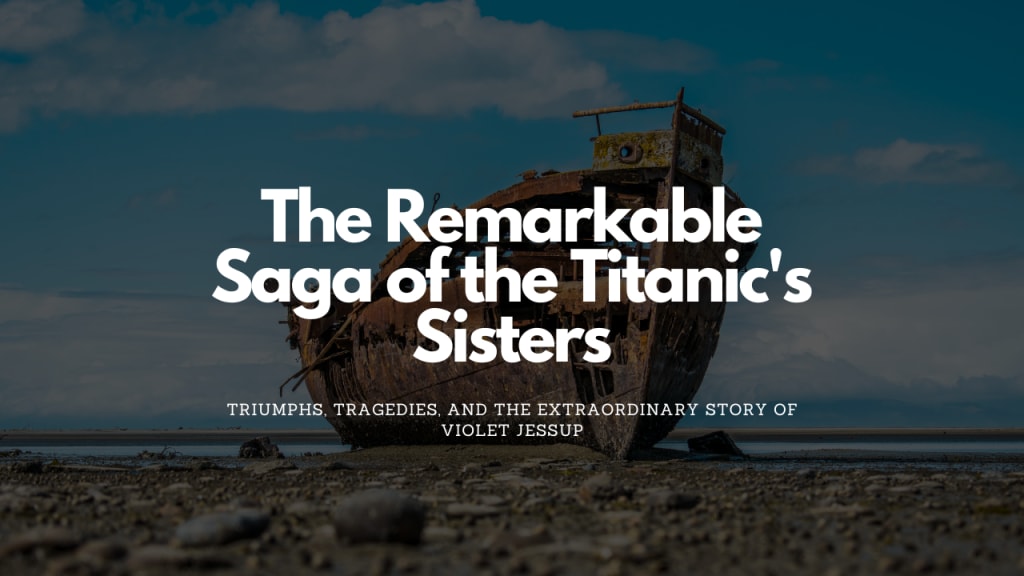
The story of the Titanic's tragic sinking is well-known, but the remarkable tale of its two sister ships, the Olympic and the Britannic, remains relatively obscure. These vessels shared a tumultuous history, marked by both remarkable achievements and devastating misfortunes. In this article, we will embark on a journey through time to explore the captivating saga of these three ships and their interconnected destinies. Additionally, we will delve into the extraordinary experiences of Violet Jessup, an exceptional woman who sailed on all three vessels and miraculously survived each of their calamities, showcasing the indomitable spirit of human resilience.
The Olympic, the first of the trio, set sail on June 11, 1911, embarking on its maiden voyage to New York. The sheer magnitude and grandeur of the ship left crowds in awe, and during its stay in New York, approximately 8,000 people eagerly explored its luxurious accommodations. However, just two months later, on September 20, 1911, the Olympics' journey took an unfortunate turn when it collided with the HMS Hawke off the Isle of Wight. Despite sustaining significant damage, the Olympic managed to make its way back to Belfast, where parts of the yet-to-be-completed Titanic were used in its repairs, offering a rare sight of the two enormous vessels side by side.
The ill-fated voyage of the Titanic unfolded on the night of April 14, 1912, when it struck an iceberg in the North Atlantic. As the crew desperately sent distress signals into the darkness, the nearby Olympic, returning from New York, intercepted the call for help. Determined to aid its sister ship, the Olympic altered its course and raced at full speed towards the stricken Titanic. However, the distance was too great, and the Olympic realized it would not reach the scene in time to assist. Instead, it joined the RMS Carpathia in rescuing survivors from the icy waters. The heroic efforts of both ships saved hundreds of lives amidst the devastating loss.
Following the Titanic disaster, the Olympic underwent significant modifications to enhance safety. The number of lifeboats was increased, and adjustments were made to the watertight bulkheads. Despite the heart-wrenching tragedy that befell the Titanic, the Olympic stood as a testament to the resilience and adaptability of the White Star Line.
With the shadow of the Titanic disaster looming over the White Star Line, construction on the HMHS Britannic began on November 30, 1911, just four months prior to the Titanic's ill-fated voyage. Originally intended to be named the "Gigantic," the ship was renamed Britannic after the tragedy, as the company sought to reclaim their reputation. Launched on February 26, 1914, the Britannic resembled its ill-fated sister, but stringent design modifications were implemented to enhance safety.
For over a year, the Britannic served as a passenger ship, offering luxury and comfort to its guests. However, with the outbreak of World War I, the ship was requisitioned by the British government and converted into a hospital ship in 1915. It underwent extensive transformations to accommodate the wounded, earning the title of His Majesty's Hospital Ship Britannic (HMHS Britannic).
Painted all white and adorned with large red crosses, the Britannic became a beacon of hope and healing. As a floating hospital, it had the capacity to treat up to 3,309 patients simultaneously. The ship's surgeons and nurses, including Violet Jessup, worked tirelessly to provide care to the wounded and the ill.
However, tragedy struck once again. On November 21, 1916, while navigating through the Aegean Sea, the Britannic encountered an explosion. The exact cause remains a subject of debate, with theories ranging from a mine laid by a German U-boat to a torpedo attack. The ship rapidly took on water, and despite efforts to reach a nearby island, it sank in just 55 minutes.
Fortunately, the disaster occurred during daylight hours when the water temperature was warmer, leading to the successful evacuation of the majority of passengers and crew. Out of the approximately 1,066 people on board, only 30 lives were lost. The swift response of nearby ships, including the Greek island of Kea, played a crucial role in saving lives.
The intertwined saga of the Titanic's sisters, the Olympic, the Titanic itself, and the Britannic, is a testament to human ingenuity, resilience, and the capricious nature of fate. These three ships, each with their moments of glory and tragedy, etched their names into the annals of maritime history. Moreover, the extraordinary experiences of Violet Jessup, who miraculously survived the calamities of all three vessels, embody the indomitable spirit of human courage and resilience. Their stories serve as a poignant reminder of the fragility of human endeavors and the enduring legacy of those who endured unimaginable hardships at sea.
About the Creator
Mahamud Hayet Arpon
I am a versatile and talented writer with a passion for storytelling. Born with a vivid imagination and a love for words, I embarked on a literary journey that has shaped their identity as a writer.
Keep reading
More stories from Mahamud Hayet Arpon and writers in FYI and other communities.
Unveiling the Secrets
Introduction : Throughout the world, there are countless stores and doors that have remained closed for decades, and even centuries, shrouded in mystery. These sealed spaces ignite our imagination, prompting us to wonder what treasures and secrets lie hidden within. While the reasons for their closure vary, from abandonment to preservation, legal issues to structural concerns, these closed doors continue to captivate our curiosity. In this article, we will delve into four intriguing examples—the Taj Mahal, the Great Sphinx of Giza, the Swami Temple, and the first Emperor's tomb—to explore the enigmas that lie behind these locked portals.
By Mahamud Hayet Arpon3 years ago in Education
Hottest in the Office
Dear Rafi, You’re very distracting to work around. For the first second I saw you the other day, I thought you were some type of executive. It took a moment to realize no, you were just the new guy, dressed up for the job he wants. Be still, my heart.
By Gabriel Shames6 days ago in Pride



Comments
There are no comments for this story
Be the first to respond and start the conversation.