
The Power of AI in Demand Forecasting: A Simple Guide for Modern Businesses
A practical look at how AI replaces outdated demand models with real-time, adaptive forecasting.
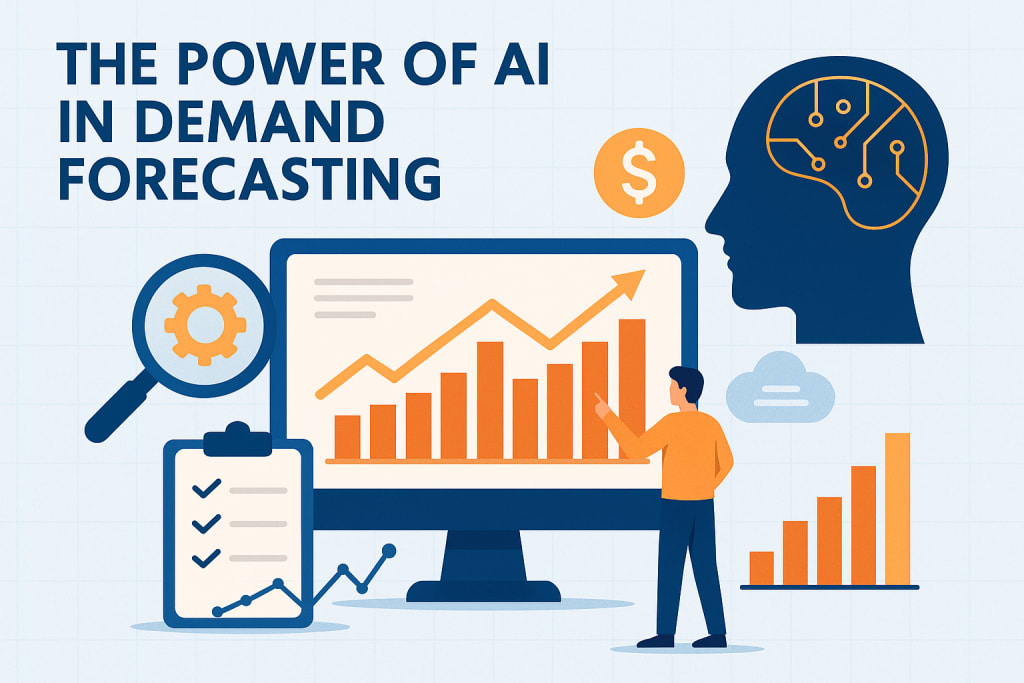
Forecasting used to be a function of memory.
Pull last year's numbers. Adjust slightly. Assume things will stay the same.
But the gap between what was expected and what actually happened? It’s widening.
Buyers don’t behave the same way twice. A viral post can clear shelves in one city. A supplier disruption can delay production across regions. Patterns break faster than models can update.
Still, most businesses plan with tools that weren’t built for this pace.
This is where AI reframes the role of forecasting-not by offering more data, but by using data more intelligently. It reads signals as they form and responds before the trend is visible in reports.
Why Traditional Forecasting No Longer Works
Most traditional forecasting methods are built around a fixed logic: use past sales as a base, apply known seasonality, and adjust for promotions. That approach worked when demand was stable and supply chains were linear.
Now, it introduces risk.
These static models miss early shifts in buyer behavior, can’t incorporate external signals, and often rely on manual updates. As a result, businesses either overproduce or run out of stock without warning.
By applying generative AI to demand forecasting, businesses can move away from reactive planning cycles and respond to shifts as they happen.
What Makes AI Forecasting Different
AI doesn’t follow fixed rules. It processes real-time inputs - sales, web behavior, weather, supplier data and learns from every signal.
It doesn’t just improve accuracy. It changes how demand is understood.
This is already happening in areas like manufacturing sales operations, where AI aligns production and sales more effectively.
What AI Brings to the Table
Real-time visibility
AI enables live tracking of demand, inventory levels, and external market signals- helping businesses respond as conditions evolve.
Adaptive modeling
Unlike static systems, AI forecasts self-adjust continuously as new data flows in, ensuring more accurate predictions.
Multi-source integration
AI combines data from ERP systems, supplier feeds, customer behavior, and third-party sources into one cohesive forecasting engine.
Forecast scalability
Whether you're managing 100 SKUs or 100,000, AI scales without performance drop, maintaining forecast precision at every level.
Learning loops
Every interaction with new data improves the model. Over time, forecasting accuracy increases without the need for manual adjustments.
AI is already influencing planning workflows across industries, from retail execution to automotive product launches.
Industry Applications
Retail
Retailers use AI to refine short-term forecasting based on traffic trends, promotion data, and seasonality. Several GenAI solution providers are helping large-format retailers move from blanket promotions to store-specific planning.
Manufacturing
With AI, manufacturers reduce overproduction by adjusting forecasts mid-cycle. This is especially useful when launching new SKUs or reacting to demand uncertainty, as explored in manufacturing sales transformation use cases.
Supply Chain
AI enables demand prediction at the warehouse level and syncs it with supplier availability. In complex networks, generative AI is helping supply chains shift from firefighting to proactive planning.
Energy & Utilities
Load forecasting improves when AI combines usage patterns, weather, and seasonal factors. In sectors like energy, the ability to anticipate demand spikes is one of the top AI use cases in utilities.
Challenges AI Forecasting Solves
1.Problem: Demand shifts missed
Impact: Overstock or lost sales
AI Fix: Real-time model recalibration helps businesses adjust forecasts instantly, preventing overproduction or stockouts.
2.Problem: Rule-based logic
Impact: Rigid forecasting
AI Fix: Adaptive learning models identify emerging patterns without relying on predefined rules, making forecasts more responsive.
3.Problem: Siloed forecasting
Impact: Teams working on disconnected data
AI Fix: Unified, real-time collaboration enables all departments to access and act on the same forecast.
4.Problem: Reporting lag
Impact: Late reactions
AI Fix: Predictive alerts and automated insights speed up decision-making and reduce reliance on delayed reports.
Benefits of AI Forecasting
- Inventory accuracy improves through location-level and SKU-specific tracking
- Planning speed increases with auto-updated forecasts
- Customer satisfaction rises as availability matches actual demand
- Cost savings come from fewer markdowns and storage issues
- Revenue retention improves when sudden spikes are anticipated
These outcomes are also seen in industries like oil and gas, where forecasting aligns more closely with real-time consumption and supply data.
Getting Started with AI Forecasting
Start with one business-critical segment—such as high-demand SKUs, seasonal inventory, or a volatile market region.
Steps to follow:
- Define a specific forecasting use case
- Ensure data quality across systems
- Choose a platform that integrates with existing workflows
- Run a test cycle, measure lift in accuracy
- Expand to other categories or regions
This phased approach has also helped businesses implement AI-powered sales automation without overwhelming existing processes.
What’s Next in Forecasting
AI forecasting is evolving to include IoT sensors and digital twins. These technologies simulate what-if scenarios and let planners test changes before rolling them out.
In enterprise settings, digital twins are being used alongside AI to improve decision-making for inventory, maintenance, and logistics.
Final Thought
Forecasting isn't about copying last year’s plan. It’s about anticipating what’s changing—before it hits the dashboard.
AI lets teams work ahead of demand curves. It aligns planning with behavior and removes delays caused by outdated tools.
Learn more about how generative AI enables real-time forecasting and start moving your operations from reactive to predictive.
About the Creator
Riya
I write about how Generative AI is reshaping enterprise workflows ,from sales to supply chain. If you’re into real-world automation and practical AI insights, you’re in the right place.


Comments
There are no comments for this story
Be the first to respond and start the conversation.