
The mystery of the disappearance of the Clovis civilization in North America 9000 years ago
Clovis people may have migrated to South America as early as 11,000 years ago

There was a hypothesis that the mammoths were killed off by the Clovis people and became extinct. Of course, this is only a hypothesis.
The Clovis culture is a prehistoric Paleo-Indian culture in North America. According to radiocarbon dating, its remains date back to the last ice age 11,500 years ago, and the Clovis culture emerged around 13,500 years ago and lasted for about 200 to 800 years.
Studies have shown that the Clovis people may have migrated to South America as early as 11,000 years ago. Instead, they mysteriously disappeared again about 9,000 years ago.
Researchers from the American journal CELL, in the November issue of the publication, said that they may have been replaced by other ancient peoples, but of course, this is only one of several speculations about the disappearance of the Clovis people, relatively reliable speculation.
Academic studies have long speculated that the original American people separated genetically from their Siberian and East Asian ancestors around 25,000 years ago. They crossed the Bering Strait continental bridge, which was still frozen at the time, and arrived in the Americas, where they gradually evolved into Americans of different ethnic tribes later.
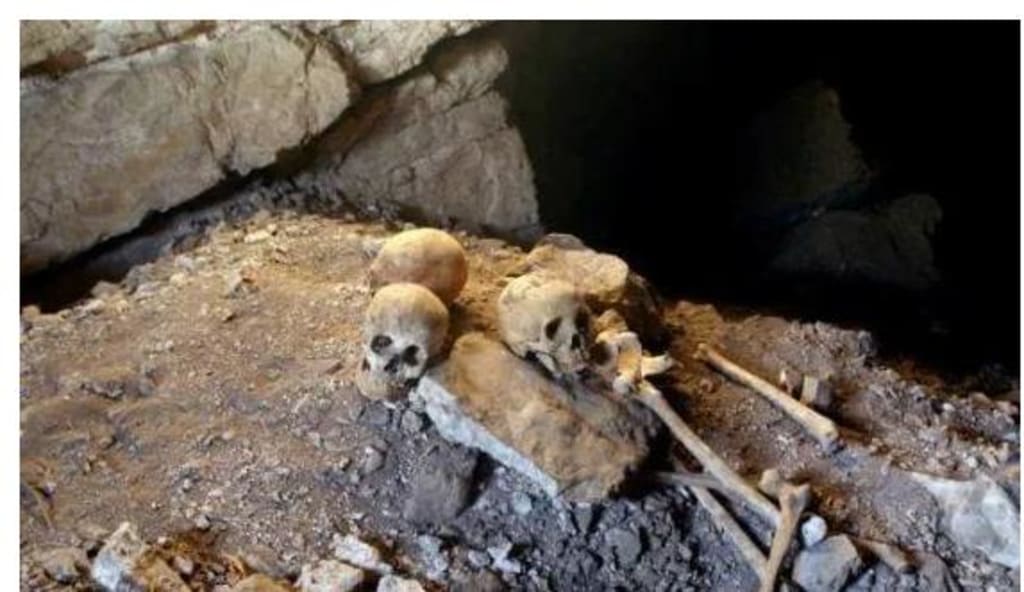
Discovered in 1968 at a Clovis-era burial site excavation in western Montana, USA
About 13,000 years ago, the Clovis civilization was known for its distinctive pointed stone tools, and they had specific tools to hunt large mammals, which swept across the North American continent. And according to archaeological findings, at least 14,500 years ago, ancient people migrated to Monte Verde in what is now south-central Chile, South America, where an important primitive stone tool site was later discovered. However, there has been confusion about the relationship between the descendants of the Clovis civilization and those of other South American civilizations.
To unlock the secrets lurking in these remains, scientists conducted DNA analysis of 49 sets of ancient human remains dating from 11,000 to 3,000 years ago that were unearthed in Belize, Brazil, Peru, Chile, and Argentina, among other countries in the Americas.

They found that DNA related to the North American Clovis civilization was found in the ancient human remains from Brazil, Chile, and Belize, but the DNA link between the ancient people of Central and South America and the North American Clovis people was only between 11,000 and 9,000 years ago, and the DNA of the South Americans, who were dated much closer to today, was different from that of the Clovis people. "One of the important findings is that a Clovis civilization-related individual from North America, dating back 12,800 years, has a distinctly different ancestry from the oldest individuals from Chile, Brazil, and Belize," so the Clovis people of North America and the later Central and South Americans, too, are not of common ancestry.
Cosimops of the Max Planck Institute, a German institute for human sciences, said in a statement. This supports the hypothesis that the Clovis civilization in North America, had expanded into Central and South America. But in the end, they failed to blossom and continue in Central and South America.
But scientists found that about 9,000 years ago, Clovis civilization DNA mysteriously disappeared in reproduction. David Reich, a professor of genetics at Harvard Medical School and a researcher at the Howard Hughes Medical Institute, says that a continent-wide population replacement may have occurred. Simply put, the Clovis people were replaced by other races.
Another hypothesis for the disappearance of the Clovis people is, of course, that the New Fairy Wood event refers to a comet exploding over the Great Lakes 12,900 years ago, and the impact on the Clovis settlement.
Even though the Clovis people disappeared. Scientists have found evidence of a great migration of people from North and South America because there is a surprising genetic link between ancient South Americans who lived 9,000 years ago and subsequent ancient people who lived in different parts of South America.
The study found a surprising link between ancient people who lived in the Channel Islands of California and those who lived between the Andes in southern Peru about 4,200 years ago, two groups that were geographically distant from each other and shared a common ancestor.
Researchers say the ancestors of these groups may have migrated thousands of years ago, with some eventually migrating to the Channel Islands and others migrating to South America. This further supports the notion that early South American primitives migrated from North America.
But scientists admit that they have not verified, any American remains older than 11,000 years. So the results of the study are yet to be refined.
In any case, from the archaeological excavation evidence, the earliest human survival remains in North America is about 40,000 years ago, it can be assumed that there is modern human activity in North America no earlier than 40,000 years. In contrast, the earliest human remains in South America are about 15,000 years ago.
About the Creator
Monu Ella
And I know it's long gone and there was nothing else I could do
What Does a Software Developer Do? How They Build Real Solutions
Behind every smooth app experience, reliable website, or business system that simply works, there is a Software Developer making countless decisions you never see. Their role goes far beyond writing lines of code. A Software Developer translates human problems into logical systems, balances performance with usability, and builds products meant to survive real-world use.
By Charles Brightabout 4 hours ago in FYI




Comments
There are no comments for this story
Be the first to respond and start the conversation.