
The mystery of embalming heads of state
To embalm the bodies of leader Lenin and late president Kim Il Sung, experts removed all the organs in the body, destroyed the veins and removed all the blood from the tissues.

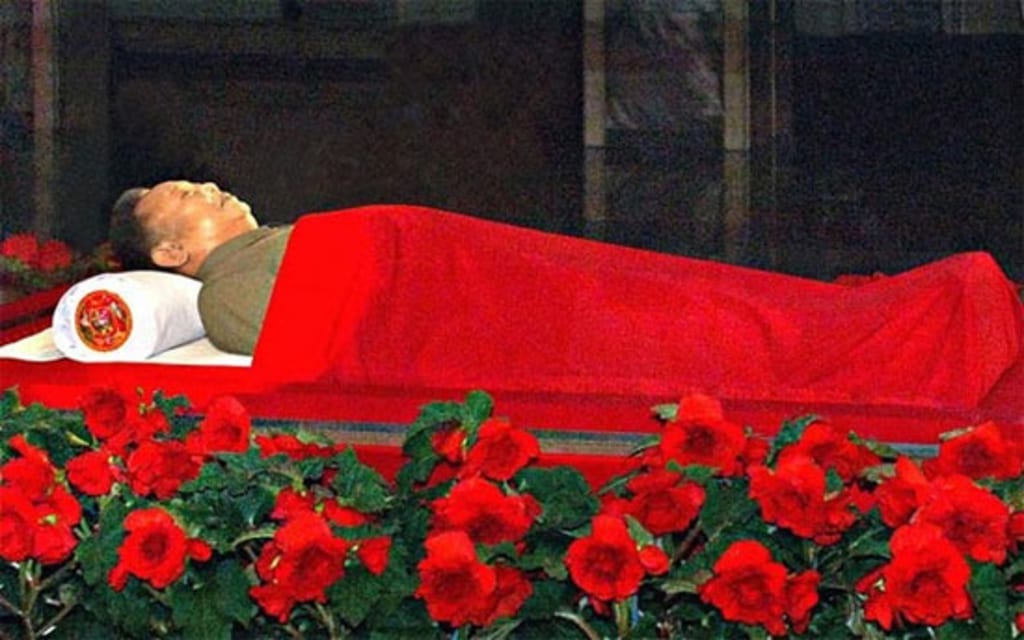
To embalm the bodies of leader Lenin and late president Kim Il Sung, experts removed all the organs in the body, destroyed the veins and removed all the blood from the tissues.
Soviet leader Lenin
Vladimir Ilich Ulianov, better known by his pseudonym Lenin, breathed his last, after nearly two years of suffering from pain and stroke, at 6:50 p.m. on April 21, 1924. Immediately, Russia's official organs met to discuss the matter of Lenin's body. According to tradition, Lenin's body was temporarily embalmed to preserve it during the week of national mourning before burial, but Stalin decided to embalm it permanently. Signs of decomposition appeared on Lenin's body, but it was not until nearly five weeks later, on March 13, 1924, that the Russian Politburo made the decision to "preserve Lenin's body by low temperature".
However, the cold only made the condition of the body worse. The usual embalming method, used by Professor Abricosov to temporarily preserve the body (injecting 6 liters of alcohol, formaldehyde and glycerin through the aorta) was ineffective. Finally, Stalin and Dgierginsky agreed to conduct a permanent embalming according to the method of Vorobiev. Accordingly, Lenin's body was opened, all internal organs were removed. Then the professors washed the chest with distilled water. The face, hands and the entire skin surface were covered with wet towels soaked in formaldehyde. This process lasted 4 months.
To be more effective, the professors, with the permission of the party, made incisions on the belly, shoulders, legs, back and palms of the leader's body so that the embalming oil could penetrate and permeate the entire body. Then they lowered Lenin into a rubber tub filled with secret medicinal wine.
Professor Ilia Zbarxki, who kept Lenin's body, explained: "The solution contains glycerin, potassium acetate and chloroquinine. This formula was proposed by the scientist Manicov Razvedencov in the 19th century. Every week we use a towel to absorb the liquid on the face and hands of the mummy."
Every year, Lenin's Mausoleum is closed for a month and a half to soak the body in solution and saturate it with chemical preparations.
Chairman of China Mao Zedong
On September 9, 1976, Chairman Mao Zedong of the People's Republic of China passed away. That same evening, the Chinese Politburo held an emergency meeting and decided to preserve his body so that people could come and pay their respects. They set a time limit of 15 days.
During his lifetime, Chairman Mao Zedong advocated cremation and was the first Chinese leader to sign a document recommending cremation after death. Therefore, the preservation period was initially set at 15 days for visiting and memorial services. However, during the memorial service, on September 10, the Party Central Committee headed by Hua Guofeng decided to preserve Chairman Mao Zedong's body for a long time and build a mausoleum so that future generations could see his remains.
This is a big problem for medical staff. Normally, after 2 hours of death, the bodies of leaders must be dissected, their organs removed, all the blood vessels in the body cleaned with chemicals, then soaked in formalin and some other chemicals to embalm. Meanwhile, Chairman Mao Zedong's body was initially treated simply, without the blood vessels being cleaned, but now following the normal procedure is no longer possible.
In the end, the decision was made to choose the method of the Beijing scientists: combining immersion preservation with gas preservation. The exposed parts of the skin such as the head and two hands were preserved with gas, while the rest of the body that did not need to be exposed was immersed in liquid. In addition, they also had to apply a combination of other preservation methods such as physics and optics. In short, it was a synthesis of very complex methods.
When the Memorial Hall is open to the public, the body is placed in a position where people can observe it, but no water is poured into the coffin. After closing the door, the body is taken down to soak in a sealed tank in the underground bunker. In addition, every year after Chairman Mao Zedong's birthday, which is December 26, the Memorial Hall is closed so that technicians can soak the body in a solution for a long time, replenishing the lost water.
North Korean President Kim Il Sung
Former President Kim Il Sung was embalmed by Russian experts after his death in 1994. His body is now placed in the Kumsusan Memorial Palace.
In an interview with Moskovsky Komsomolets, Pavel Fomenko, who traveled to North Korea to help embalm President Kim Il Sung, explained more about the embalming process.
"Usually three to six specialists are involved in embalming operations. In special cases, the number of specialists can be up to seven. First, all the internal organs are removed, the veins are destroyed and the blood is removed from the body tissues. The body is placed in a glass tub filled with embalming solution, then closed and covered with a white sheet. Precise conditions of temperature and humidity are maintained in the body room ," he said.
Gradually, the water in the body's cells will be replaced by embalming solution. This process takes about six months. Fomenko said the North Korean government spent millions of dollars to embalm and maintain Kim Il Sung's body.
Former North Korean leader Kim Jong-il
The body of Kim Jong-il at the Kumsusan Memorial Palace in Pyongyang during days of national mourning.
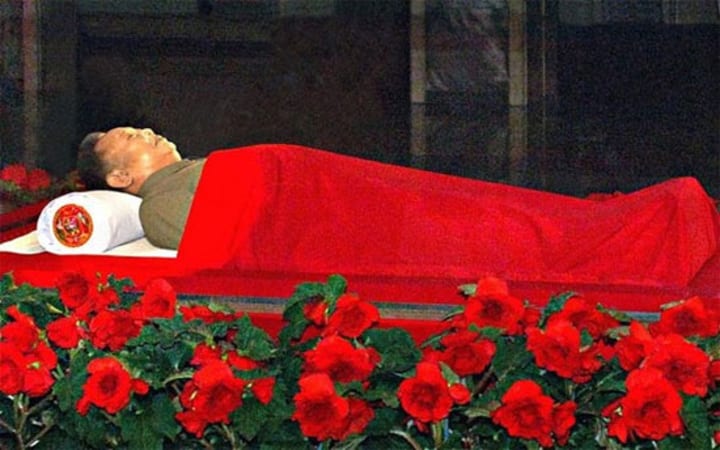
in Pyongyang during the days of national mourning.
Kim Jong-il died on December 17, 2011, of a heart attack while traveling by train. Hundreds of thousands of North Koreans poured into the streets of Pyongyang, weeping bitterly in the snow as the hearse carrying Kim Jong-il's body passed through the streets of the capital.
A year after his death, Pyongyang unveiled the preserved body of late leader Kim Jong-il, still wearing his famous khaki suit. Kim lies a few floors below his father, Kim Il-sung, in the Kumsusan Memorial Palace, which was once Kim Il-sung’s office. Kim Jong-il’s body is covered with a red blanket, with a spotlight shining on his face in the red-tinted room.
About the Creator
Ken Daklak
Telling stories my heart needs to tell <3 life is a journey, not a competition
If you like what you read, feel free to leave a tip,I would love some feedback
https://s.shopee.vn/VwwLTGLe9
Keep reading
More stories from Ken Daklak and writers in FYI and other communities.
Numerology and the mysterious meaning of 12 numbers
"It's everywhere. You're at home or in the store and you suddenly realize you've seen the same number. It could be a price tag on an item or the name of the TV channel you're watching. It could be the time, a phone number, a home address, and now you're thinking about it and you seem to notice it more."
By Ken Daklakabout a year ago in FYI
Miss Persephone's Manual to a Seemingly Ordinary Life
Miss Persephone was found at the dining table, her blue eyes swollen, her tears arriving and retreating like the tides of the ocean. Earlier that day, her family had visited her in the retirement home where she had lived for eight years. It was her eightieth birthday.
By Imola Tóth3 days ago in Fiction



Comments
There are no comments for this story
Be the first to respond and start the conversation.