

Prologue
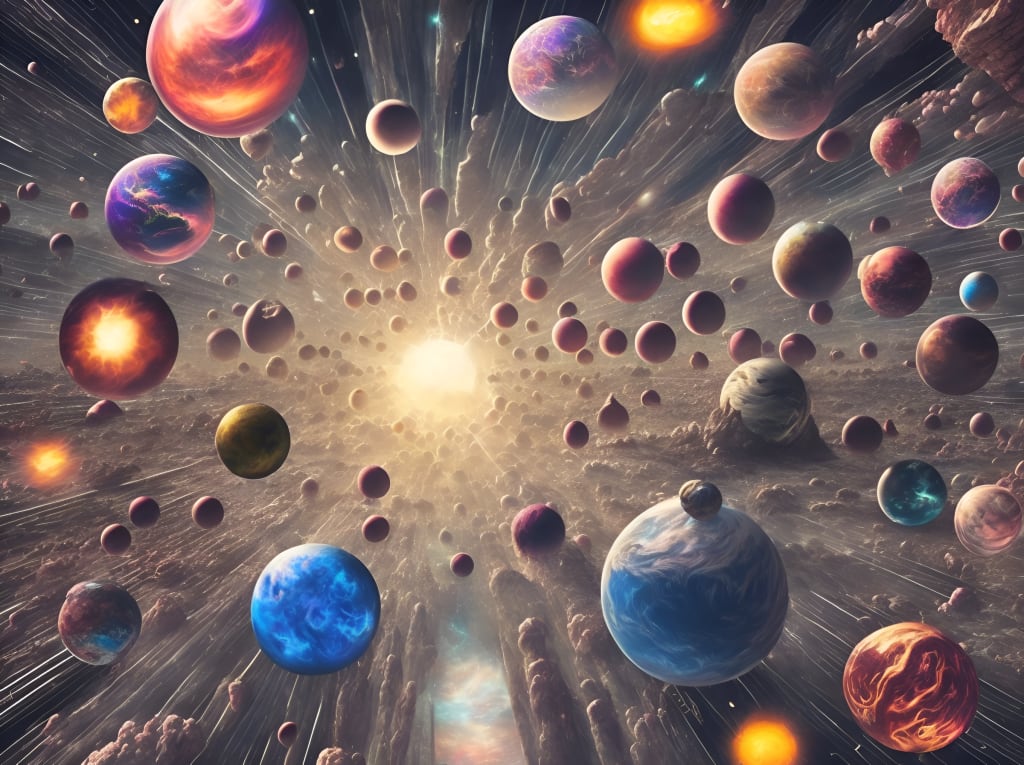
As human beings, we have always been curious about the world around us. We have longed to understand the mysteries of the universe and our place within it. One of the most fascinating and mind-bending concepts that have captured the human imagination is the notion of parallel realities or the multiverse. The idea that there may be an infinite number of universes, each with its own set of physical laws and realities, is both awe-inspiring and humbling.
In "The Multiverse: A Guide to Parallel Realities," I, Damion Trimmier, will take us all on a journey through the theoretical foundations of the multiverse. We explore the latest scientific theories, including string theory and quantum mechanics, that suggest the existence of parallel universes. I will use clear and concise language to help readers understand complex ideas and theories, making this book accessible to both scientific and lay audiences.
But "The Multiverse" is not just about science. It is also about imagination and creativity. By including vivid descriptions of hypothetical parallel worlds, I will be inviting readers to explore different realities and the consequences of different choices. We are asked to imagine worlds where gravity is reversed, where time moves backwards, or where dinosaurs still roam the earth. These thought experiments help us to think beyond the limitations of our own reality and consider the vastness of possibilities that may exist beyond it.
Beyond the scientific and imaginative aspects of the multiverse, we will also explore the potential societal and philosophical implications of its existence. The idea of multiple realities raises questions about free will, determinism, and the nature of consciousness. I invite all of my readers to ponder these questions and consider the implications of living in a multiverse.
Chapter One : Infinite Spectrums of Complexity
The concept of the multiverse is not a new one. It has been contemplated for centuries by scientists, philosophers, and writers alike. However, it was not until the 20th century that the idea began to take shape in the scientific community. Theoretical physicists, such as Hugh Everett III and Brian Greene, have explored the possibility of multiple parallel universes, each with its own unique properties and laws of physics.
The idea of the multiverse can be difficult to grasp, even for the most astute minds. It suggests that there may be an infinite number of universes, each with its own version of reality. These realities may be similar to our own or vastly different, with alternate histories, different laws of physics, and different outcomes for events that occurred in our own reality. The complexity of this concept is vast, and the implications of its existence are equally profound.
As we begin our journey through the multiverse, we must first understand the complex nature of the concept itself. The idea of multiple parallel realities is not a new one; it has been contemplated by some of the greatest thinkers throughout history.
In ancient Greek philosophy, the concept of atomism was proposed by Leucippus and his student Democritus. They believed that everything in the universe was made up of tiny, indivisible particles called atoms. This theory was the precursor to the idea of parallel universes, as it suggested that there may be an infinite number of possible configurations of atoms, leading to an infinite number of universes.
Moving forward to the 20th century, the concept of parallel universes was further developed by renowned physicist Hugh Everett III. He proposed the many-worlds interpretation of quantum mechanics, which suggests that every possible outcome of a quantum event actually occurs, but in different parallel universes.
This idea of multiple realities has also been explored in popular culture, from the works of science fiction writers such as H.G. Wells and Isaac Asimov, to television shows like "Doctor Who" and "Sliders". These creative works have not only entertained us but have also helped to shape our understanding and fascination with the multiverse.
One of the most fascinating aspects of the multiverse is the idea that every possible outcome of any given situation may exist in another universe. This means that there are universes where every choice we make leads to a different outcome, and where every version of reality is simultaneously true. It is an almost incomprehensible thought, and yet it is a possibility that cannot be ignored.
In order to begin to understand the multiverse, we must first look at the scientific theories that underpin it. String theory, for example, suggests that there may be more than four dimensions in our universe, and that these extra dimensions may exist in other parallel universes. This theory, along with quantum mechanics, provides a theoretical foundation for the existence of the multiverse.
However, the multiverse is not just a concept of science. It is also a concept of the imagination. The idea of infinite parallel universes allows us to explore the boundaries of our own reality and contemplate the vastness of possibilities that may exist beyond it. From the existence of alternate versions of ourselves to the possibility of entire civilizations existing in other realities, the multiverse offers endless opportunities for exploration and contemplation.
As we delve deeper into the multiverse, we must also consider the potential philosophical and societal implications of its existence. The idea of multiple realities raises questions about free will, determinism, and the nature of consciousness. If there are infinite versions of ourselves and every possible outcome exists in another universe, does this mean that our choices are predetermined? Or does it mean that our choices have no meaning at all?
The implications of the multiverse go beyond just philosophy and science. They also have the potential to impact our understanding of our place in the universe and our connection to each other. The idea that every choice we make creates a new reality means that we are not just connected to each other in our own reality, but also in every other possible reality. It is a humbling thought that has the potential to change the way we view ourselves and our place in the world.
Infinite spectrums of complexity is just a concept within the multiverse. Each parallel reality presents unique physical laws and realities, thus resulting in an infinite number of universes. As we dive deeper into the multiverse, we encounter an ever-expanding landscape of possibilities, each with their own nuances and intricacies.
At the heart of the multiverse lies the theory of quantum mechanics, which suggests that particles can exist in multiple states simultaneously until they are observed. This theory offers a glimpse into the complex nature of the universe, one that challenges our understanding of reality itself.
The multiverse concept has sparked debates among scientists, philosophers, and theologians alike, leading to a multitude of theories and interpretations. Some suggest that the existence of a multiverse implies the absence of a grand design, while others see it as evidence of a greater cosmic plan.
The concept of the multiverse has also permeated popular culture, inspiring movies, TV shows, and literature. From the famous Star Trek episode "Mirror, Mirror" to the popular Marvel comic series "What If," the multiverse has become a staple in science fiction, pushing the boundaries of what is possible.
As we explore the multiverse and its infinite spectrums of complexity, we must be willing to confront our own biases and preconceived notions about the universe. It challenges us to question what we know, to think beyond our own existence, and to consider the vastness of possibilities that may exist beyond our own reality.
Chapter Two : The Many-Worlds Interpretation
The concept of the multiverse leads to an intriguing question: if there are infinite universes, what happens in each of them? The Many-Worlds Interpretation (MWI) of quantum mechanics attempts to answer this question by suggesting that every possible outcome of a quantum event occurs in a different parallel universe.
The MWI was first proposed by physicist Hugh Everett III in 1957, in his doctoral dissertation at Princeton University. Everett suggested that the universe splits into multiple parallel universes every time a quantum event occurs, such as the decay of a radioactive atom. In each of these parallel universes, the outcome of the quantum event is different.
The MWI proposes that every possible outcome of a quantum event actually happens in a parallel universe, even if the outcome seems impossible or contradictory in our own universe. For example, in one parallel universe, a person may be able to walk through a solid wall because the atoms in their body are arranged differently. In another parallel universe, gravity may not exist, or the speed of light may be different.
This interpretation of quantum mechanics is controversial, with many physicists disagreeing with the MWI. However, it has gained a significant following over the years, with proponents arguing that it provides a more elegant solution to the problems of quantum mechanics than other interpretations.
One of the strengths of the MWI is that it does not require the introduction of additional variables, such as hidden variables, to explain quantum mechanics. Instead, it proposes that every possible outcome of a quantum event occurs in a different parallel universe, which avoids the problem of the observer effect.
The MWI also provides a potential explanation for the phenomenon of quantum entanglement. According to the MWI, when two particles become entangled, they exist in multiple parallel universes, each with a different outcome. In this way, the MWI offers a possible explanation for the strange behavior of quantum particles.
The MWI has been the subject of much debate and speculation, with some suggesting that it offers a way to explain the existence of consciousness and free will. If every possible outcome of a quantum event exists in a different parallel universe, then it suggests that every decision we make creates a new reality, with a different version of ourselves in each parallel universe.
The implications of the MWI are vast and profound, raising questions about the nature of reality and our place in the universe. It challenges us to consider the possibility that there may be infinite versions of ourselves, each with a different destiny and a different reality.
Despite its controversy, the MWI continues to captivate the imagination of scientists and science fiction writers alike. It has been the subject of numerous books, movies, and TV shows, including the recent Marvel Studios production, "Loki." The MWI has also inspired new theories and interpretations of quantum mechanics, pushing the boundaries of our understanding of the universe.
In conclusion, the Many-Worlds Interpretation of quantum mechanics suggests that every possible outcome of a quantum event occurs in a different parallel universe. It challenges our understanding of reality and raises profound questions about the nature of consciousness and free will. The MWI is a concept that continues to fascinate and inspire, offering a glimpse into the vastness of possibilities that may exist beyond our own reality.
Chapter Three : String Theory
String theory is a theoretical framework that attempts to reconcile the seemingly incompatible theories of general relativity and quantum mechanics. The central idea of string theory is that the fundamental building blocks of the universe are not point-like particles but rather one-dimensional "strings" that vibrate at different frequencies.
The theory was first proposed in the late 1960s as a way to unify the four fundamental forces of nature: gravity, electromagnetism, the strong nuclear force, and the weak nuclear force. String theory suggests that these forces are not separate but are all part of the same underlying framework.
One of the key features of string theory is that it requires the existence of more than four dimensions. In addition to the three spatial dimensions we are familiar with (length, width, and height), string theory proposes the existence of six or seven extra dimensions, depending on the specific version of the theory. These extra dimensions are "curled up" or "compactified" so tightly that we do not perceive them in our everyday lives.
The existence of these extra dimensions has profound implications for our understanding of the universe. For one, it provides a possible explanation for why gravity is so much weaker than the other fundamental forces. According to string theory, gravity is weaker because it is the only force that can propagate through all the extra dimensions, while the other forces are confined to our four-dimensional spacetime.
Another implication of string theory is its connection to the multiverse. The existence of multiple parallel universes is a natural consequence of the theory, as the extra dimensions could exist in other parallel universes.
However, string theory remains a highly controversial and unproven theory. One of the main criticisms of the theory is that it is difficult to test experimentally. The energy required to observe the effects of strings is currently beyond our technological capabilities.
Despite its challenges, string theory has continued to inspire physicists and mathematicians alike. The theory has led to the development of new mathematical tools and techniques that have applications beyond string theory. It has also given rise to new ideas in other fields, such as cosmology and condensed matter physics.
One of the most promising developments in string theory is the AdS/CFT correspondence. This is a mathematical relationship that connects two seemingly unrelated physical theories: string theory in a space with extra dimensions and a conformal field theory, which describes the behavior of particles in a lower-dimensional space. The AdS/CFT correspondence has been used to study the properties of black holes, quark-gluon plasmas, and other exotic phenomena.
Another area of active research in string theory is the landscape of string vacua. String theory predicts the existence of a vast number of possible universes, each with its own unique set of physical properties. These universes, or string vacua, form a landscape of possibilities that is so large that it is difficult to comprehend.
The landscape of string vacua has profound implications for our understanding of the universe. It suggests that our universe is just one of a vast number of possible universes, each with its own unique set of physical laws and properties. This idea is similar to the multiverse concept, but instead of parallel universes, it suggests that there are an infinite number of possible universes.
Despite its promise, string theory remains a highly controversial and speculative field. One of the major challenges facing string theory is that it currently lacks any experimental evidence to support it. The energy scales required to test string theory directly are far beyond what is currently possible, and many physicists argue that the theory is therefore unfalsifiable and therefore unscientific.
Nonetheless, string theory has had a profound impact on theoretical physics and has influenced the development of other areas such as cosmology and condensed matter physics. It remains an active area of research, and many physicists believe that it may hold the key to unlocking some of the most profound mysteries of the universe.
Chapter Four : Multiverse or Simulation?
One of the most intriguing questions in modern physics is whether our universe is the only one, or whether there are many other universes out there in what is called the multiverse. At the same time, some scientists and philosophers have speculated that our universe may not even be real, but rather a simulation created by a highly advanced civilization. In this chapter, we'll explore both of these ideas and the evidence for and against them.
The Multiverse Hypothesis:
The idea of a multiverse is not a new one. In fact, it has been proposed by various physicists and cosmologists for decades as a way to explain certain features of our universe that would otherwise be difficult to account for. The basic idea behind the multiverse is that there are many other universes out there, each with its own set of physical laws and properties.
One of the most well-known models of the multiverse is the "many-worlds" interpretation of quantum mechanics, first proposed by physicist Hugh Everett in 1957. According to this interpretation, when a quantum system is measured, it doesn't collapse into a single state, as is commonly thought. Instead, it splits into multiple states, each corresponding to a different possible outcome. In other words, every possible outcome of a quantum measurement actually occurs, but in different "worlds" or universes.
There are other models of the multiverse as well, including the inflationary multiverse and the string theory multiverse. The inflationary multiverse proposes that our universe is just one of many "bubbles" that have formed as a result of the rapid inflation of space that occurred shortly after the Big Bang. The string theory multiverse, on the other hand, suggests that there are many different universes that exist as part of a larger "landscape" of possible universes that arise from different configurations of the extra dimensions predicted by string theory.
The idea of a multiverse is still highly speculative, and there is currently no direct evidence for its existence. However, some physicists argue that the multiverse hypothesis may be testable in the future through the observation of certain cosmological phenomena that could be explained by the presence of other universes.
The Simulation Hypothesis:
Another intriguing idea that has gained popularity in recent years is the simulation hypothesis, which proposes that our universe is actually a computer simulation created by a highly advanced civilization. This idea has been explored in science fiction for decades, but it has gained traction in the scientific community as well.
The simulation hypothesis is based on the assumption that it is technologically possible to create a simulated universe that is indistinguishable from a real one. If this is true, then it is reasonable to assume that such simulations would be created by advanced civilizations in order to study their own history, or to explore different scenarios and possibilities.
There are several arguments that have been made in support of the simulation hypothesis. One is that if our universe is a simulation, then it would explain certain features of our reality that would otherwise be difficult to account for, such as the apparent fine-tuning of the laws of physics that make our existence possible.
However, there are also many arguments against the simulation hypothesis. One of the most compelling is the idea that creating a simulation of the entire universe would require an enormous amount of computational power, far beyond what we are currently capable of. Additionally, if our universe is a simulation, then it raises the question of who or what is running the simulation and what their motivations might be.
Conclusion:
The ideas of the multiverse and the simulation hypothesis are both fascinating and thought-provoking, and they have captured the imaginations of scientists and the public alike. While there is currently no empirical evidence to prove the existence of either, the theoretical frameworks and mathematical models used to describe them have yielded intriguing possibilities.
Ultimately, the debate between these two concepts highlights the limits of our current understanding of the universe. As we continue to explore the mysteries of the cosmos, it is important to remain open-minded and receptive to new ideas, even if they may challenge our preconceived notions of reality. By doing so, we may come one step closer to unraveling the mysteries of the universe.
Chapter Five : Beyond the Boundaries of Reality
As we have explored in the previous chapters, our current understanding of reality is limited by the boundaries of our perception and knowledge. However, there are some theories and ideas that push beyond these boundaries and challenge the very foundations of our understanding.
One such theory is the concept of time travel. While it may seem like a science fiction trope, the idea of traveling through time has been explored by physicists and philosophers alike. One of the most well-known models of time travel is the "block universe" theory, which suggests that time is not linear but rather a fourth dimension like space. According to this theory, all events in time already exist and are simply waiting to be experienced.
Another idea that pushes beyond our current understanding is the concept of higher dimensions. While we are accustomed to living in a three-dimensional world, there are theories that suggest that there could be additional dimensions beyond the three we experience. For example, string theory predicts that there are at least ten dimensions, and some models even suggest that there could be up to 26 dimensions.
Additionally, the presence of higher dimensions could have important implications for the search for a theory of everything. Currently, the standard model of particle physics and general relativity are our best descriptions of the universe, but they are incomplete and incompatible with each other. The inclusion of higher dimensions could potentially unify these two theories and provide a more complete understanding of the universe.
There are also other models that propose the existence of higher dimensions, such as the Kaluza-Klein theory, which suggests that the extra dimensions could be curled up in a way that makes them undetectable at large scales, but still have important effects on the behavior of particles at smaller scales.
While the concept of higher dimensions may seem fantastical, it is important to remember that many scientific discoveries that we take for granted today were once considered impossible or unbelievable. As our technology and understanding of the universe continue to advance, we may one day be able to explore these hidden dimensions and unlock even more mysteries of the cosmos.
The concept of a holographic universe is another idea that challenges our understanding of reality. According to this theory, the three-dimensional world we experience is actually a projection of information encoded on a two-dimensional surface. In other words, our universe may be a hologram.
While this may seem like an outlandish idea, it is supported by a wide range of mathematical models and theoretical frameworks that have been developed and debated by physicists and philosophers over the years. For example, the holographic principle, which is the basis of the holographic universe theory, was first proposed by physicist Juan Maldacena in 1997. Since then, it has been the subject of intense research and investigation by scientists and theorists around the world.
One of the key arguments in favor of the holographic universe theory is the so-called "information paradox" that arises in black holes. According to classical physics, information that falls into a black hole is lost forever, as it cannot escape the event horizon. However, according to the holographic principle, all of the information that falls into a black hole is actually encoded on the two-dimensional surface that surrounds it.
Such theories may seem far-fetched, though they are supported by mathematical models and theoretical frameworks that have been rigorously tested and debated by physicists and philosophers. While there is currently no empirical evidence to prove the existence of higher dimensions or a holographic universe, these ideas continue to push the boundaries of our understanding and inspire new avenues of research and exploration.
Another idea that challenges our understanding of reality is the concept of consciousness. While we may think of consciousness as a product of the brain, some philosophers and scientists suggest that consciousness may exist independent of the physical body. This idea is often referred to as panpsychism, which proposes that consciousness is a fundamental aspect of the universe and is present in all matter.
The concept of parallel universes is another idea for understanding reality. While the multiverse hypothesis suggests that there may be many other universes out there with different physical laws and properties, the idea of parallel universes takes this concept even further. According to this theory, there could be multiple universes that are identical to our own, but with slight variations in the events that occur.
Parallel universes may seem like the stuff of science fiction, but it is based on solid mathematical models and supported by experimental evidence. One of the most well-known examples is the Schrödinger's cat thought experiment, which explores the concept of quantum superposition. According to this principle, particles can exist in multiple states at once, until they are observed or measured. This means that there could be multiple versions of reality existing simultaneously, each with different outcomes and possibilities.
But the concept of parallel universes is not just a topic of academic speculation. It has real-world implications for fields like quantum computing and artificial intelligence. Scientists are exploring the possibility of using quantum parallelism, which allows multiple calculations to be performed at the same time, to create more powerful and efficient computers. And in the field of AI, researchers are exploring the idea of creating virtual parallel universes, where AI agents can learn and evolve in parallel environments, before being deployed in the real world.
The concept of parallel universes also has implications for philosophy and our understanding of the nature of reality. If there are truly parallel universes, then what does that mean for our own existence and the choices we make? Are there alternate versions of ourselves making different choices in parallel universes? These questions may never be fully answered, but they challenge us to think beyond our current understanding of reality and to explore the limits of our imagination and creativity.
Finally, the concept of the "hard problem" of consciousness challenges our understanding of reality in a different way. This problem refers to the question of how subjective experience arises from the physical processes of the brain. While we may be able to understand the mechanics of the brain and how it processes information, we still do not fully understand how this leads to the subjective experience of consciousness.
As some of these ideas may seem far-fetched or even impossible, they are supported by rigorous mathematical models and theoretical frameworks. By continuing to explore and challenge our understanding of the universe, we may come one step closer to unraveling the mysteries of existence. The physicist Richard Feynman once said, "I think I can safely say that nobody understands quantum mechanics." But by embracing the unknown and continuing to ask questions, we can continue to push the boundaries of our knowledge and understanding of reality.
Chapter Six : The Philosophical and Societal Implications
Traditionally, reality has been understood to be the sum total of everything that exists. However, if the multiverse exists, then reality is no longer a singular entity, but rather a vast collection of infinite parallel universes, each with its own set of physical laws and collection of materialized realities. This challenges our intuition about what it means to exist and raises the question of whether we should broaden our definition of reality to include these other universes.
A thought-provoking implication of the multiverse is its potential impact on the concept of free will. The idea of multiple universes suggests that there are many possible outcomes to any given situation, each corresponding to a different universe. If this is the case, then it could be argued that our actions are predetermined and that free will is an illusion.
If that is understood then there is the intriguing implication of the multiverse and its potential effect on the nature of reality. With the likeliness that there are an infinite number of universes, then there is the possibility that everything that can happen does happen somewhere in its own universe. This raises questions about the nature of reality and what it means for something to be real. This idea of multiple universes has the power to alter our traditional understanding of cause and effect.
One of the most significant implications of the multiverse is its impact on the anthropic principle. The anthropic principle states that the laws of physics and the conditions necessary for life are precisely what they need to be in our universe to allow for the existence of intelligent life. However, the multiverse theory suggests that there are countless other universes with different laws of physics and conditions, raising the question of why we happen to live in a universe that is conducive to our existence. This has led to the development of the fine-tuning argument, which posits that the existence of a multiverse is necessary to explain the fine-tuning of our universe for life.
The implications of the multiverse extend beyond philosophical speculation and into the realm of societal impact. For example, if the multiverse theory is correct, it could have profound implications for our understanding of the origins of life and the universe. It could also have implications for our ability to explore and colonize space, as it suggests that there may be an infinite number of potentially habitable worlds in other universes.
This greatly challenges our understanding of the role of science in society. Science is built on the idea of making observations, testing hypotheses, and coming to conclusions based on evidence. But what happens when the evidence points to the existence of something that is, by definition, unobservable? The multiverse theory forces us to reconsider the limits of scientific inquiry and the role of faith and speculation in scientific discovery.
What about the implications for our understanding of consciousness? If there are an infinite number of universes, each with its own set of physical laws, does consciousness exist in the same way in every universe? Or does consciousness vary depending on the physical laws of each universe? This raises profound questions about the nature of consciousness and its relationship to the physical world.
One way to understand this is by considering the human experience of dreaming. When we dream, we enter into a different reality that is distinct from our waking life. This reality is shaped by our innermost thoughts and desires, which can manifest in ways that are impossible in the waking world. In a sense, the dream world can be seen as a manifestation of the inner spectrum, where the subatomic particles of our thoughts and emotions interact to create a unique experience. This creation process could have great similarities structured in the multiverse theory.
Furthermore, the concept of the multiverse challenges traditional notions of religion and spirituality. If there are an infinite number of universes, does this mean that every possible god or gods' exist in some universe? Or does the multiverse suggest that there is no need for a god or gods, as the universe exists on its own without divine intervention? These questions have profound implications in reality.
The same questions also have a huge impact on understanding identity and individuality. If there are an infinite number of universes, each with its own version of ourselves, then what does it mean to be unique? Is our identity determined by our experiences in a particular universe, or does it extend beyond that to encompass all versions of ourselves in all universes?
Ultimately, the study of the subatomic and atomic worlds offers a glimpse into the world of these questions. By exploring these different realms of reality, we can gain a deeper understanding of ourselves and our place within the larger universe. Whether we are dreaming, interacting with virtual realities, or simply going about our daily lives, the subatomic and atomic worlds are always at play, shaping the world around us in ways that we are only beginning to understand.
Chapter Seven : The Consequences of Choice
The idea of multiple universes and infinite possibilities raises questions about the role of choice in shaping our reality. If every possible outcome exists somewhere in the multiverse, then what impact do our choices really have?
One interpretation of the multiverse theory suggests that every possible outcome does indeed exist, but that our consciousness only experiences one version of reality at a time. This means that our choices do matter, as they determine which version of reality we will experience.
Another interpretation suggests that the act of making a choice creates a branching off into a new universe where that choice plays out. In this way, our choices have a profound impact on our reality, as they determine which path we take and which universe we inhabit.
This raises questions about the nature of decision-making and the factors that influence our choices. Is it our consciousness that drives our choices, or are they predetermined by the laws of physics and the initial conditions of the universe? The multiverse theory suggests that both factors may play a role in shaping our reality.
Furthermore, the consequences of our choices may extend beyond our individual lives and into the larger universe. For example, our choices about energy consumption and environmental impact could have profound consequences for the habitability of other worlds in other universes. This highlights the importance of taking responsibility for our choices and considering their broader implications.
The idea of the multiverse also has implications for the concept of destiny. If every possible outcome exists somewhere in the multiverse, does this mean that our destiny is predetermined? Or does the existence of multiple universes suggest that we have the power to shape our own destiny by making different choices?
This raises questions about the nature of fate and free will. Do we have complete control over our destiny, or are we bound by the laws of physics and the initial conditions of the universe? The multiverse theory suggests that both factors may play a role in shaping our destiny.
The concept of the multiverse challenges traditional notions of success and failure. If there are an infinite number of universes, each with its own version of ourselves, then what does it mean to succeed or fail? Is success or failure determined by our experiences in a particular universe, or does it extend beyond that to encompass all versions of ourselves in all universes?
Consequences of choice in the multiverse theory highlight the interconnectedness of all things and the impact that our choices can have on the larger universe. By taking responsibility for our choices and considering their broader implications, we can shape our own destiny and contribute to the well-being of the larger universe.
Chapter Eight : Living in a Multiverse
The concept of a multiverse is fascinating, but how does it affect our daily lives? How can we tell if we are living in a multiverse? What signs should we look for? In this chapter, we will explore these questions and provide a guide to living in a multiverse.
The first thing to understand is that if the multiverse theory is correct, then we are already living in a multiverse. We just may not be aware of it. One of the signs that we might be living in a multiverse is the presence of coincidences and synchronicities. Have you ever experienced a string of events that seemed too coincidental to be mere chance? These could be signs that you are living in a multiverse, where different versions of reality are converging and influencing each other.
Another sign of a multiverse is the presence of déjà vu. This feeling of having experienced something before can be attributed to the possibility that we have lived through a similar experience in a parallel universe. Similarly, dreams may also be a way of experiencing alternate realities within the multiverse.
Quantum physics also provides evidence for the existence of a multiverse. The famous double-slit experiment, where particles can act like waves and exhibit interference patterns, suggests that particles exist in a state of superposition where they occupy all possible states simultaneously. This implies the existence of parallel universes, where each possibility is realized in a different universe.
Another sign of a multiverse is the existence of parallel worlds in science fiction. From the Mirror Universe in Star Trek to the Upside-Down in Stranger Things, the idea of alternate realities has been a popular theme in science fiction. The fact that we can imagine and conceive of parallel worlds is evidence that the idea of a multiverse is already embedded in our culture.
Living in a multiverse can also offer us a sense of hope and optimism. If there are infinite versions of reality, then it stands to reason that there are versions of ourselves that have achieved our goals and dreams. This means that no matter how dire our situation may seem, there is always a version of reality where things work out for us.
As we delve deeper into the idea of a multiverse, we begin to understand that it is not just a scientific theory, but a way of life. Living in a multiverse means embracing the unknown, accepting that anything is possible, and taking control of our own destiny.
Imagine a world where every decision you make creates a new version of reality. A world where you can choose the path you want to take, and create a reality where anything is possible. This is the power of the multiverse.
But with great power comes great responsibility. Living in a multiverse means being aware of the consequences of our actions, and understanding that every decision we make has an impact on the reality we inhabit. It means being conscious of our thoughts, and choosing them wisely, as they have the power to create the reality we want to live in.
One of the most exciting aspects of living in a multiverse is the potential for adventure and exploration. The idea of traveling between parallel universes, and discovering new worlds and realities, is the stuff of science fiction. But with the multiverse theory, it becomes a possibility.
But with this potential for adventure comes the risk of getting lost in the vastness of the multiverse. It is important to stay grounded, and remember that we are not just travelers, but also creators. We have the power to shape the reality we inhabit, and create a world that reflects our values and desires.
Living in a multiverse also means embracing the unknown. It means being open to new ideas, and accepting that there is always more to learn. It means being willing to step outside of our comfort zones and explore the infinite possibilities that the multiverse has to offer.
But with this openness comes the risk of becoming overwhelmed. The sheer scale of the multiverse can be daunting, and it is easy to get lost in the vastness of it all. It is important to remember that we are not alone, and that there are others who are also exploring the multiverse. By connecting with others, we can find support and guidance, and navigate the multiverse together.
Living in a multiverse also means accepting that there are some things we cannot control. The multiverse is vast and unpredictable, and there are always unexpected twists and turns along the way. But this is what makes life exciting. It is the unknown that makes every moment precious, and every decision meaningful.
The concept of a multiverse is not just a scientific theory but a philosophy that can change the way we live our lives. Living in a multiverse is about more than just acknowledging the existence of multiple realities. It is about taking charge of our destiny and using our power as creators to shape the reality we want to live in. It is about stepping out of our comfort zones, taking risks, and finding joy in exploring the unknown. In this chapter, we will delve deeper into what it means to live in a multiverse and how we can use this knowledge to create the life we desire.
Chapter Nine : Exploring the Multiverse
In a universe so vast, with countless galaxies, stars, and planets, one might wonder if there are other versions of ourselves out there, living different lives in alternate realities. What if we could journey through the multiverse and explore these parallel worlds? It sounds like science fiction, but with the latest technological breakthroughs, it might soon become a reality.
Exploring the multiverse requires a fundamental understanding of the concept of parallel universes. These are not just fictional constructs, but a logical possibility. Parallel universes may be similar to our own, with just minor variations, or they may be vastly different with no resemblance to our reality. These universes may have different histories, geographies, and even physical laws, making them distinct entities of their own.
Once we grasp the concept of parallel universes, we must then consider the means of traversing them. Will it be through a device or machine that can transport us to alternate realities, or through the power of the human mind, through meditation or dreams? This question is central to any exploration of the multiverse, and each method comes with its own set of challenges and limitations.
If we opt for the machine-based approach to travel the multiverse, we must first consider the technological advancements required to make this a possibility. It's an idea that has been explored in science fiction for decades, from H.G. Wells' "The Time Machine" to the popular TV series "Doctor Who." In theory, we could construct a time machine, a wormhole generator, or a stargate to transport us to different parallel universes. However, each of these approaches comes with its own set of complications.
Time travel, for instance, raises paradoxical issues that could potentially render the whole enterprise moot. The possibility of changing the past and creating a new timeline presents a significant problem, as we cannot predict the consequences of altering history. It also leads to the question of whether we have free will or if everything is predetermined. While many have proposed solutions to these issues, such as the concept of a "fixed timeline," it remains a controversial and uncertain field.
Wormholes, on the other hand, are purely theoretical constructs that may never be realized. These hypothetical tunnels through space-time could allow for almost instantaneous travel between two distant points, but we have yet to discover a way to create or control them. While it's an exciting prospect, the technology required to harness them may be beyond our current capabilities.
Star gates require the use of exotic forms of energy that are currently beyond our reach. These hypothetical devices would allow us to travel instantaneously between two distant points by creating a shortcut through space-time. While some researchers have proposed ideas for creating stable wormholes or traversable wormholes, the energy required for this type of travel is currently unknown, and we have yet to discover a method for creating and manipulating it.
Another approach to machine-based travel is to reconstruct a UFO from a place like Area 51 or other rumored locations holding extraterrestrial technology. While this may seem far-fetched, the possibility of reverse-engineering alien technology has been explored in science fiction and conspiracy theories for years. Some believe that the United States government has already succeeded in doing so, with the famous Roswell incident often cited as proof.
If such a device were to exist, it could potentially allow us to travel between different parallel universes. However, it's worth noting that even if we could construct such a device, we would still need to understand the science behind it to be able to navigate the multiverse. Additionally, we would need to consider the ethical implications of utilizing potentially alien technology and the impact it could have on our understanding of the universe.
Overall, the machine-based approach to multiverse travel presents many challenges and uncertainties. While the idea is undoubtedly fascinating, we may need to wait for significant technological advancements before it becomes a reality. In the meantime, you could start with the use of your own mind as a gateway.
If we choose the route of the human mind, we must delve deeper into the nature of consciousness and its relationship with reality. We could explore altered states of consciousness through meditation or lucid dreaming, allowing us to access parallel universes without the need for a physical device. However, this method is fraught with its own set of challenges, such as the difficulty of maintaining focus during meditation or the unpredictable nature of dreams.
As we consider the best method for exploring the multiverse, we must also keep in mind the implications of such an endeavor. Will we encounter versions of ourselves in these parallel universes, and if so, what will be the consequences of meeting them? Will our actions in these alternate realities affect our own, or will they be entirely separate entities? These are just some of the questions that arise when we contemplate the vast possibilities of exploring the multiverse.
Chapter Ten : The Multiverse and the Search for Extraterrestrial Life
The search for extraterrestrial life within the multiverse is a topic of intense scientific research, with a growing number of experts believing that life may be far more abundant and diverse than we ever imagined. In one parallel universe, for example, Earth may never have formed, while in another, life may have evolved in a completely different way.
The multiverse theory also raises the possibility of intelligent alien civilizations existing in other universes, possibly even with the capability to travel between universes. Such civilizations may be radically different from our own, with different physical laws and societal structures.
The search for extraterrestrial life within the multiverse has led to the development of innovative technologies and methodologies for investigating alternate realities. These encompass theoretical concepts such as wormholes and star gates, alongside the possible reconstruction of unidentified flying objects (UFOs) sourced from sites like Area 51.
But despite these advancements, the search for extraterrestrial life within the multiverse remains a daunting task. The sheer scale of the multiverse makes it difficult to determine where to begin our search, and the possibility of life existing in other universes may be so different from our own that we may not even recognize it.
However, some argue that we don't even need to search, as there have been numerous recorded events of extraterrestrial beings attempting to make contact with us. The Roswell Incident, the Betty and Barney Hill Abduction, and the Rendlesham Forest Incident are just a few examples of encounters that have gained widespread attention.
Other incidents include the Travis Walton Abduction of 1975, the Phoenix Lights Incident of 1997, the Ariel School Encounter of 1994, the Kelly–Hopkinsville Encounter of 1955, the Lubbock Lights of 1951, the Varginha UFO Incident of 1996, the Shag Harbour Incident of 1967, the Belgian UFO Wave of 1989-1991, the Hill Abduction of 1961, the Tehran UFO Incident of 1976, the McMinnville UFO Photographs of 1950, the Flatwoods Monster Encounter of 1952, and the Mantell Incident of 1948.
These encounters are just the tip of the iceberg. There have been numerous other sightings, abductions, and encounters that suggest that intelligent extraterrestrial life exists and has been attempting to make contact with us for some time. In fact, some people have even claimed to have had direct communication with extraterrestrial beings.
What makes these encounters particularly intriguing is the variety of extraterrestrial beings that have been reported. Some have been described as humanoid, with features similar to humans but with distinct differences, while others have been described as insect-like or reptilian. There have even been reports of "Grey aliens", small beings with large heads and big black eyes, who are said to be the most commonly encountered extraterrestrial species.
Despite the numerous reports of encounters, there is still no concrete evidence to confirm the existence of extraterrestrial life. However, this has not stopped some people from trying to identify and classify the different species of extraterrestrial beings that have been reported. There have been a number of individuals who have worked with sketch artists to draw and name some of the most commonly reported species, such as the Andromedans, Anunnaki, Arcturians, Greys (Zeta Reticulans), Insectoids (Mantids), Nordics, Pleiadians, Reptilians, and Sirians.
While the existence of extraterrestrial life remains unproven, these encounters have raised intriguing questions about our place in the universe. If extraterrestrial life does exist and has been attempting to make contact with us, what does that mean for humanity? How would such a discovery change our understanding of the world and our place in it? These are questions that scientists, philosophers, and the public continue to grapple with, and they are sure to remain relevant for years to come.
As we continue to explore the possibilities of the multiverse and search for extraterrestrial life, we must also consider the implications of contact. How would our society and culture change if we were to make contact with an advanced civilization from another universe? What new technologies and knowledge might they bring?
When searching for extraterrestrial life, we must not overlook the profound implications that such a discovery could have on our understanding of the universe and our place within it. While there have been numerous recorded events of probable extraterrestrial contact, there are still many unknowns that remain a mystery.
It is important that we consider all potential outcomes of such discoveries and that we recognize the vast amount of knowledge we have yet to uncover about these beings and their intentions. The existence of other intelligent civilizations in other universes may force us to confront our own place in the cosmos, reevaluate our understanding of ourselves, and reconsider our perception of the universe.
But despite the unknowns, the potential rewards of discovering other forms of life in the cosmos are immense and outweigh the fear of discovering what lurks within the unknown. The possibility of learning from and communicating with other intelligent beings could lead to advancements in science and technology that we could not even fathom. It could open doors to new discoveries, new ways of thinking, and new perspectives on life, the universe, and the future of our species.
As we continue to explore the vast expanse of the cosmos and search for signs of extraterrestrial life, we must approach this quest with an open mind, a willingness to learn, and a respect for the unknown. For in the end, it is only through these qualities that we will be able to understand the mysteries of the multiverse.
Chapter Eleven : Quantum Entanglement: A Key to Unlocking the Multiverse
Quantum entanglement, a hidden key to multiverse experimentation, is a phenomenon in which two or more particles become linked in such a way that the state of one particle is dependent on the state of the other particle, regardless of the distance between them. This means that if you measure the state of one particle, you will instantly know the state of the other particle, no matter how far apart they are.
The concept of the multiverse is related to quantum entanglement because it suggests that the entangled particles could exist in multiple universes simultaneously. This means that the state of one particle in our universe could be dependent on the state of its entangled partner in a parallel universe.
One interpretation of quantum mechanics, known as the many-worlds interpretation, suggests that the universe splits into multiple parallel universes every time a quantum measurement is made. In this interpretation, the entangled particles exist in separate universes, but the state of each particle in one universe is still dependent on the state of its entangled partner in another universe.
Quantum entanglement has been a topic of fascination and study for many years, and it has a wide range of potential applications in fields such as cryptography, quantum computing, and quantum communication. One particularly interesting application of quantum entanglement is in quantum teleportation.
Quantum teleportation is a process by which the state of one particle is transmitted to another particle instantaneously, without any physical transfer of matter or energy. The process works by entangling two particles, and then using one of them to encode the state of a third particle. This encoded state can then be transmitted to the second entangled particle, effectively teleporting the state of the third particle.
The potential applications of quantum teleportation are vast, and could include secure communication, faster and more efficient computing, and even space travel. However, there are still significant challenges to overcome in order to realize these applications in practice.
One challenge is the fragility of entangled states. Entangled particles are extremely sensitive to their environment, and any interaction with the outside world can cause the entanglement to break down. This makes it difficult to maintain entangled states over long distances, and in noisy or imperfect environments.
Another challenge is the difficulty of creating and manipulating entangled states. Entangling particles requires precise control over their quantum states, which can be difficult to achieve in practice. Furthermore, the process of entangling particles is inherently probabilistic, meaning that it is not always possible to create an entangled state with a desired level of fidelity.
Nonetheless, Quantum entanglement is a remarkable and mysterious phenomenon that has captured the imagination of scientists and the public alike. Its connection to the multiverse and its potential applications in fields such as quantum computing and teleportation make it a subject of ongoing fascination and study. As we continue to probe the mysteries of the quantum world, we may find that quantum entanglement holds the key to unlocking new and exciting discoveries about the nature of our own universe.
Chapter Twelve : The Multiverse and Time Travel
The idea of time travel has captured the imagination of people for centuries. The possibility of journeying through time to visit the past or the future is a concept that has been explored in countless works of fiction. But is time travel possible in the real world? And if so, what role does the multiverse play in this phenomenon?
According to some theories of the multiverse, there exist parallel universes that differ from our own in various ways. These universes could contain alternate versions of ourselves, different historical events, and even different laws of physics. It is also believed that the multiverse could hold the key to unlocking the possibility of time travel.
One theory suggests that time travel could be achieved by traveling through different branches of the multiverse. In this scenario, an individual would travel to a parallel universe that exists at a different point in time than our own. By doing so, they would effectively be traveling through time without violating the laws of physics in our universe.
Another theory suggests that time travel could be achieved by manipulating the fabric of space-time within our own universe. This would involve warping space-time in such a way that it creates a bridge or wormhole between two different points in time. Through this wormhole, an individual could travel to a different point in time without physically moving through space.
While these theories are still largely speculative, recent advances in quantum mechanics and cosmology have provided some support for the idea of the multiverse and its potential connection to time travel.
For example, the concept of quantum entanglement, which we explored in the previous chapter, suggests that particles can exist in multiple states simultaneously. This means that there could be alternate universes where different versions of ourselves exist and where different events have taken place.
Furthermore, the concept of inflation, a theory that describes the rapid expansion of the universe after the Big Bang, suggests that our universe could be just one of many universes that make up the multiverse. Inflation may have created "bubbles" of space-time that are separate from our own, each with its own unique history and timeline. These bubbles could potentially allow for time travel between parallel universes..
While the idea of time travel remains a subject of much debate and speculation, the multiverse offers a tantalizing possibility for exploring this concept further. By unlocking the secrets of the multiverse, we may one day be able to travel through time and unlock the mysteries of the universe in ways that were once thought impossible.
However, even if time travel becomes possible, it raises ethical and philosophical questions about the implications of altering the course of history and the consequences of playing with time. These questions will continue to be debated as we delve deeper into the mysteries of the multiverse and the possibilities of time travel.
The multiverse and time travel are fascinating concepts that continue to captivate our imagination and drive scientific inquiry. While the challenges and paradoxes of time travel may seem insurmountable, the potential implications and benefits of exploring this phenomenon make it a subject worthy of ongoing study and exploration. As we continue to push the boundaries of our understanding of the universe, we may one day unlock the secrets of time travel and journey through the depths of space and time.
Chapter Thirteen : The Multiverse and the Anthropic Principle
The multiverse theory has been a topic of fascination and debate among physicists for decades. One of the most intriguing aspects of this theory is the concept of the anthropic principle, which suggests that the universe we live in is finely tuned to allow for the existence of life.
The anthropic principle asserts that the laws of nature and the physical constants that govern our universe must be precisely balanced in order for intelligent life to exist. This idea has led some scientists to propose the existence of a multiverse, where an infinite number of universes exist, each with their own unique set of physical constants and laws of nature.
The multiverse theory posits that we are just one of many universes that exist, and that the laws of physics and the constants that govern our universe are the result of a random selection from a vast array of possible universes. This suggests that the reason our universe appears to be fine-tuned for life is simply because we are here to observe it.
Proponents of the multiverse theory argue that the existence of a multiverse is necessary to explain the fine-tuning of our universe. They argue that if the laws of physics and the physical constants were even slightly different, life as we know it would not be possible.
The anthropic principle has been the subject of much debate and controversy within the scientific community. Some argue that the principle is nothing more than a tautology, while others believe that it provides a compelling argument for the existence of a multiverse.
One of the criticisms of the anthropic principle is that it relies on a sample size of one - our own universe - to draw conclusions about the nature of the universe as a whole. Critics argue that this is not a sound basis for making broad generalizations about the universe.
However, proponents of the anthropic principle argue that the existence of life is evidence that our universe is indeed finely tuned for life. They point out that the conditions necessary for the existence of life are so precise that it seems unlikely that they could be the result of chance.
The multiverse theory offers a potential solution to this conundrum. If the universe is just one of many, with each having its own unique set of physical constants and laws of nature, it becomes less surprising that we find ourselves in a universe that is finely tuned for life.
The anthropic principle and the multiverse theory are both fascinating and thought-provoking concepts that have captured the imaginations of scientists and the public alike. While they are still the subject of much debate and controversy, they offer a tantalizing glimpse into the mysteries of the universe and our evolution.
Chapter Fourteen : Ancient Theories and Modern Science
Throughout time, humans have been fascinated by the mysteries of the universe and our place within it. From the ancient Greeks to modern-day scientists, we have sought to understand the world around us and the laws that govern it. In this chapter, we will explore some of the most prominent ancient theories about the universe and how they compare to modern scientific understanding.
One of the earliest theories about the universe comes from the ancient Greeks. According to their beliefs, the universe was made up of four elements: air, earth, fire, and water. These elements were thought to be the building blocks of everything in the world, including the stars and planets. While this theory may seem primitive by modern standards, it was a significant step in the development of scientific thinking.
Another ancient theory about the universe comes from Hinduism. According to Hindu belief, the universe goes through cycles of creation and destruction, with each cycle lasting billions of years. During each cycle, the universe expands and contracts, creating and destroying entire galaxies. This theory is similar to modern scientific understanding of the Big Bang and the eventual heat death of the universe.
Similarly, the ancient Indian theory of Brahman, which suggests that the universe is a manifestation of a divine consciousness, may have parallels with modern theories of the universe as a complex, interconnected system. This concept is reflected in the theory of cosmic inflation, which suggests that the universe underwent a period of rapid expansion shortly after the Big Bang, allowing for the formation of galaxies and other large-scale structures.
Fast forward to modern science, and we now have the ability to observe the universe through advanced telescopes and other technological advancements. Through these observations, we have learned that the universe is vast and complex, and there is much we have yet to discover.
One of the most significant discoveries of modern science is the concept of dark matter and dark energy. These two mysterious entities make up approximately 95% of the universe, yet we cannot see or directly detect them. While we do not yet fully understand the nature of dark matter and dark energy, their existence has profound implications for our understanding of the universe.
Modern science has also brought us closer to understanding the nature of the universe's origins. The Big Bang theory, supported by extensive research and evidence, suggests that the universe began as a singularity and has been expanding ever since. This theory provides a comprehensive explanation for many of the universe's observable phenomena, including the cosmic microwave background radiation and the distribution of galaxies throughout the universe.
Another fascinating and compelling area of modern scientific research is the quest to discover extraterrestrial life.. This quest has been inspired by ancient theories and beliefs that suggest that life may exist beyond our planet. For example, the ancient Greek philosopher Epicurus suggested that there may be other worlds beyond our own that support life, while the ancient Egyptian Book of the Dead describes the journey of the soul to the afterlife as passing through different realms and encountering various beings.
Astrobiologists and astronomers have been scouring the universe, searching for any signs of life beyond our planet. From analyzing the chemical composition of distant planets and moons to studying the atmospheres of nearby exoplanets, scientists are leaving no stone unturned in their search for extraterrestrial life.
Modern science has taken this search to new heights with all of the recent discoveries of exoplanets, the planets that orbit stars outside our solar system. Since the first exoplanet was discovered in 1992, thousands more have been identified, and many are believed to be in the habitable zone, where conditions may be suitable for life to exist.
However, the search for extraterrestrial life remains elusive, and scientists continue to debate the best methods for detecting it. Some suggest that we should look for signs of life on other planets through the detection of biomarkers, such as atmospheric gases that are produced by living organisms. Others suggest that we should focus on searching for intelligent life through the detection of radio signals or other technological signatures.
Ancient theories and modern science both seek to understand the universe and our place within it. While ancient theories were often based on religious or philosophical beliefs, modern science is rooted in empirical evidence and observation. Yet, there is potential for the two to intersect, as ancient theories may offer insights into modern scientific discoveries. The search for extraterrestrial life is one such area where ancient beliefs and modern science come together, offering hope that we may one day discover other forms of life in the vast expanse of the cosmos.
Chapter Fifteen : The Nature of Consciousness in the Multiverse
For centuries, philosophers and scientists alike have grappled with the question of consciousness. What is it, and how does it arise? And, perhaps most intriguingly, could there be consciousness beyond our own?
As we delve deeper into the mysteries of the multiverse, we must also consider the nature of consciousness and its role in shaping the reality we experience. From the philosophical debates of ancient Greece to modern-day neuroscience, consciousness has been a topic of great fascination and speculation. In this chapter, we will explore some of the theories and research surrounding consciousness and its potential implications for the multiverse.
One of the most fundamental questions surrounding consciousness is whether it is a product of the brain or a separate entity entirely. This debate has been ongoing for centuries, with no clear answer in sight. Some argue that consciousness is a byproduct of the brain's activity, while others believe it is a distinct entity that exists independently of the physical body.
Advancements in neuroscience have shed some light on the connection between the brain and consciousness. Studies have shown that certain areas of the brain are associated with specific aspects of consciousness, such as perception and emotion. However, the exact relationship between brain activity and conscious experience remains elusive.
Another intriguing aspect of consciousness is its potential role in the multiverse. Some theorists speculate that consciousness may play a fundamental role in shaping the reality we experience. According to this view, our consciousness may interact with the multiverse in ways we do not yet fully understand, influencing the probability of different outcomes and even the fundamental laws of physics.
This idea is not without its critics, who argue that consciousness cannot influence the physical world in any meaningful way. However, some researchers point to experiments such as the double-slit experiment, which suggests that the act of observation can impact the behavior of particles at the quantum level.
Observing this type of interconnection has led to the theory that consciousness is a fundamental aspect of the universe, much like space and time. This idea is known as panpsychism, and it suggests that even elementary particles may have some level of consciousness.
The idea of panpsychism is not new, and it has been explored by philosophers and mystics throughout history. However, modern science has recently begun to take it seriously, and some prominent physicists and neuroscientists have proposed it as a viable theory.
If consciousness is indeed a fundamental aspect of the universe, then it raises the question of whether other forms of consciousness could exist elsewhere in the multiverse. Some scientists and philosophers believe that the multiverse is teeming with intelligent life, including beings with advanced forms of consciousness.
One of the most fascinating aspects of consciousness is its seemingly boundless nature. While our physical bodies are confined to a single point in space and time, our consciousness has the potential to travel beyond these limitations. Some researchers have explored the idea of astral projection, or the ability to project one's consciousness outside of the physical body. While this phenomenon is not yet fully understood, it opens up a realm of possibilities for our understanding of consciousness and its relationship to the multiverse.
As we continue to explore the mysteries of the multiverse, the nature of consciousness remains a fascinating and complex topic. While we may not have all the answers, the search for understanding has led to a wealth of knowledge and opened up new avenues of research. From the ancient Greek philosophers to modern-day scientists, consciousness has captured our imagination and will continue to do so for generations to come.
And as we continue to push the boundaries of science and technology, we may one day find ourselves on the brink of a new era of discovery and understanding, one in which we are no longer alone in the universe and our very conception of consciousness is forever transformed.
Chapter Sixteen : Religion and Spirituality
Throughout human history, religion and spirituality have been important aspects of our lives. They offer us a sense of purpose and meaning, and provide us with a framework for understanding the world around us. However, as we continue to make scientific discoveries and explore the possibilities of the multiverse theory, we are forced to reconsider the role of religion and spirituality in our lives.
One of the biggest challenges to religion and spirituality posed by the multiverse theory is the possibility of multiple versions of ourselves and our world. If there are infinite universes, then there are infinite versions of us, each with different life experiences and outcomes. This raises questions about the nature of free will and the role of a divine plan in the universe.
For some, the multiverse theory challenges their beliefs in a singular, all-knowing, and all-powerful deity. If there are infinite universes, then there may be infinite versions of gods or goddesses, each with their own unique characteristics and beliefs. This raises questions about the nature of divinity and the existence of a singular, all-powerful being.
On the other hand, the multiverse theory can also provide a sense of wonder and awe that is akin to religious or spiritual experiences. The idea of infinite universes, each with their own unique characteristics and possibilities, is awe-inspiring and may lead some to believe in the existence of a higher power or universal consciousness that is responsible for creating and sustaining the multiverse.
The multiverse theory can also provide new opportunities for spiritual experiences. If there are infinite versions of ourselves and our world, then it is possible that there are infinite versions of spiritual experiences as well. This can open up new possibilities for spiritual growth and exploration.
Moreover, some argue that religion and spirituality can coexist with the multiverse theory. They suggest that the existence of infinite universes provides more opportunities for divine intervention and the possibility of life after death. They believe that each universe may have its own afterlife, and that souls may travel between universes after death.
For example, in Hinduism, the concept of reincarnation suggests that the soul travels from one body to another after death. This idea can be extended to the concept of multiple universes, where the soul can travel from one universe to another after death.
Additionally, the multiverse theory can also provide a new understanding of divinity and the nature of the universe. If there are infinite versions of ourselves and our world, then it is possible that there are infinite versions of divinity as well. This can provide a deeper understanding of the nature of divinity and the role it plays in the multiverse.
Furthermore, the multiverse theory can also provide new insights into the concept of karma. If there are infinite versions of ourselves and our world, then it is possible that each version of ourselves is responsible for creating our own karma. This can provide a deeper understanding of the concept of cause and effect and how it applies to the multiverse.
Conclusively, the relationship between religion and spirituality and the multiverse theory is complex and multifaceted. While the multiverse theory may challenge traditional religious beliefs, it also provides new opportunities for spiritual experiences and may even deepen our understanding of divinity and the nature of the universe.
Chapter Seventeen : The Future of Multiverse Research
The multiverse, an enigmatic realm that continues to intrigue scientists and theorists alike, presents a vast and uncharted frontier for discovery. With infinite variations of our reality and mind-bending concepts such as time travel and alternate histories, the multiverse offers a cornucopia of fascinating and potentially groundbreaking areas of study.
But what does the future hold for multiverse research? As we delve deeper into this realm, we may uncover even more mind-bending possibilities and concepts that challenge our understanding of the universe.
One area of research that holds great promise is the study of parallel universes. As we continue to develop advanced technologies and explore the far reaches of space, we may one day discover evidence of other universes that exist alongside our own. Such a discovery would not only revolutionize our understanding of the cosmos but could also lead to new technologies and applications that we can only begin to imagine.
Another captivating field of inquiry is the study of consciousness in the multiverse. As we unravel the intricate fabric of the multiverse, we may unlock unprecedented insights into the nature of consciousness itself and the fundamental laws of the universe. This could potentially usher in a new era of breakthroughs in the areas of artificial intelligence and neuroscience, and even transform our understanding of what it means to be human.
Furthermore, the study of the multiverse may shed new light on the concept of time travel. If the multiverse is truly infinite and every possibility exists, then the idea of traveling through time may not be as far-fetched as we once thought. By studying the intricacies of the multiverse, researchers may one day develop technologies that allow us to visit alternate histories or even travel through time itself.
The discovery of multiple versions of ourselves and our world is yet another fascinating field of research. As we continue to uncover the secrets of the multiverse, we may one day discover ways to communicate or even travel between these parallel universes. Such a discovery could revolutionize the way we think about our own lives and the possibilities that exist beyond our own universe.
Given that these are all excellent fields of study, there are several promising approaches currently being pursued to advance our understanding of the multiverse, including analyzing the cosmic microwave background radiation and studying the properties of fundamental particles and the forces that govern them. Additionally, scientists are exploring the possibilities of using quantum computing to simulate the behavior of hypothetical parallel universes.
In the years and decades to come, researchers will continue to push the boundaries of our understanding of the multiverse, and with each new discovery, we may come one step closer to unraveling the mysteries of the universe itself. Whether we are exploring the infinite variations of ourselves and our world or uncovering the secrets of time travel and parallel universes, the possibilities for discovery in the multiverse seem endless. The future of multiverse research is a thrilling and exciting journey into the unknown, and one that holds the promise of unlocking some of the greatest mysteries of our time.
Chapter Eighteen : Coping with Infinite Possibilities
As the realization of the multiverse dawns on humanity, we are faced with the daunting task of coping with infinite possibilities. The sheer scale of the multiverse, with its countless parallel universes and potential variations, can be overwhelming to contemplate.
Many individuals may find themselves struggling to come to terms with the implications of the multiverse. How do we navigate a reality in which every possible outcome and version of ourselves exists? How do we find meaning and purpose in a world where every decision we make leads to a different outcome in a different universe?
One way to approach this challenge is to embrace the uncertainty of the multiverse. Rather than being paralyzed by infinite possibilities, we can choose to see them as a source of wonder and excitement. The multiverse offers us the opportunity to explore endless variations of ourselves and our world, to experience new realities and perspectives that we could never have imagined in our own universe.
Another approach is to focus on the present moment and the choices we make in our own universe. While it can be tempting to dwell on the countless alternatives that might exist, it is important to remember that we can only experience the present moment in our own reality. By staying grounded in the here and now, we can find purpose and meaning in our lives, even amidst the infinite possibilities of the multiverse.
Research has also shown that mindfulness practices, such as meditation and yoga, can be effective in helping individuals cope with uncertainty and anxiety. These practices can help us stay present and focused, and can even lead to a greater sense of connection and meaning in our lives.
Furthermore, it is important to remember that we are not alone in our struggles to cope with the multiverse. Many others are grappling with the same challenges, and there is a growing community of individuals and organizations dedicated to exploring the implications of the multiverse.
Scientists and researchers are also working to develop new theories and models to better understand the multiverse and its potential impact on our lives. By continuing to push the boundaries of our understanding of the multiverse, we may one day be able to develop new technologies and applications that allow us to navigate its infinite possibilities more effectively.
Ultimately, the challenge of coping with infinite possibilities is a deeply personal one, and there is no one-size-fits-all solution. Each individual must find their own way to navigate the multiverse, whether through mindfulness practices, community support, or other means.
As we continue to explore the mysteries of the multiverse, it is important to remember that we are all part of a vast and interconnected web of existence. While the infinite possibilities of the multiverse can be overwhelming at times, they also offer us the opportunity to explore and discover new aspects of ourselves and our world, and to find meaning and purpose in the midst of uncertainty.
Sources:
⦁ Aczel, Amir. (2015). "The Multiverse: The Theories of Multiple Universes"
⦁ Albert, D. Z. (1992). Quantum Mechanics and Experience. Harvard University Press.
⦁ Asimov, Isaac. The End of Eternity (1955)
⦁ Barrow, J. D., & Tipler, F. J. (1986). The Anthropic Cosmological Principle.
⦁ Becker, K., Becker, M., & Schwarz, J. H. (2007). String Theory and M-Theory: A Modern Introduction.
⦁ Bennett, C. H., & Brassard, G. (1984). Quantum cryptography: Public key distribution and coin tossing. In Proceedings of the IEEE International Conference on Computers, Systems, and Signal Processing (Vol. 175, pp. 8-10).
⦁ Bouwmeester, D., Ekert, A., & Zeilinger, A. (2000). The physics of quantum information: Quantum cryptography, quantum teleportation, quantum computation. Springer Science & Business Media.
⦁ Bostrom, N. (2003). Are You Living in a Computer Simulation? Philosophical Quarterly, 53(211), 243-255.
⦁ Bruce, Robert. "Astral Dynamics: The Complete Book of Out-of-Body Experiences".
⦁ Byrne, P. (2010). The Many Worlds of Hugh Everett III: Multiple Universes, Mutual Assured Destruction, and the Meltdown of a Nuclear Family.
⦁ Calemi, Francesco F. "The Multiverse Hypothesis: A Philosophical Critique"
⦁ Carr, Bernard. Universe or Multiverse? Cambridge University Press, 2007.
⦁ Carroll, S. (2012). The Particle at the End of the Universe: How the Hunt for the Higgs Boson Leads Us to the Edge of a New World.
⦁ Castandeda, Carlos. & Wilber, Ken. (1984). "The Art of Dreaming" Quantum Questions: Mystical Writings of the World's Great Physicists. Shambhala,
⦁ Chalmers, D. J. (1996). The Conscious Mind: In Search of a Fundamental Theory.
⦁ Chalmers, D. J. Metzinger, T. & Perry, J. "Theoretical Foundations of Consciousness".
⦁ Chown, M. (2010). Multiverse: Exploring the Worlds Beyond Our Own.
⦁ Chuang, I. L. & Nielsen, M. A. (2010). Quantum computation and quantum information. Cambridge University Press.
⦁ Darling, David J. (2020) "UFOs and Extraterrestrial Life: A Brief History".
⦁ Davies, P. (2019). The Demon in the Machine: How Hidden Webs of Information Are Finally Solving the Mystery of Life.
⦁ Dawid, R. (2013). String Theory and the Scientific Method.
⦁ DeWitt, B. S., & Graham, N. (Eds.). (1973). The Everett Interpretation of Quantum Mechanics: Collected Works 1955-1980 with Commentary.
⦁ Earman, J. (1995). Bangs, Crunches, Whimpers, and Shrieks: Singularities and Acausalities in Relativistic Spacetimes. Oxford University Press.
⦁ Encyclopedia Britannica. "Theories of the Universe", Website Link: https://www.britannica.com/science/theory-of-the-universe
⦁ Everett, Allen and Roman, Thomas. "Time Travel and Warp Drives"
⦁ Everett III, H. (1957). Relative State Formulation of Quantum Mechanics.
⦁ Goswami, Amit. "The Self-Aware Universe: How Consciousness Creates the Material World".
⦁ Gott, Richard J. (2001) "Time Travel in Einstein's Universe: The Physical Possibilities of Travel Through Time".
⦁ Greene, B. (1999). The Elegant Universe.
⦁ Greene, B. (2004). The Fabric of the Cosmos: Space, Time, and the Texture of Reality.
⦁ Greene, B. (2011). The Hidden Reality: Parallel Universes and the Deep Laws of the Cosmos.
⦁ Greer, Steven. (2020) "Close Encounters of the Fifth Kind: A Documentary on UFOs and Contact".
⦁ Hameroff, Stuart. & Penrose, Roger. "Consciousness and the Universe: Quantum Physics, Evolution, Brain & Mind".
⦁ Henry, Richard Conn. "The Mind in the Universe: A New Scientific Theory of Consciousness"
⦁ Hinduwebsite.com. "The Brahman Concept of Hinduism". Website Link: https://www.hinduwebsite.com/hinduism/concepts/brahman.asp
⦁ Hinduwebsite.com. "The Hindu Theory of Creation and Destruction". Website Link: https://www.hinduwebsite.com/hinduism/h_cosmo.asp
⦁ Hood, B. (2012). The Self Illusion: How the Social Brain Creates Identity.
⦁ Horgan, J. (1997). The End of Science: Facing the Limits of Knowledge in the Twilight of the Scientific Age.
⦁ Internet Encyclopedia of Philosophy. (n.d.). Atomism.
⦁ Jaskolla, L., & Brüntrup, G. (Eds.). (2017). Panpsychism: Contemporary Perspectives.
⦁ Jones, A. Z., & Robbins, D. (2009). String Theory for Dummies.
⦁ Kaku, M. (2000). Parallel Worlds.
⦁ Krauss, L. M. (2012). The Universe and Nothing. In A Universe from Nothing: Why There Is Something Rather Than Nothing (pp. 173-188). Free Press.
⦁ Kuhn, T. S. (1962). The Structure of Scientific Revolutions.
⦁ Laureys, Steven. & Tononi, Giulio. "The Emergence of Consciousness: From Early Life to Human Mind".
⦁ Linde, A. (1986). Eternally Existing Self-Reproducing Chaotic Inflationary Universe. Physics Letters B, 175(4), 395-400.
⦁ Marvel Comics. (n.d.). What If comic series.
⦁ Marvel Studios. (2021). Loki TV series.
⦁ NASA. "Dark Matter and Dark Energy". Website link: https://science.nasa.gov/astrophysics/focus-areas/what-is-dark-energy
⦁ NASA. "The Search for Extraterrestrial Life. Website Link: https://www.nasa.gov/audience/forstudents/5-8/features/nasa-knows/what-is-life-exoplanet.html
⦁ Nolan, Christopher. (2014). "Interstellar"
⦁ Page, Don N. "Singularities and the Geometry of Spacetime." In Black Holes and Relativistic Stars, edited by Robert M. Wald, 1-43. University of Chicago Press, 1998.
⦁ Radin, Dean. "The Conscious Universe: The Scientific Truth of Psychic Phenomena"
⦁ Rinpoche., Tenzin Wangyal. "The Tibetan Yogas of Dream and Sleep"
⦁ Smolin, Lee "The Trouble with Physics"
⦁ Space.com. "Big Bang Theory". Website Link: https://www.space.com/25126-big-bang-theory.html
⦁ Spira, Rupert. "The Nature of Consciousness: Essays on the Unity of Mind and Matter"
⦁ Stanford Encyclopedia of Philosophy. "Multiverse"
⦁ Susskind, L. (2005). The Cosmic Landscape: String Theory and the Illusion of Intelligent Design.
⦁ Susskind, L. (2018). Black Holes, Information, and the String Theory Revolution.
⦁ Svozil, K. (2016). Quantum mechanics and the simulation hypothesis. Foundations of Physics, 46(10), 1339-1350.
⦁ Talbot, M. (1991). The Holographic Universe.
⦁ Tegmark, M. (1998). Parallel Universes. Scientific American, 278(4), 90-101.
⦁ Tegmark, M. (2014). Our Mathematical Universe: My Quest for the Ultimate Nature of Reality.
⦁ Vafa, C. (2005). The String Theory Landscape and the Swampland.
⦁ Vilenkin, A. (1983). Birth of Inflationary Universes. Physical Review D, 27(12), 2848-2855.
⦁ Vilenkin, A. (2006). Many Worlds in One: The Search for Other Universes. Hill and Wang.
⦁ Waggoner, Robert "Lucid Dreaming: Gateway to the Inner Self"
⦁ Wallace, David. "The Emergent Multiverse: Quantum Theory According to the Everett Interpretation".
⦁ Warner, R., & Szubka, T. (1994). The Mind-Body Problem. Blackwell.
⦁ Wells, H.G. (1895) The Time Machine.
⦁ Wikipedia. "String theory"
⦁ Zeh, H. D. (2007). The Physical Basis of the Direction of Time. Springer.
About the Creator
Damion Trimmier
I am a multi-talented aspiring author with a passion for storytelling. As a filmmaker and a lover of literature, I will create unique perspective when crafting compelling narratives. Together, we will share our thought-provoking stories!
Keep reading
More stories from Damion Trimmier and writers in FYI and other communities.
The Science of Happiness
Prologue The human quest for happiness and contentment continues to captivate our collective imagination, this is a contribution to the ongoing discourse on this timeless and universal theme. Synthesizing cutting-edge research and timeless wisdom, I intend to take you on a journey of self-discovery, encouraging you to question the cultural and historical narratives that shape your understanding of happiness, and offering fresh perspectives and strategies to cultivate greater well-being and satisfaction. Drawing upon an eclectic range of disciplinary perspectives encompassing psychology, neuroscience, and philosophy, this seminal work endeavors to explicate the intricacies of the science of happiness and the elusive secrets to achieving a life of fulfillment.
By Damion Trimmier3 years ago in FYI
Daylight Saving Time Turns 60 and Arrives Earlier This Year
It's time to Spring Forward Daylight Saving Time is when we Spring Forward and turn clocks up one hour. It was once the last Sunday in March, but it has been coming earlier. This year, we lose an hour of sleep on March 8, and 2026 marks the 60th anniversary of this annual change that gives more daylight in the evenings.
By Cheryl E Preston6 days ago in FYI
Review of 'Man on the Run'
My wife and I saw Man on the Run, a nearly 2-hour documentary on Amazon Prime, about Wings, Paul McCartney's group that flew around the world from shortly after The Beatles broke up in early 1970 to shortly after John Lennon was murdered at the end of 1980, making a Beatles reunion forever impossible.
By Paul Levinsona day ago in Beat


Comments
There are no comments for this story
Be the first to respond and start the conversation.