
The Most Mysterious Star in the Universe: What is KIC 8462852?
The Bizarre Dimming of Tabby’s Star and the Theory of Alien Megastructures

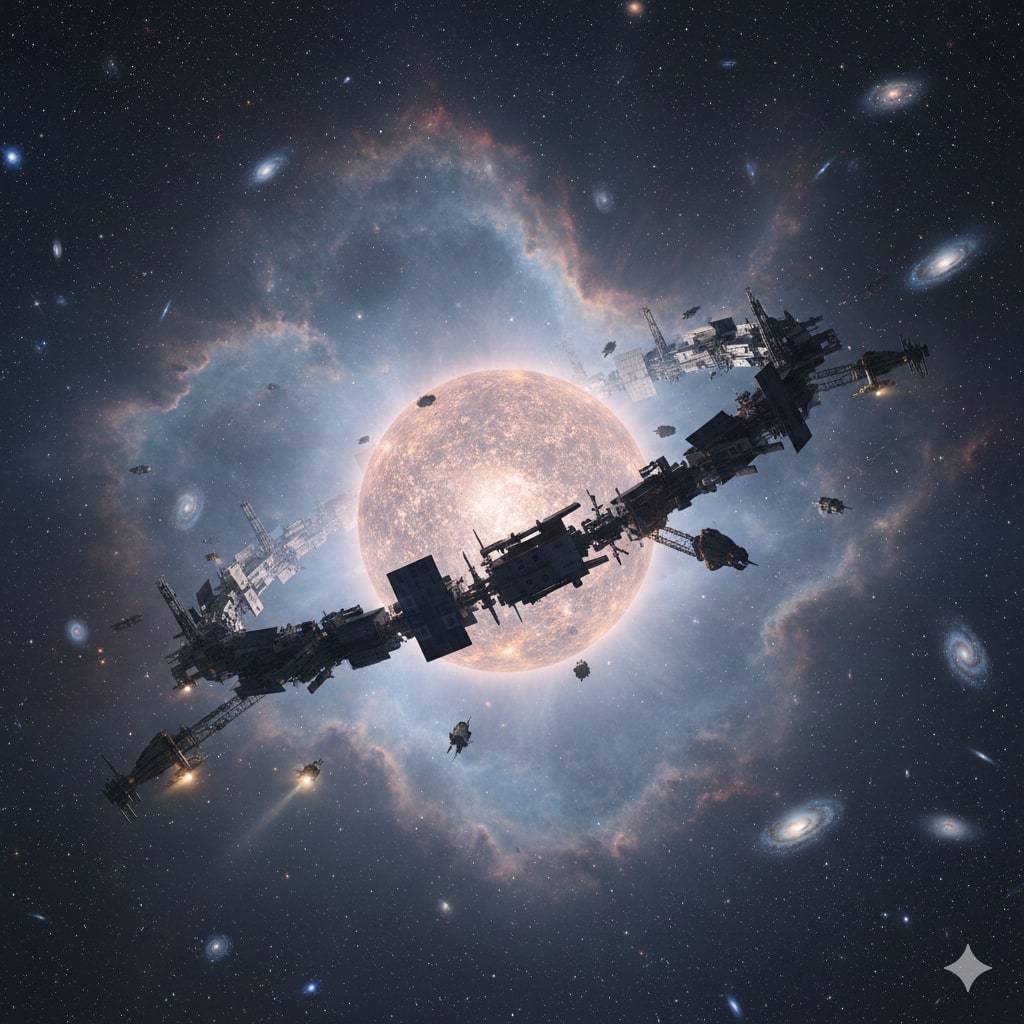
It’s a story straight out of science fiction, but it’s completely real. In 2015, the Kepler telescope stumbled upon something baffling on a potentially habitable star named KIC 8462852. This star, which sits just above the Milky Way between the constellations Cygnus and Lyra, is also known as Tabby’s Star after its discoverer, Yale University’s Tabetha Boyajian.
What made Tabby’s Star so famous? It was emitting a light pattern stranger than anything else around it. It seemed that something was causing highly erratic fluctuations and major dimming in the light coming from the star. The light would drop by as much as 20% in just a few days!
The Unsolved Mystery Deepens
The initial discovery sparked wild speculation. Many researchers wondered if the star was surrounded by some kind of alien megastructure. Some even raised the possibility that an advanced alien civilisation might be intentionally sending us signals.
So far, the mystery remains unsolved, and it’s only gotten weirder. As much as researchers have tried to find a more rational, non-alien cause, the data keep challenging the conventional theories.
Earlier studies by astronomer Bradley Schaefer had suggested that the star’s light had dimmed by almost 20% over the past century. While some researchers were sceptical of these historical observations, a new report by Caltech’s Ben Montet and the Carnegie Institute’s Joshua Simon found a similar trend in more recent, high-precision data.
By studying images from the Kepler telescope, Montet and Simon found that the brightness of Tabby’s Star had gone down by about $0.34%$ per year over a 1,000-day period since 2009. For the next 200 days, the star dimmed even more rapidly, decreasing by another $2.5%$. They even checked 500 other stars in the proximity and found no similar behaviour.
Montet noted that the most surprising part was “just how rapid and nonlinear it was.” The rate at which the star is dimming cannot easily be explained by the current, non-alien theories, such as a swarm of comets passing by or a warped star.
The Dyson Sphere Theory
If an exotic, non-natural explanation is required, the idea of an alien construction seems to make sense.
One key piece of speculation suggests the dimming is caused by a Dyson Sphere or a similar massive alien megastructure.
- What is a Dyson Sphere? It’s a hypothetical concept first fully explored by physicist and mathematician Freeman Dyson in a 1960 paper. It suggests that once a civilisation becomes technologically advanced enough, its energy needs would escalate dramatically.
- The Concept: To meet these colossal needs, they would construct a system of orbiting structures (sometimes called a Dyson swarm) that would act like a shell to collect all the energy produced by their star.
The phenomenon astronomers are observing on Tabby’s Star, massive, erratic dimming, was actually described in many sci-fi novels as the effect a Dyson Sphere (or swarm in more realistic interpretations) would cause as it was being constructed or passing in front of the star.
As astronomer Jason Wright of Penn State once told The Atlantic, “Aliens should always be the very last hypothesis you consider, but this looked like something you would expect an alien civilisation to build.”
The Search Continues
The good news is we may not have to wait too long for more answers. Tabetha Boyajian, the star’s original discoverer, led a successful crowdfunding campaign that secured observation time at the Las Cumbres Observatory Global Telescope Network. This will allow researchers to observe the star for a full year and hopefully catch a dip in brightness as it happens.
Do you think this strange phenomenon is caused by a passing cloud of comets, or do you believe we are witnessing the construction of a massive alien megastructure?
About the Creator
Areeba Umair
Writing stories that blend fiction and history, exploring the past with a touch of imagination.
Keep reading
More stories from Areeba Umair and writers in FYI and other communities.
7 Materials That Defy the Laws of Physics
There are tons of scientific laws out there. You’ve heard of them: Kepler’s Laws of Planetary Motion, the Universal Law of Gravitation, Newton’s Laws of Motion, you get the idea. But let’s be honest, very few of us can actually recite what those laws state word for word. We mostly remember the basics, like what goes up must come down, or that extreme heat usually makes things melt.
By Areeba Umairabout a month ago in FYI



Comments
There are no comments for this story
Be the first to respond and start the conversation.