
The Man Who Survived Two Atom Bombs
Recognized as ‘nijyuu hibakush’ or ‘double bombed’ man

Imagine going through a sad and depressing heartbreak. The person you loved the most was cheating on you. You feel betrayed. You go through a rollercoaster of emotions, sometimes blaming yourself for the unfortunate incident.
But as days pass by, you muster enough courage to fall in love again. And then, you are dumped again. That's the final nail in the coffin of trust and faith. All your belief system is shattered. You give up hope and don’t think you can love again.
Now replace heartbreak with an atom bomb, yes you read it correctly, an atom bomb. Try to imagine what you will go through when you survive one bombing, only to be hit by another.
Only a few humans in the entire history of the earth would have ever endured such a traumatic experience twice, and Tsutomu Yamaguchi was one of the very few who encountered the horror of both blasts and lived to tell the tale.
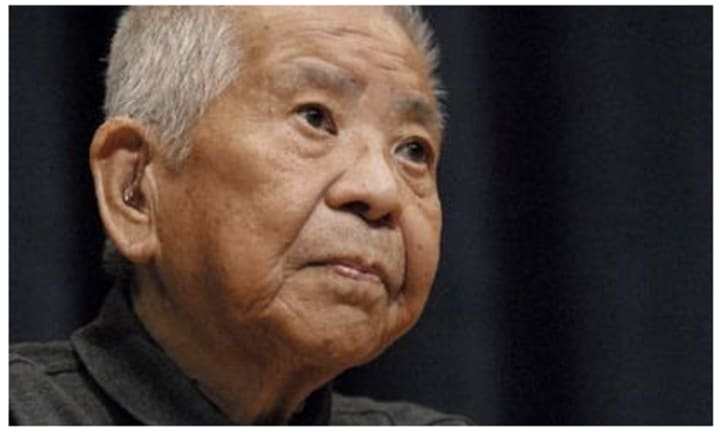
Tsutomu was a 29-year-old naval engineer, who was in Hiroshima on a 3-month long business trip for his employer, Mitsubishi. And August 6, 1945, was supposed to be his last day in the city after designing a 5,000-ton tanker for Mitsubishi. He was eagerly looking forward to finally returning home to his wife, Hisako, and their infant son, Katsutoshi.
Around 8:15 that morning, Yamaguchi was walking to Mitsubishi’s shipyard a final time when he heard the drone of an aircraft overhead. Looking skyward, he saw an American B-29 bomber soar over the city and drop a small object connected to a parachute. Suddenly, the sky erupted in a blaze of light and he had just enough time to dive into a ditch before an ear-splitting boom rang out.
“It was very clear, a really fine day, nothing unusual about it at all. I was in good spirits. As I was walking along, I heard the sound of a plane, just one. I looked up into the sky and saw the B-29, and it dropped two parachutes. I was looking up into the sky at them, and suddenly … it was like a flash of magnesium, a great flash in the sky, and I was blown over,” he later explains
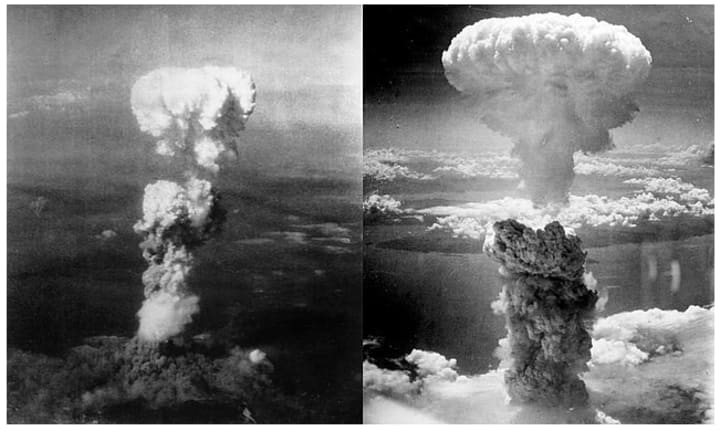
The “Little Boy” had completely destroyed the city. It detonated with an estimated 15,000 tons of TNT, destroying five square miles of the city and directly killing some 70,000 people.
When he opened his eyes, it was completely dark. The blast had kicked up enough dust and debris to nearly blot out the morning sun. The once clear blue sky had turned into an inky shade of purple and grey.
Yamaguchi was surrounded by torrents of falling ash, and he could see a mushroom cloud of fire rising in the sky over Hiroshima. His face and forearms had been badly burned, and both his eardrums were ruptured.
After spending a restless night in an air-raid shelter, he woke up on August 7 and made their way toward the train station, which they had heard was somehow still operating. As this article explains, the journey took them through a nightmarish landscape of still-flickering fires, shattered buildings, and charred and melted corpses lining the streets.
Many of the city’s bridges had been turned into twisted wreckage, and at one river crossing, Yamaguchi was forced to swim through a layer of floating dead bodies. Upon reaching the station, he boarded a train full of burned and bewildered passengers and settled in for the overnight ride to his hometown of Nagasaki.
Yamaguchi arrived in Nagasaki early in the morning on August 8 and limped to the hospital. The doctor who treated him was a former school classmate, but the blackened burns on Yamaguchi’s hands and face were so severe the man didn’t recognize him at first. Neither did his family. He returned home afterward, feverish and swaddled in bandages.
On Aug. 9, Yamaguchi dragged himself out of bed and headed to Mitsubishi offices in Nagasaki to hand in his assignment. When he arrived, he told his boss about the strange new bomb that had evaporated parts of Hiroshima, but the boss, writes Sam, didn’t believe him.
“You’re an engineer,” he barked. “Calculate it. How could one bomb…destroy a whole city?”
At the very moment, the landscape outside exploded with another iridescent white flash. Yamaguchi dropped to the ground just seconds before the shock wave shattered the office windows and sent broken glass and debris careening through the room.
His bandages were blown off, and he was hit by yet another surge of cancer-causing radiation, but he emerged relatively unhurt. For the second time in three days, he’d had the misfortune of being within two miles of a nuclear explosion. For the second time, he’d been fortunate enough to survive.
In the next few days, the double dose of radiation took its toll. In his book, The Violinist’s Thumb, Sam Kean, describes what could have happened next. In the short run, DNA damage creates radiation sickness, headaches, vomiting, internal bleeding, peeling skin, anemic blood, and all that happened to Mr. Yamaguchi. His hair fell out, the wounds on his arms turned gangrenous, and he began vomiting incessantly.
Yet unlike so many victims of radiation exposure, Yamaguchi slowly recovered and went on to live a relatively normal life. He served as a translator for the U.S. armed forces during their occupation of Japan and later taught school before resuming his engineering career at Mitsubishi.
He was recognized by the Japanese government as ‘nijyuu hibakush’ or as the ‘double bombed’ man. He died in 2010 at the age of 93.



Comments
There are no comments for this story
Be the first to respond and start the conversation.