
The Invisible Force of Water: Understanding Surface Tension
How Water Holds a Fly, Floats a Needle, and Keeps Us Breathing
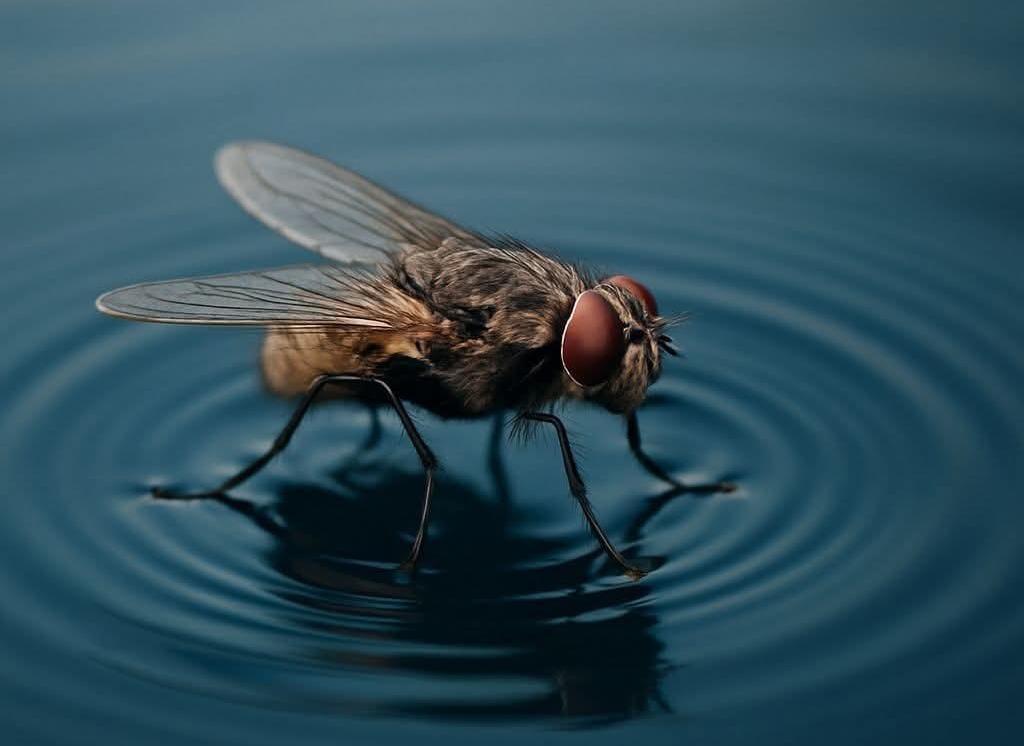
Have you ever wondered how a drop of water can hold a fly on its surface? Or why a tiny sewing needle, despite being made of iron, floats on water? At first glance, these phenomena may seem magical or strange. But behind these everyday wonders lies a fascinating scientific principle: surface tension.
What is Surface Tension?
Surface tension is the invisible but powerful force that acts on the surface of liquids—most commonly water. To understand this, let’s zoom in to the molecular level. Every molecule in a liquid pulls on its neighboring molecules due to cohesive forces—the natural tendency of like molecules to stick together.
In the middle of the liquid, these cohesive forces are balanced in all directions. But at the surface, it's a different story. Molecules at the top have no liquid molecules above them, only air. As a result, they experience a stronger pull inward from the molecules below and beside them. This unbalanced force creates a sort of "skin" on the liquid's surface—a thin, elastic-like layer that resists external force. This is what we call surface tension.
Why Are Water Droplets Spherical?
One of the most common and beautiful examples of surface tension is the shape of water droplets. Why are they round? Because a spherical shape has the smallest possible surface area for a given volume. Surface tension naturally tries to minimize the surface area, so water droplets form into nearly perfect spheres.
Next time you see a raindrop hanging delicately on a leaf, know that it’s not just gravity or beauty at play—it’s science working silently through surface tension.
How Does It Work in Real Life?
Surface tension can be observed in several real-world scenarios:
Floating a Needle: A metal needle is denser than water, so it should sink. But if placed gently, the surface tension keeps it afloat by creating a dip on the surface—like a tiny trampoline holding it up. Break that tension with soap or detergent, and the needle will immediately sink.
Water Strider Insects: Some insects like water striders can actually walk on water. Their long legs distribute their weight evenly and don’t break the surface tension, allowing them to "skate" across ponds and streams.
Droplet Formation: When water flows out of a tap, it doesn’t come out in a smooth stream forever. Instead, it forms droplets that fall one by one. Each droplet is a mini marvel of surface tension striving to maintain a balanced form before falling due to gravity.
Wicking in Plants: Plants use surface tension to pull water from the roots to their leaves through thin tubes (xylem). This is part of a larger process called capillary action, which wouldn't be possible without surface tension.
Surface Tension in Human Biology
The importance of surface tension isn't limited to physics or nature—it plays a crucial role in human biology, especially in the lungs. Our lungs contain tiny air sacs called alveoli, where oxygen and carbon dioxide are exchanged. These alveoli are lined with a thin film of liquid.
If surface tension in this film were too high, the alveoli would collapse, making breathing nearly impossible. Thankfully, our lungs produce a substance called surfactant that reduces surface tension, allowing the alveoli to expand and contract easily with each breath.
In premature babies, the lungs are often underdeveloped and don’t produce enough surfactant. This is why they may struggle to breathe on their own. In such cases, doctors administer artificial surfactant to help the lungs function properly. It’s a lifesaving application of understanding and managing surface tension.
Breaking Surface Tension: The Role of Detergents
You might have noticed that when you add soap to water, it spreads more easily and quickly wets surfaces. That’s because soaps and detergents reduce surface tension. These substances interfere with the cohesive forces between water molecules, making the surface "weaker" and allowing it to spread out.
This is incredibly useful for cleaning, as it allows water to penetrate dirt, grease, and fabrics more effectively. It's also why you can't float a needle or hold a water droplet on a greasy or soapy surface—the surface tension has been compromised.
Conclusion
Surface tension is an invisible force with visible effects. It shapes our world in ways most of us never notice—from water droplets on a flower to the very act of breathing. It’s a perfect example of how seemingly simple things are actually supported by deep and intricate science.
The next time you see a floating insect, a drop of water, or breathe without difficulty, take a moment to appreciate the silent but powerful role of surface tension. Whether in nature, in science labs, or within our bodies, it is a force that keeps things together—literally and figuratively.
About the Creator
Keep reading
More stories from Ikram Ullah and writers in FYI and other communities.
Stealth Technology and Quantum Radar: From Atom to Atom!!
Stealth Technology and Quantum Radar: From Atom to Atom!! By: Ikram Ullah Gone are the days when wars were fought on horseback with spears, and soldiers faced each other eye to eye while historians later turned a blind eye to the truth. Modern warfare has transitioned into a battlefield of advanced technology—where soldiers have been replaced by computers, cannons by code, and horses by stealth aircraft that vanish from enemy radars as easily as merit disappears in bureaucracy or truth evades an Indian military press conference. These aircraft emit no sound, leave no shadow—much like an electoral promise or a relative who borrows money and then disappears on a pilgrimage.
By Ikram Ullah8 months ago in FYI
Miss Persephone's Manual to a Seemingly Ordinary Life
Miss Persephone was found at the dining table, her blue eyes swollen, her tears arriving and retreating like the tides of the ocean. Earlier that day, her family had visited her in the retirement home where she had lived for eight years. It was her eightieth birthday.
By Imola Tótha day ago in Fiction


Comments (3)
Surface tension is really interesting. I remember trying to float a needle when I was a kid. It was amazing how it stayed on top. And those water droplets being spherical makes sense now that you explained the surface area thing. Do you think there are other liquids with even stronger surface tension than water?
Surface tension is really interesting. I remember trying to float a paperclip on water as a kid. It was cool to see it stay on top. You explained how it works well. But how does adding soap break the surface tension so quickly? And are there other liquids with even stronger surface tension than water?
good writing