
THE HIDDEN CELLAR OF WHITEHALL
Concealed under the Ministry of Defence in Whitehall is an unexpected survivor

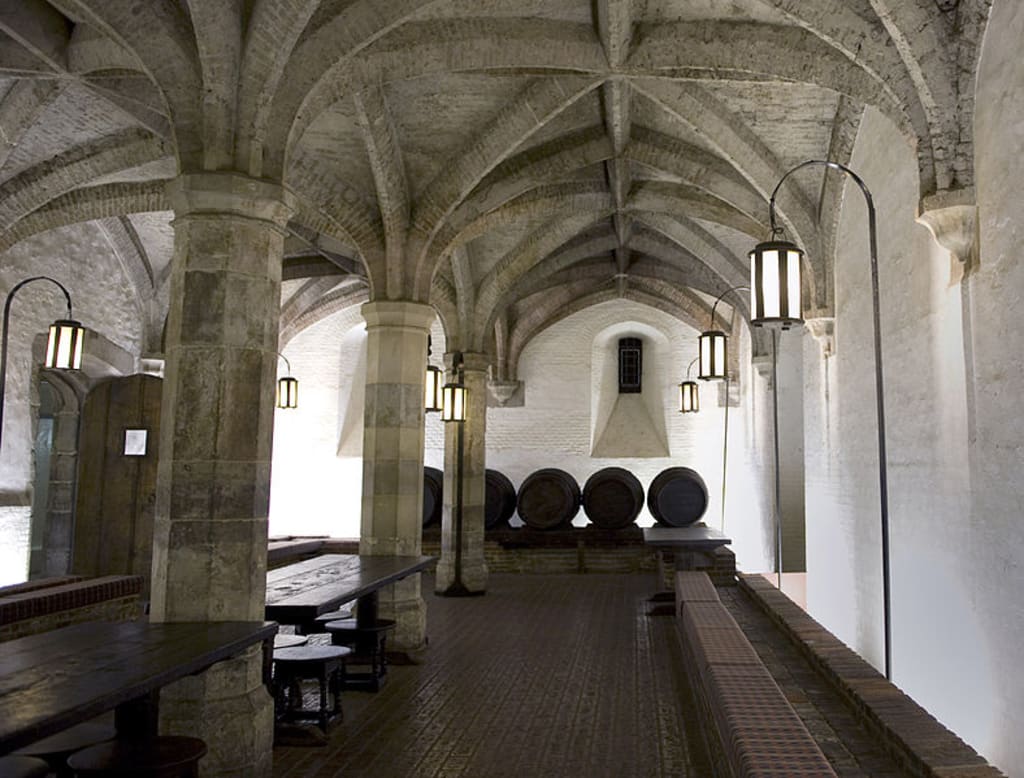
The Wine Cellar of Henry VIII is one of the few remaining pieces of Whitehall Palace, the principal London home of kings and queens of England for over one-hundred and fifty years.
Now, Whitehall is the name of a road linking Parliament Square to Trafalgar Square. Covering more than 93,000 square metres. And with over fifteen hundred rooms, Whitehall was the largest palace in Europe, even bigger than the Vatican.
Henry VIII moved to Whitehall after the royal apartments at the Palace of Westminster were damaged by a fire. The palace stretched over much of the area bounded by Northumberland Avenue to Downing Street.
The Palace was the principal residence of English monarchs from 1530 until 1698. But when most of its buildings, except Inigo Jones’s Banqueting House of 1622, were devastated by fire. But Henry VIII’s Wine Cellar is one of the few parts of Whitehall Palace that still survives today. The amazing Tudor brick-vaulted cavern built in 1536 is seventy feet long and thirty feet wide and is impeccably conserved under the current Ministry of Defence building.
Whitehall became a royal palace when Henry VIII seized York Place from Cardinal Wolsey. Wolsey was the Archbishop of York whose London seat was York Place. When Wolsey failed to get Henry’s marriage to Katherine of Aragon annulled, Henry was not a happy man. Wolsey’s property became forfeit to the Crown and Henry got his hands on York Place and Hampton Court Palace. Henry then spent enormous amounts of money developing it. It became known as Whitehall after the white stone used for the great hall. Henry married Anne Boleyn at Whitehall in 1533. And then Jane Seymour in 1536. He died there in 1547.
There was a large fire in 1691, then a disastrous one in 1698. It was said nothing, but walls and ruins were left. The only noteworthy parts of the palace to survive intact were the Banqueting House and Henry’s Wine Cellar.
When renovation to the Ministry of Defence was required in the 20th Century, b Queen Mary requested provision be made for the preservation of the Wine Cellar. When the renovation was resumed after the war, they couldn’t dismantle it because the Tudor brick was too soft. So, they dug around it and encased the entire room in concrete and steel and moved it nine feet to the west and nineteen feet deeper. This process was carried out without any substantial damage to the structure and it now rests within the basement of the building.
It was a remarkable bit of engineering. It took ninety men eighteen months, according to a parliamentary response at the time.
It was incredible the Cellar survived. Not only were the buildings above it was burnt to the ground several times by fire in the 16th and 17th centuries. There were also major developments in the18th and 19th centuries.
Sadly, not many people get to see the cellar because of its position in the bowels of the Ministry of Defence building. Special permission is needed to view it and there are strong security procedures in place.
Over years speculation has grown about what sort of wines were stored there. There was no shortage of vineyards in those days, but it’s presumed the Tudors would have made sure most of the wines would have come from France.
Entering the wine cellar today is like tumbling into a time capsule. In the depths of the building where battles are calculated and nuclear strategies are discussed. Bar a small bit of restoration and a lick of white paint on the walls. It recreates the atmosphere of a long-gone age.
About the Creator
Paul Asling
I share a special love for London, both new and old. I began writing fiction at 40, with most of my books and stories set in London.
MY WRITING WILL MAKE YOU LAUGH, CRY, AND HAVE YOU GRIPPED THROUGHOUT.
paulaslingauthor.com
Keep reading
More stories from Paul Asling and writers in FYI and other communities.
THE REGENT’S PARK TRAGEDY
The start of January 1867 was extremely cold throughout England and skaters all over the country were enjoying themselves on rivers and frozen lakes. At that time, Regent’s Park incorporated a zoo, gardens, paths for horse riding, and an ornamental lake. There was also a lake for boating. In freezing winters, when the lake froze over, it became a location for skating.
By Paul Asling4 years ago in FYI
Why Structural Components Are Critical in Aircraft Design
Aircraft design is a meticulous balance between engineering precision, safety, and performance. Every part of an airplane—from its wings to its fuselage—relies on structural components that must withstand extreme stresses while minimizing weight. Understanding the role of these components helps explain why aircraft are both remarkably strong and incredibly efficient.
By Beckett Dowhan4 days ago in FYI
A Transparent Look at Vocal Challenges and Top Stories
Almost three years ago, we shared a resource article that served as a place for people to suggest new challenge prompts. We thought it would be a good idea to refresh that thread, and take the opportunity to answer a few common questions about top stories, how challenges are judged and how submissions are reviewed.
By Vocal Curation Team3 days ago in Resources


Comments
There are no comments for this story
Be the first to respond and start the conversation.