
"The evolution of international single-seater racing: FORMULA 1"
"The growing interest in this sport."
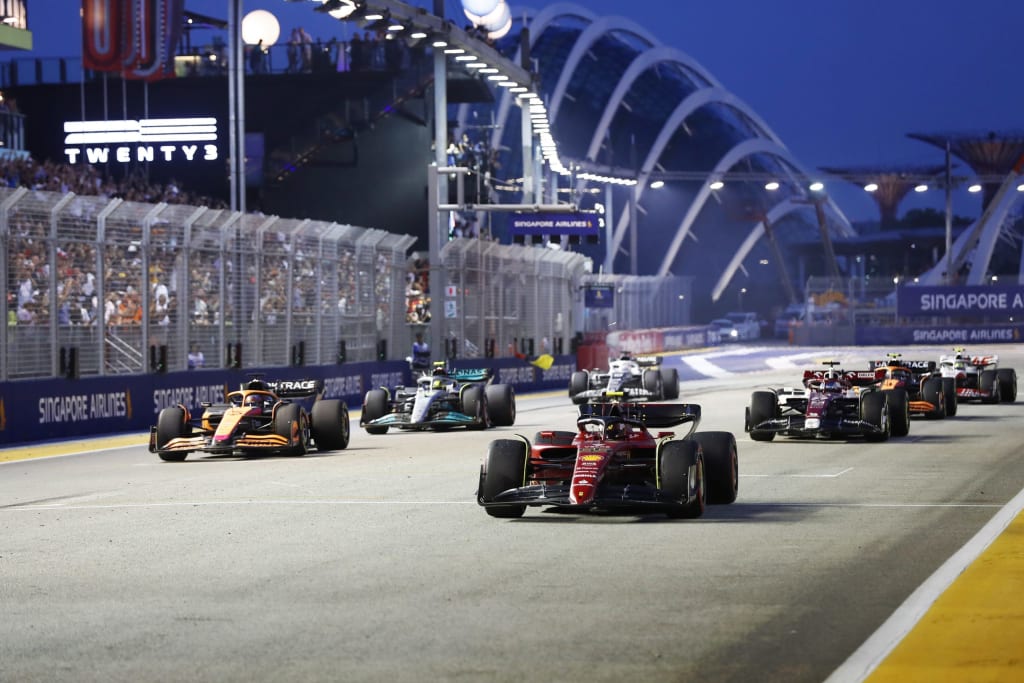
Formula 1, often abbreviated as F1, is a highly prestigious and popular type of car racing worldwide. In Formula 1, drivers pilot specially designed racing cars known as "monopostos" or "single-seaters." Here are some key points to remember:
Formula cars: These are ultra-fast and technologically advanced racing cars designed to be lightweight, aerodynamic, and powerful. Formula 1 teams invest significant amounts of money to make their cars as fast as possible.
Drivers: Formula 1 drivers are among the best in the world. They are highly skilled, brave, and competitive. F1 attracts some of the most renowned athletes.
Races: Formula 1 organizes a series of races throughout the year, called Grand Prix, on special circuits around the world. These races take place on tracks ranging from city circuits to traditional racetracks.
Speed: Formula 1 cars can reach incredibly high speeds, well beyond what you'll see on the road. They are capable of exceeding 300 km/h (186 mph).
Competition: Formula 1 is highly competitive. Teams compete to win the World Constructors' Championship, while drivers vie for the World Drivers' Championship.
Technology: F1 serves as an innovation laboratory for the automotive industry. Many technologies developed in F1 end up being used in everyday cars.
In summary, Formula 1 is a high-level motorsport where talented drivers pilot ultra-fast racing cars in exciting races on circuits around the world. It's a sport that blends cutting-edge technology, speed, and intense competition.
The concept of single-seater car racing dates back to the early decades of the 20th century (1900-1940). However, these races were often unregulated and dangerous. During this period, car manufacturers and drivers participated in various single-seater races, but there was no official world championship.
After World War II (1940-1950), there was growing interest in creating a global-level single-seater racing championship. In 1950, the Fédération Internationale de l'Automobile (FIA) organized the first Formula 1 World Championship, consisting of seven races. Italian driver Giuseppe Farina won the inaugural championship, and Alfa Romeo was crowned the World Constructors' Champion.
The 1950s and 1960s were marked by legendary drivers like Juan Manuel Fangio and Stirling Moss. The cars were powered by powerful naturally aspirated internal combustion engines. It was a dangerous era with many fatal accidents.
The transitional years (1970s-1980s) saw technological advancements with the introduction of turbocharged engines and more advanced aerodynamics. Iconic drivers like Niki Lauda, James Hunt, and Ayrton Senna became Formula 1 legends.
The modern era (1990s-present): The 1990s saw the rise of Michael Schumacher, one of the greatest drivers of all time. Cars continued to evolve with increasing automation and improved safety. In the 21st century, drivers like Lewis Hamilton and Sebastian Vettel have dominated the sport.
Technological aspect: Formula 1 has become a hub of innovation for the automotive industry, with technological developments such as Kinetic Energy Recovery Systems (KERS) and turbocharged hybrid power units (PU).
Global broadcast: Formula 1 races are broadcast worldwide, making it one of the most popular sports. Teams are supported by significant sponsors and investors.
Competition: Formula 1 remains one of the most competitive sports in the world, with teams competing for the World Constructors' Championship and drivers for the World Drivers' Championship.
Today, Formula 1 stands at the forefront of automotive technology, with incredibly fast cars and talented drivers, while continuing to be a global sport followed by millions of fans worldwide.
Furthermore, Formula 1 is considered the highest class of international single-seater racing for several reasons:
Advanced Technology: Formula 1 cars are among the most technologically advanced in the world, with constant innovations in engines, aerodynamics, electronics, and materials. This attracts the attention of engineers and technology enthusiasts.
Top Drivers: Formula 1 brings together some of the best racing drivers in the world. F1 drivers are highly skilled, competitive, and often regarded as elite athletes.
Global Visibility: Formula 1 is followed by millions of fans worldwide. Races are broadcast in many countries, making it a major media platform for sponsors and teams.
History and Tradition: Formula 1 has a long and rich history dating back to the 1950s. Iconic Grand Prix races like Monaco, Silverstone, and Monza are part of the sport's heritage.
Significant Investments: Formula 1 teams benefit from substantial budgets, allowing them to develop cutting-edge cars and hire top-level drivers.
International Competition: Formula 1 is truly international, with teams, drivers, and races from various countries. This creates a unique global competition.
These factors contribute to making Formula 1 the highest class of single-seater racing and one of the most prestigious sports disciplines in the world.
About the Creator
Keep reading
More stories from writers in FYI and other communities.




Comments (1)
Great Article 👍📝💯