
The Early History of Jet Fighters
It's almost 80 years since jet fighters were first used in warfare - here's a brief history of those far off flights

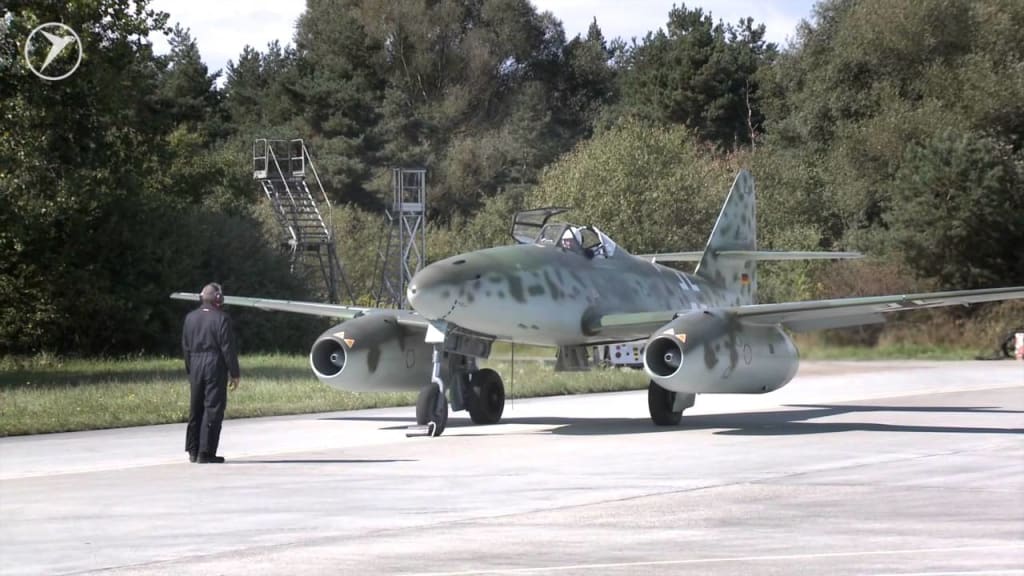
My stories are often triggered by books, and a novel I read recently sent me off into the early world of jet fighters. The book is 'Angel, Archangel' by Nick Cook, who was a heavyweight aviation defence journalist in his early career.
This story is about the so-called first generation of jet fighters. It's a great read cleverly weaving fact and fiction. There's quite a lot about the Russian army and the invasion of Germany from the East. Recommended, no affiliation.
The beginnings
Who invented the jet engine?
A British engineer, Frank Whittle, who took out a patent on his design in 1930. The rest is history as they say, and here's a potted version.
The first to fly
In the late 1930s and early 1940s several countries began experimenting with jet propulsion. One of the earliest jet-powered aircraft to fly was the German Heinkel He 178, which made its maiden flight in 1939.
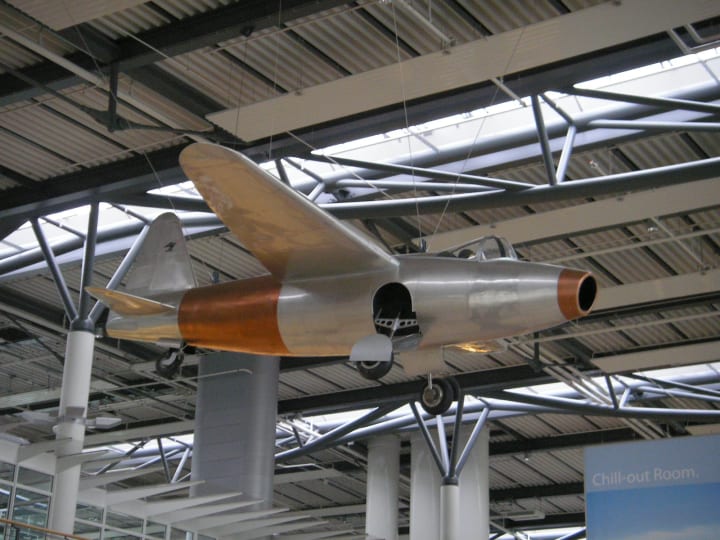
The Heinkel He 178 was designed as a single-engine, low-wing monoplane with a bubble canopy. It was powered by a single Heinkel HeS 3 turbojet engine.
Although the He 178 was an important milestone in the history of aviation, it was never mass-produced. Its successful flight demonstrated the feasibility of jet propulsion and helped to establish the foundation for the development of the jet-powered fighters that would play a significant role in air combat during World War II and beyond.
Britain was some way behind due to contractual issues over Whittle's engine.
However, it was the Messerschmitt Me 262, which entered service in 1944, that is widely considered to be the first operational jet-powered fighter aircraft, although the Gloster Meteor was not far behind. To my eye, the ME262 has a distinctive shark-like appearance.
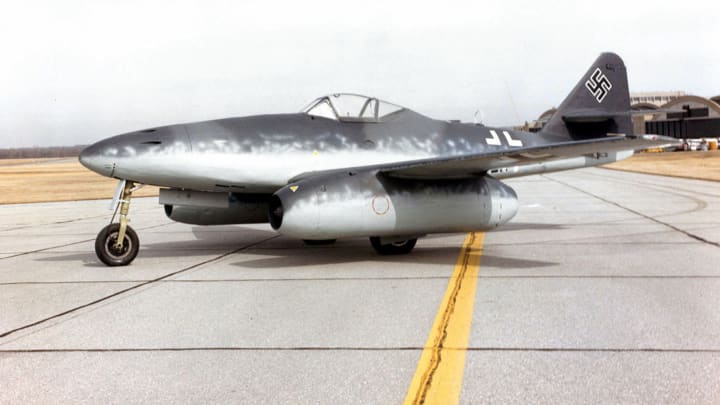
The German Me 262 was used primarily as a fighter and attack aircraft against bombers, while the British Gloster Meteor - distinctly less shark-like in appearance - was used primarily for reconnaissance missions in WW2, although they first saw service successfully countering the V1 'flying bombs'.
A night-fighter version of the Meteor was developed later during the Korean War.
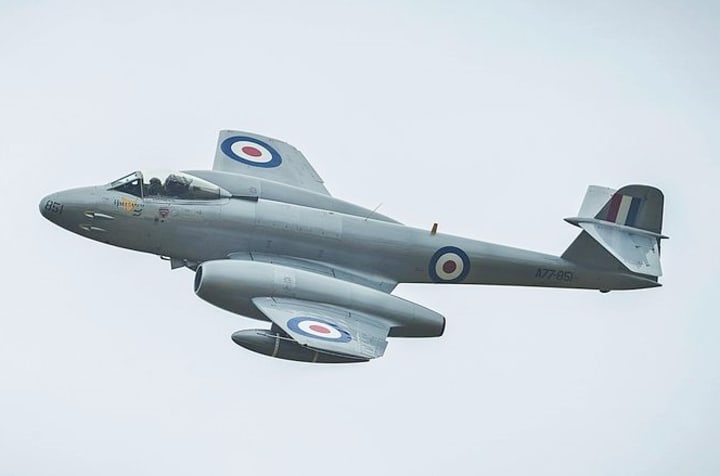
Both of these aircraft represented significant advancements in aviation technology, as they were capable of much higher speeds and altitudes than their propeller-driven counterparts. The ultimate Meteor version, the F8, was capable of 600 mph with a ceiling of 43,000 feet and widely used in the Korean War. The ME262 flew at 530 mph with a ceiling of 38,000 feet.
Engine differences
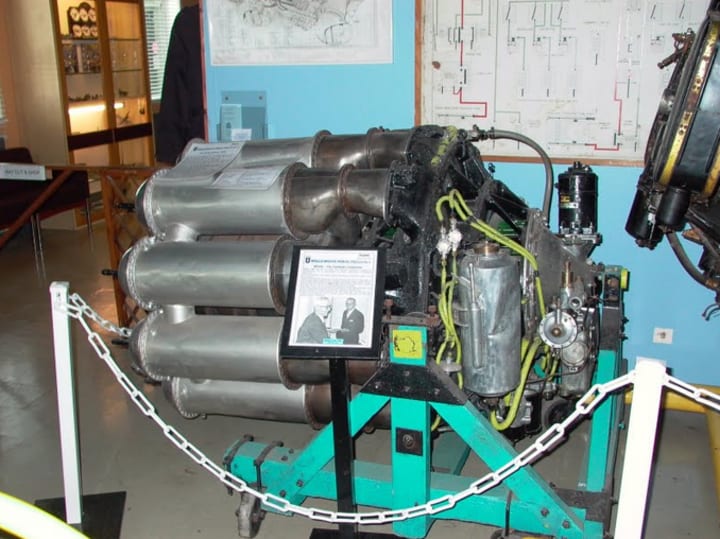
The main difference in engine design between the Me 262 and the Meteor was that the Me 262 was powered by two Junkers Jumo 004 axial-flow turbojet engines while the Meteor was powered by two Rolls-Royce Welland turbojet engines.
The Jumo 004 engines used in the Me 262 were more advanced than the Welland engines in the Meteor and provided higher thrust, but were also more complicated to manufacture and maintain. The Welland engines in the Meteor, on the other hand, were simpler and more reliable but generated less thrust compared to the Jumo 004 engines.
However, the production of the Jumo 004 engines was hampered by a shortage of strategic metals such as nickel, cobalt and chromium, which were critical components in the manufacture of the engines. As a result, some of the engine components were made with substitute materials that were of lower quality and less durable. Mild steel coated with aluminium was used extensively. This led to an increased likelihood of engine failures, particularly in the high-stress war-time operational environment. The engine failures not only affected the performance of the Me 262, but also led to a high rate of aircraft losses and reduced its operational effectiveness.
Axial versus centrifugal compressor design
The Junkers Jumo 004 and the Rolls-Royce Welland were both turbojet engines, but they differed in design and operation.
The Jumo 004 was an axial-flow turbojet engine, which means that the air entered the engine at the front and was compressed as it flowed axially through the compressor blades before entering the combustion chamber. The compressed air was then mixed with fuel and ignited to produce hot gases that expanded through the turbine blades and exited through the nozzle at the rear, providing thrust to the aircraft. This is where the strategic materials were critical.
The Welland, on the other hand, was a centrifugal-flow turbojet engine, where the air entered the engine at the front and was accelerated radially outward through the compressor blades to a much higher speed before entering the combustion chamber. The compressed air was then mixed with fuel and ignited to produce hot gases that expanded through the turbine blades and exited through the nozzle at the rear, providing thrust to the aircraft.
The main difference between these two types of engines is in the way that the air is compressed and the shape of the engine. Axial-flow engines are typically longer and have more stages of compression than centrifugal-flow engines, which are shorter and wider. Axial-flow engines are generally more efficient at high altitudes and high speeds, while centrifugal-flow engines are simpler and easier to manufacture, making them more reliable and well-suited for lower-altitude, lower-speed operations.
New engagement tactics
The Me 262 was so fast that German pilots needed new tactics to attack Allied bombers. In the head-on attack, the combined closing speed of about 320 m/s (720 mph) was too high for accurate shooting with ordnance that could only fire about 650 rounds/min from each cannon, (~44 rounds/sec in total from the quartet of cannon). Even from astern, the closing speed was too great to use the short-ranged quartet of MK 108 cannon to maximum effect.
A roller-coaster attack was devised, the Me 262s approached from astern and about 1,800 m higher (5,900 ft) than the bombers. From about five km behind (3.1 mi), they went into a shallow dive that took them through the escort fighters with little risk of interception as they were so fast. When they were about 1.5 km astern (0.93 mi) and 450 m (1,480 ft) below the bombers, they pulled up sharply to reduce speed. On levelling off, they were one km astern (1,100 yd) and overtaking the bombers at about 150 km/h (93 mph), well placed to attack them. (Wikipedia)
After World War 2
The end of World War 2 marked the beginning of the Cold War, and this period saw rapid advancements in jet fighter technology, with the Korean War seeing the first large scale jet fighter confrontations.
There were several models of jet fighters used in the Korean War:
- Mikoyan-Gurevich MiG-15: The MiG-15 was the primary fighter aircraft used by the North Korean and Soviet air forces.
- North American F-86 Sabre: The F-86 was the primary fighter aircraft used by the United States Air Force and its allies
- Lockheed F-94 Starfire: The F-94 was an all-weather interceptor aircraft used by the United States Air Force
- Grumman F9F Panther: The F9F was a jet-powered fighter aircraft used by the United States Navy
- Gloster Meteor: The Meteor was used by the Royal Australian Air Force
Two particularly stand out - the USSR's MIG 15 and the USA's F-86 Sabre.
MiG 15
The Mikoyan-Gurevich MiG-15 was a Soviet jet fighter aircraft developed in the late 1940s. It was one of the first successful jet-powered fighters and became one of the most widely produced fighter aircraft in history, with approximately 12,000 built. It was the first successful swept wing jet fighter.
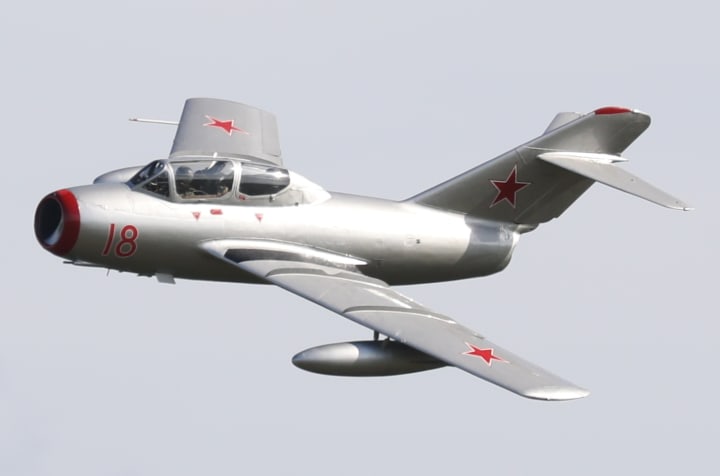
The MiG-15 was powered by a single Soviet-designed Klimov RD-45 engine. These were basically rip-offs of the Rolls Royce Nene engine, several of which had been sold to the USSR for 'peaceful purposes' by the UK government.
Despite its many advantages, the MiG-15 was not without its problems. One of the biggest challenges that the aircraft faced was a limited range. The early models of the MiG-15 were only capable of flying for a few hours, which made them unsuitable for long-range missions. Additionally, the aircraft was difficult to fly and required a high level of skill from its pilot. This was due in part to the powerful engine and high speed of the aircraft, which put significant stress on the airframe and made the aircraft difficult to control - it was capable of trans-sonic speeds in a dive but pilots were restricted to Mach 0.92. Spin recovery was very difficult.
Nevertheless it was a very successful aircraft and in the Korean War excelled in its prime objective of attacking B-29 bombers.
It was the first Soviet fighter to have an ejection seat.
F-86 Sabre
The North American F-86 Sabre was one of the primary opponents of the MiG-15 during the Korean War and was considered one of the most capable fighter aircraft of its time. Over 9,000 were built.
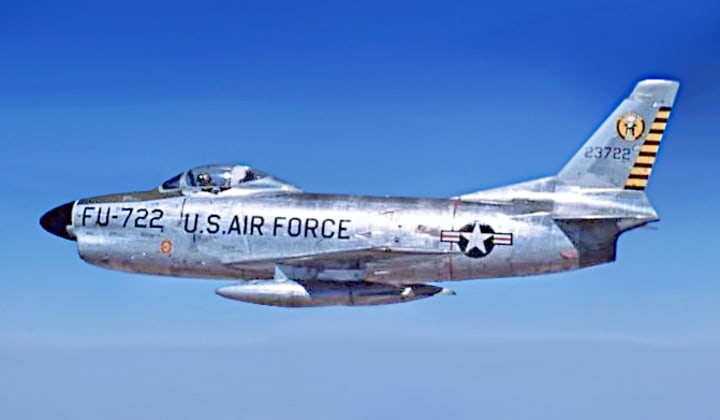
The F-86 was designed by North American Aviation and was powered by a General Electric J47 turbojet engine. The airframe featured a swept-wing design that provided exceptional performance at high altitudes and speeds, making it one of the fastest fighter aircraft of its time.
Its avionics far surpassed those of the MiG 15
Its main problems were:
- Engine Reliability: Early versions of the engine were prone to compressor stalls, especially at high altitudes
- Structural Issues: The F-86's swept-wing design was prone to wing failures, especially at high speeds and design changes were necessary
- Ejection Seat: The F-86's ejection seat was prone to malfunctions, and many pilots were injured or killed when the seat failed to deploy in an emergency
- Fuel System: The aircraft was prone to fuel leaks and fires.
- Early radar systems were unreliable and prone to false readings
Mig 15 and F-86, side by side
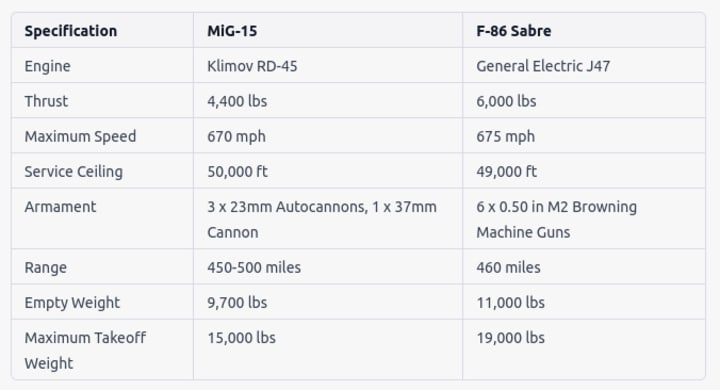
The kill ratio between the F-86 Sabre and the Mig-15 in the Korean War is still argued over. It is widely accepted that the F-86 had a significant advantage over the Mig-15 in aerial combat, with the F-86 scoring a higher number of victories against the Mig-15.
According to some sources*, the F-86 scored a kill ratio of 10:1 against the Mig-15, while others claim that the ratio was closer to 7:1.
The next - Second Generation - of jet fighter
The next major milestone in the development of jet fighters came in the 1960s with the introduction of the supersonic fighter. The Soviet Union was the first to develop a supersonic fighter, but that's another story.
Today
Several generations later, so-called Sixth generation jet fighter-bombers are on the drawing board.
---
*Sources re kill ratio:
- "F-86 Sabre vs Mig-15: Korea 1950–53" by Warren Thompson.
- "The Korean War: A History" by Bruce Cumings.
- "The Korean War: An International History" by W. Stueck.
---
Author's note: The concept, structure, style and creative content in this story are all my own and I hope that is obvious to a reader. I do not employ third party writers. However, I do occasionally use an AI assistant to research and present small sections of factual content and data. All facts are checked where possible and sources quoted.
***

About the Creator
James Marinero
I live on a boat and write as I sail slowly around the world. Follow me for a varied story diet: true stories, humor, tech, AI, travel, geopolitics and more. I also write techno thrillers, with six to my name. More of my stories on Medium
Keep reading
More stories from James Marinero and writers in FYI and other communities.
The Battle of the River Plate
Why this story? I've had an interest in this battle for many years as I knew a man called Jack Lewis, who had served on HMS Exeter as a humble stoker during the battle. Jack was a larger-than-life character whose later careers included being a farmer, a milkman, a scrap merchant and pig-breeder. He always wore wellington boots when I knew him. I had hoped to visit the River Plate one day in my boat, but it looks like the Covid pandemic has now put paid to that plan.
By James Marinero3 years ago in FYI


Comments
There are no comments for this story
Be the first to respond and start the conversation.