
The Difference Between The Halfwit and the Midwit
The dangers of stupidity amongst us.


A while ago in some hippy coffee shop, my friend dragged me to, I heard someone say this quote in passing. It was a familiar one that many so-called “intellectuals” proudly display this quote on their social media profiles or even recite as a clever conversation starter:
“There are some ideas so absurd that only an intellectual could believe them.”— George Orwell
But here’s the twist: George Orwell never actually said this. The real inspiration for this quote comes from his essay Notes on Nationalism.
In that work, Orwell critiques nationalism — specifically, how it manifests in different cultures and political movements. He sharply criticizes the “intelligentsia” of his time, particularly their tendency toward communist nationalism. Orwell concludes one of his paragraphs with:
“One prod to the nerve of nationalism, and the intellectual decencies can vanish, the past can be altered, and the plainest facts can be denied.”
This misattributed quote has become the preface between the halfwit and the midwit. The halfwit — who never bothered to read Orwell, is content with basic instincts. In contrast, the midwit pretends to be well-read, using such quotes as badges of honor, even if they misunderstand the deeper critique embedded within Orwell’s original words.
I recall a heated coffee shop debate where discussions quickly devolved into a chaotic tangle of fervent opinions. Most participants didn’t truly engage with the issues but were fixated on isolated details that confirmed their pre-existing biases.
This opened my eyes to a troubling pattern: while the truly insightful — whether by instinct or through systems thinking — saw the bigger picture, the majority were trapped in minutiae. They represented what we now call midwits: individuals who process information in fragments rather than as an integrated whole.
Understanding the Divide
To truly grasp the danger of midwit thinking, we must first understand what distinguishes a halfwit from a midwit.
The Halfwit
Halfwit is often used pejoratively to describe someone with significantly limited intellectual capacity. A halfwit struggles to see relationships between ideas, relying solely on instinct without any capacity for reflection or learning.
While halfwits are predictable in their simplicity, their actions tend to be driven by basic survival instincts. Their decisions are rarely complex; they rely on immediate, gut-level reactions. As a result, while they might sometimes arrive at the truth by pure chance, their understanding of the world remains fundamentally shallow.
The Midwit
In contrast, a midwit is a person of average intelligence who, thanks to their education and social conditioning, constructs what appears to be a sophisticated system of thought. However, the midwit’s intellect is confined by a rigid adherence to detail. They meticulously inspect every puzzle piece but never attempt to see how those pieces form a larger picture.
This overemphasis on minutiae blinds them to the inherent simplicity that might emerge from instinct or the interconnected complexity that a genius perceives. They tend to respect deductive logic, not out of genuine understanding, but because they fear the “mystery” of how the pieces might be connected — a process they consider akin to conspiracy theory rather than genuine insight.
As I witnessed in my allegory, while the halfwits might be crude in their reasoning, they often rely on instinct and gut feelings that can sometimes be uncannily accurate. Midwits, on the other hand, fall into the trap of overcomplication, convinced that their constant scrutiny of details equates to intellectual superiority — even when it leads them astray.
The Lurking Dangers of Midwit
Reflecting on my experience at that town hall meeting, it became clear that the dangers of midwit thinking are multifaceted. In the allegory, had the midwits dominated the discussion without any challenge from those who saw the forest for the trees, the community could have been led astray by policies based on half-truths and selective data. Here are some potential dangers of midwit thinking drawn from that experience:
1. Fragmented Decision-Making
Midwits focus on individual pieces of information without ever synthesizing them into a coherent strategy. In my allegory, this meant that while every minute detail was passionately debated, no one arrived at a unified understanding of the issue.
This fragmented approach to decision-making can lead to policies that are piecemeal and reactive rather than strategic and comprehensive.
2. Resistance to Novel Ideas
The midwit’s fear of deductive reasoning and the unknown often leads them to reject innovative solutions. They demand hard, indisputable evidence for every claim — a standard that, ironically, stifles creativity and progress.
When confronted with groundbreaking ideas, a midwit’s first reaction is skepticism and dismissal, rather than curiosity or the willingness to explore new perspectives.
3. The Illusion of Mastery
Midwits are often seduced by the act of analysis itself. They become so engrossed in dissecting each component of an argument that they mistake this process for genuine understanding.
The midwit’s confidence in his piecemeal analysis blinded him to the larger, more obvious truths that others — whether geniuses or even wise halfwits — could see.
4. Polarization and Social Fragmentation
In a democratic society, when midwit thinking dominates, policies are tailored to appease the majority of average thinkers. This tendency can lead to the entrenchment of status-quo thinking and hinder progressive reforms.
As midwits form the bulk of the electorate, political discourse becomes polarized, with no room for nuanced debate or the acceptance of alternative viewpoints.
Had the midwits in my allegory been left unchallenged, the resulting decisions might have led to a scenario where societal progress was stalled, and critical issues — ranging from public health to economic policy — were managed by an intellect that, while sufficient in numbers, lacked the necessary depth to see beyond the obvious.
The danger is that such a society, confident in its fragmented understanding, may be vulnerable to manipulation by those who either operate on instinct (the halfwits) or possess genuine systems thinking (the geniuses), yet find themselves sidelined by a populous that is content with superficial analysis.
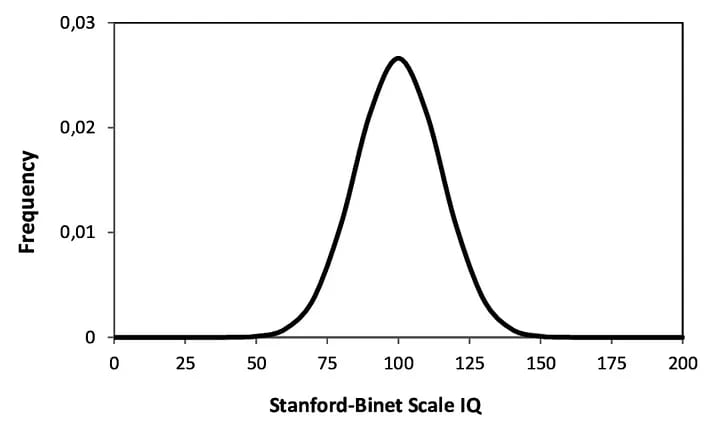
The IQ Bell Curve
At its core, IQ is a Gaussian distribution — a bell curve — that attempts to quantify human intelligence. This statistical model tells us that most people fall squarely in the middle, with only a few outliers on either extreme. In this model, the majority are midwits: individuals of average intelligence who populate the center of the curve.
The Left Tail → The Halfwits
On the lower end of the curve, we find individuals who may be termed halfwits. Their cognitive processing is limited; they cannot connect ideas across different domains.
Their approach is instinctual, and while it can sometimes lead to accurate conclusions, it is generally unsophisticated. Their decisions are immediate, unreflective, and driven by basic needs.
The Center → The Midwits
The vast middle of the bell curve is where midwits reside. These are those competent in routine cognitive tasks and can engage in detailed analysis.
However, their intellect is often marked by an overreliance on data and specifics, without the holistic insight required to see the broader picture. They are adept at processing isolated fragments of information but frequently fail to integrate these into a comprehensive understanding.
The Right Tail → The Geniuses
At the far right of the curve are the geniuses. These individuals possess an extraordinary ability to synthesize information from various domains into coherent, dynamic systems.
The limitations of linear thinking don’t confine the geniuses as it does others. Instead, their minds work in a continuously adaptive manner, open to correction, and driven by a relentless quest for truth — often irrespective of personal ego.
The danger in a society dominated by midwits is that while they represent the majority, their approach to information processing can lead to systemic stagnation.
Their inability to see beyond the immediate details means that innovative ideas and necessary reforms may be dismissed or misunderstood, paving the way for inherently conservative and risk-averse policies.
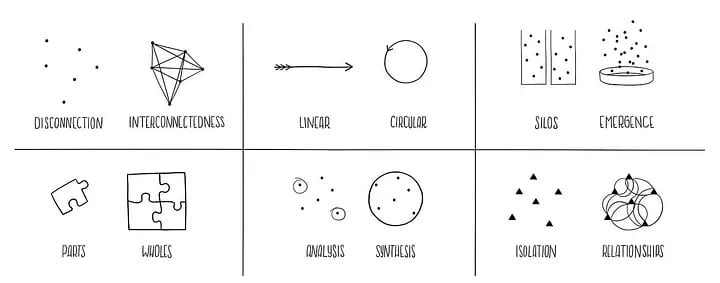
Unlocking True Intellectual Power
What does this all mean for us? The key lesson is not to undervalue the role of instinct and broad, integrative thinking in making sense of our world. While it is tempting for midwits to pride themselves on their detailed analysis and insist on hard evidence, true wisdom lies in connecting the dots. A process that sometimes requires embracing uncertainty and the unknown.
1. Embrace Systems Thinking
The genius does not merely analyze; he builds systems. To overcome the limitations of midwit thinking, we must strive to cultivate an approach that looks beyond isolated data points and sees the interconnectedness of ideas.
This means being open to revising our beliefs in light of new information and understanding that sometimes, the truth is not found in the minutiae, but in the broader context.
2. Foster Intellectual Humility
Recognizing the limits of our understanding is the first step toward intellectual growth. Midwits often fall into the trap of believing that their detailed analysis is equivalent to genuine understanding.
By acknowledging that no single perspective holds all the answers, we open ourselves to learning from both geniuses and even those who rely on instinct.
3. Value Diverse Approaches
In any robust intellectual community, there is room for different ways of thinking. The halfwit’s instinct can sometimes lead to surprising insights; the genius’s systems thinking can reveal deep truths; and the midwit’s detailed analysis, when coupled with humility and a willingness to integrate, can lead to balanced decisions.
By valuing all these approaches we can overcome the pitfalls of a society dominated by a singular mode of thought.
The “Narrative”
In a world where the midwit mentality pervades, our collective future depends on our ability to recognize detailed analysis's limits that lack holistic synthesis. The difference between a society led by geniuses or halfwits and one dominated by midwits is not just academic — it has real-world implications for governance, innovation, and social progress.
I invite you to look around and question the narratives that shape your worldview. Are you content with merely inspecting puzzle pieces, or are you willing to step back and see the bigger picture? The danger of midwit thinking is not that it is easily manipulated. That it blinds us to the very connections that drive progress.
Joining the Conversation
Living in a world where midwit thinking prevails is dangerous. It leads to reactive rather than strategic policies, and a society polarized and resistant to change. The difference between a society led by geniuses or even wise halfwits and one dominated by midwits is profound — it affects our institutions, innovation, and overall progress.
Take a moment to reflect on your thought processes. Are you content with inspecting every detail without ever connecting the dots? Do you see the forest for the trees?
If you believe true insight comes from a balanced, holistic view of information, join us in challenging the status quo. Comment below, share this article with your community, and let’s pave the way for a more enlightened future!✍️💛
About the Creator
Gading Widyatamaka
Jakarta-based graphic designer with over 5 years of freelance work on Upwork and Fiverr. Managing 100s logo design, branding, and web-dev projects.
Keep reading
More stories from Gading Widyatamaka and writers in FYI and other communities.
The Rise of the Creative Class: How It’s Transforming Work and Society
The way we work, interact, and live has undergone a significant shift over the past few decades. Richard Florida’s seminal work, The Rise of the Creative Class, highlights how creative professionals are reshaping economies, cities, and cultural norms. This shift isn’t just a passing trend — it’s a fundamental change in how businesses operate, individuals seek fulfillment in their careers, and cities position themselves for economic success. Creativity is no longer a niche skill; it’s a driving force behind innovation, economic development, and competitive advantage.
By Gading Widyatamakaabout a year ago in FYI
Blood Moon March 3: A Night the Sky Turns Red
There are nights when the sky feels closer than usual. You look up, expecting the familiar silver glow of the moon, and instead you see something strange. A deep red circle hangs in the darkness. It feels ancient, almost unsettling. On March 3, many people will search the sky for that rare sight known as the blood moon March 3 event. Some will step outside quietly with their phones. Others will gather with family on rooftops or in open fields. A few will watch through telescopes, tracing shadows across the lunar surface. No matter how you see it, a blood moon carries emotion. It makes you pause. It reminds you that even the moon can change before our eyes.
By Muqadas khan4 days ago in FYI


Comments
There are no comments for this story
Be the first to respond and start the conversation.