
The Diamond Ring: Eternal Love or Enduring Sexism?
She must be admired for her diamonds while he must provide them.

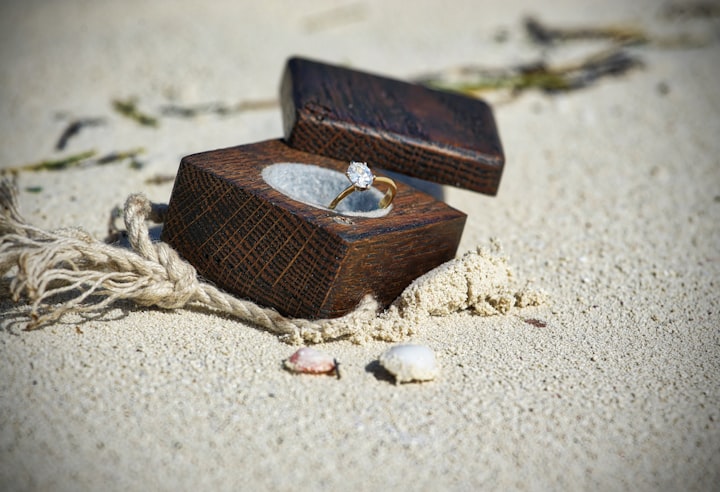
1947: A boardroom, probably in New York
“So, we have these diamonds. How do we sell them?”
“Well, they are pretty. And they more or less last forever. Come to think of it, they’d make a great symbol of love. I mean, look how popular they are in Europe.”
“Alright, but I want every middle-class American woman to feel like they need one.”
“Hmm, then we have to show them that diamonds are the quintessential mark of a perfect relationship. Every successful romance needs a diamond ring.”
“What about the men?”
“Easy. Make every man feel like they must buy one. Make it part of their identity. Their ability to purchase a diamond ring is a measure of their success.”
“So women must have a diamond ring to feel loved, and men must purchase them to feel worthy? Sounds about right. Let’s do it.”
And so the clever execs at De Beers and N.W. Ayer turned the diamond ring into a social norm. A symbol of the perfect romantic love and a reflection of enduring gender norms.
But I’m getting ahead of myself. Let’s pretend I didn’t just reveal the masterminds behind the now deeply entrenched diamond ring tradition.
Present Day
What does a picture-perfect proposal look like for you? Perhaps it’s sunset at the beach with the waves gently crashing on the shore. Or maybe it’s a romantic dinner at the restaurant where you first met. Whatever the case, imagine the love of your life getting down on one knee (to the gasps of all those watching), slowly reaching into a pocket to retrieve that precious little box, and getting ready to utter that much-anticipated question… But then, you catch a glimpse of the ring. It’s sparkly alright, but why is it green??
How would you respond? Perhaps you believe “tradition equals boring,” and you’d be delighted that your partner had the sense to get something a little different.
Or maybe you’d be a little disappointed. Maybe, just maybe, you’d been hoping for a diamond ring.
If so, you most certainly wouldn’t be alone.
According to a study by the Knot, diamonds still reigned supreme in 2020. Even as the pandemic disrupted or postponed wedding plans worldwide, couples were spending an average of $5,500 on engagement rings. In 2020, 86% of ring shoppers opted for a diamond as their center stone. Moving forward in 2021, Glamour Magazine predicts that the key trend for engagement rings will be sustainable and ethical diamonds. Perhaps diamonds really are forever.
Diamonds may seem like the norm these days, but was it always like this? How did the diamond ring come to carry so much cultural significance? So much so that it has become a necessity for many American couples?
Answering this question is going to require a little history lesson. Because actually, diamonds were not always this popular. We have De Beers and N.W. Ayer to thank for the thousands that we spend on a small piece of jewelry. Okay, fine, not entirely, but let’s just say that diamond rings became a social norm because De Beers’ aggressive marketing strategies capitalized on existing gender norms in the 1940s that have persisted even to the present.
1400s to Infinity(?)
The tale of diamonds dates all the way back to the 1400s when Archduke Maximilian of Austria commissioned the very first diamond ring for his bride, Mary of Burgundy.
Over the next several hundred years, diamonds varied in popularity, remaining for the most part, a luxury for the European elite. Few Americans in the early 1900s proposed with a diamond engagement ring. By the Great Depression in the 1930s, the diamond industry was in steady decline as couples opted for simpler and less expensive gemstones.
Then, in 1947, everything changed when the slogan “A Diamond is Forever” entered the American consciousness.
De Beers, the world’s leading diamond company at the time, hired advertising giant N.W. Ayer to help them appeal to the American middle-class. Their goal? To create “a situation where almost every person pledging marriage feels compelled to acquire a diamond engagement ring.”
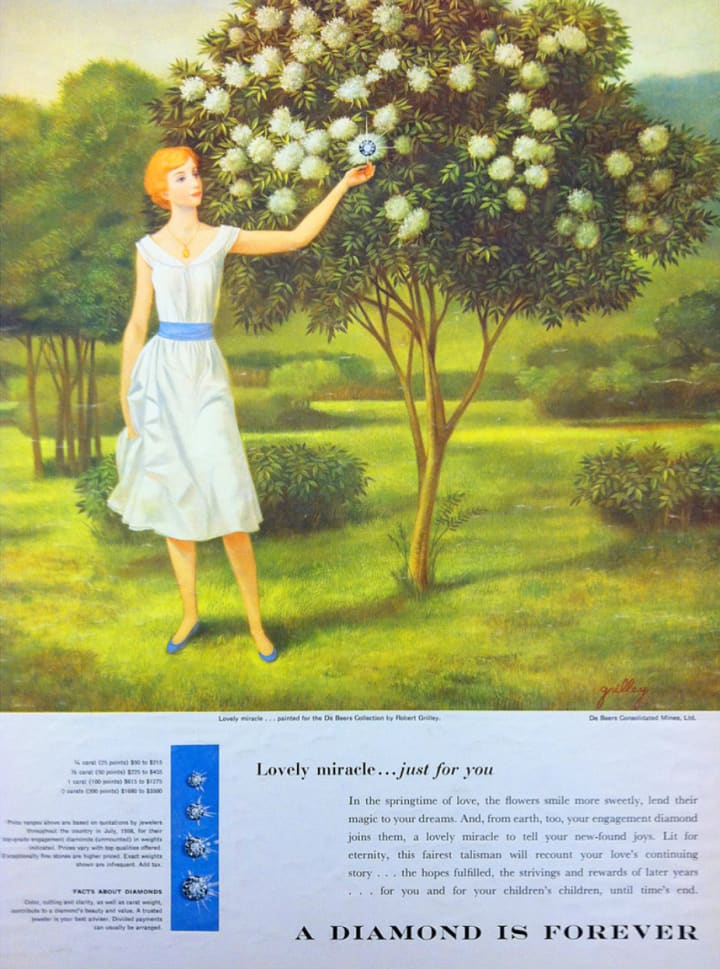
Shown above, the original 1947 De Beers ad features the image of a young woman marveling at a large diamond as well as some general information about diamonds. However, the main advertising element appears in the ad’s declaration “A Diamond Is Forever.” (Fun fact: the slogan was coined by a woman, copywriter Frances Gerety.) Diamonds, because of their durability and hardness, are the perfect symbol of a couple’s ideal relationship, a love story that lasts. With one word, “forever,” diamonds became the emblem of love.
Simple enough, right? But remember, De Beers’ goal wasn’t just to popularize the diamond ring. Their goal was to make it necessary for all Americans.
A quick thought: the most successful ad campaigns are those that reflect public sentiment and cultural values. Products become successful through consumer relevance. To that end, ads for the diamond ring needed to appeal to values already entrenched in the American psyche, to existing notions of what gender roles within a heterosexual, romantic relationship should look like.
And that’s exactly what De Beers did.
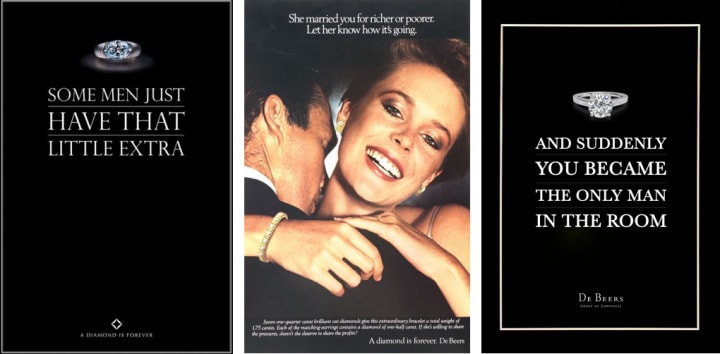
Oof. How do these De Beers ads make you feel? How do you think they made men feel at the time? An elaborate diamond piece and the words “Some men just have that little extra.” This is a loud message to men that their ability to purchase a diamond ring is related to their masculinity. Not only is the diamond necessary as a symbol of love, it is also crucial as a display of their wealth, power, and ability to be a good provider for the woman. Another ad informs the man, “And suddenly you became the only man in the room.” Clearly, his social status is also on the line.
Now what about the women?
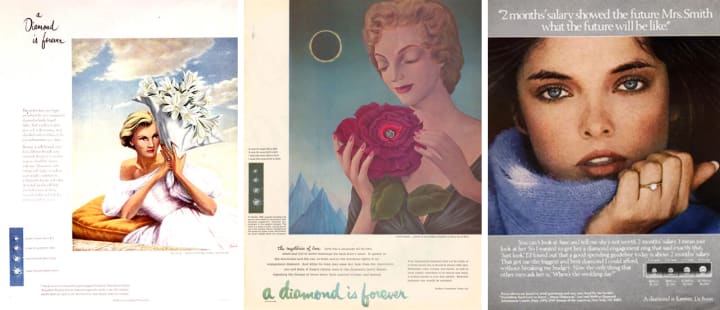
Though the ad captions are mostly addressed to the man inviting him to take action, the visual images are of women – women in flowing dresses, women with grace and beauty, class and confidence. The message? If you want to look as happy and beautiful as this woman, then you need your man to get you a diamond ring. If you want the perfect, enviable romance, you need a diamond ring.
She must be admired for her diamonds while he must provide them.
By emphasizing how a diamond ring can be a display of a man’s masculinity and a woman’s femininity, De Beers was able to manipulate consumers into believing that diamonds are necessary to their identities. Diamonds were given a power and significance that weren't inherently there. (Fun fact: diamonds aren't actually rare – De Beers manipulated not only our demand for diamonds, but also tightly controlled diamond supply to maintain the fiction that they were scarce.)
Still unsure whether this whole diamond craze is a fabricated norm? Let’s look at some not-so-successful De Beers campaigns then.
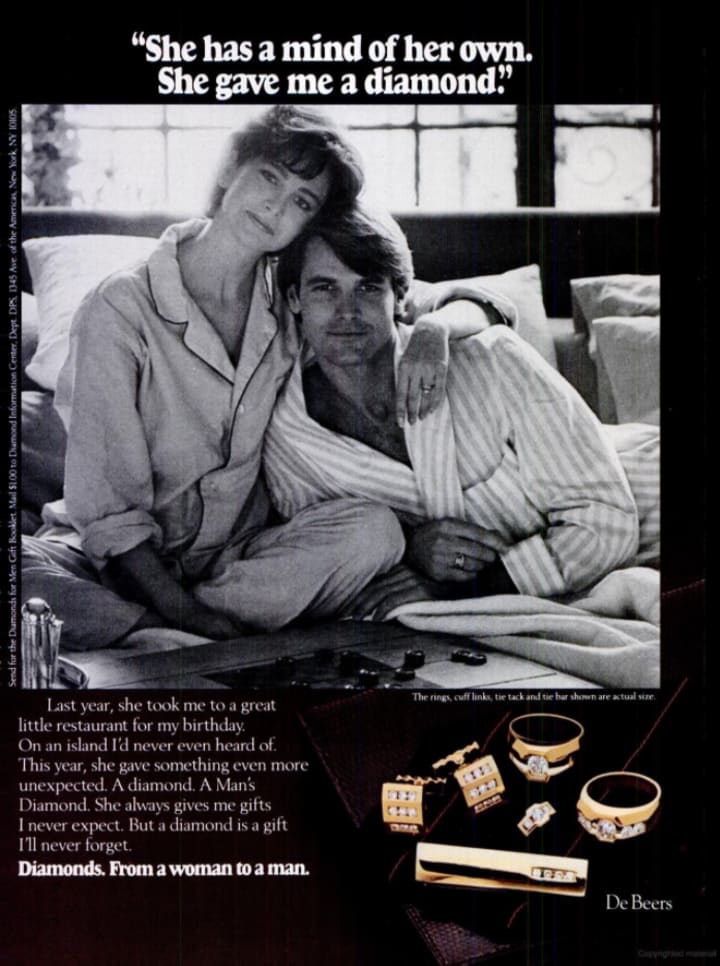
I’m still chuckling at this one. Just read it. Go ahead. De Beers tried for some time in the 1980s to get men to wear diamond rings, even using the same appeal to get women to purchase them (because apparently now it was a good thing for women to have “a mind of their own”...), but the campaign was a flop. Cultural attitudes had already been set. The diamond was a feminine object, and men were intended to give diamonds, not wear them.
Another campaign in 1965 was also met with less-than-hoped-for success as it encouraged all women – bachelor girls, divorcees, widows, etc – to purchase diamond rings for themselves. Alas, the diamond as a symbol of romantic love had already become too entrenched in American society.
De Beers began its advertising campaign with the goal of creating a love for diamonds in American culture. They were hugely successful, but that success was founded upon pre-existing gender norms. Decades later, these norms are still highly prevalent.
Perhaps a rethinking of the diamond’s value in America is necessary, since what the diamond ring represents is not the simple completion of a wedding proposal but the perpetuation of the inherent sexism present in American gender relations.
So, how does an emerald sound?
Disclaimer: I own a diamond ring. But you, with this knowledge, can decide what best symbolizes your love.
If you enjoyed the read, consider giving a heart or even a tip! Better yet, check out some of my other writing! There's an easy "see all posts" link below :)
About the Creator
Lilia
dreamer of fantasy worlds. lover of glutinous desserts.
twitter @itslalalilia



Comments
There are no comments for this story
Be the first to respond and start the conversation.