

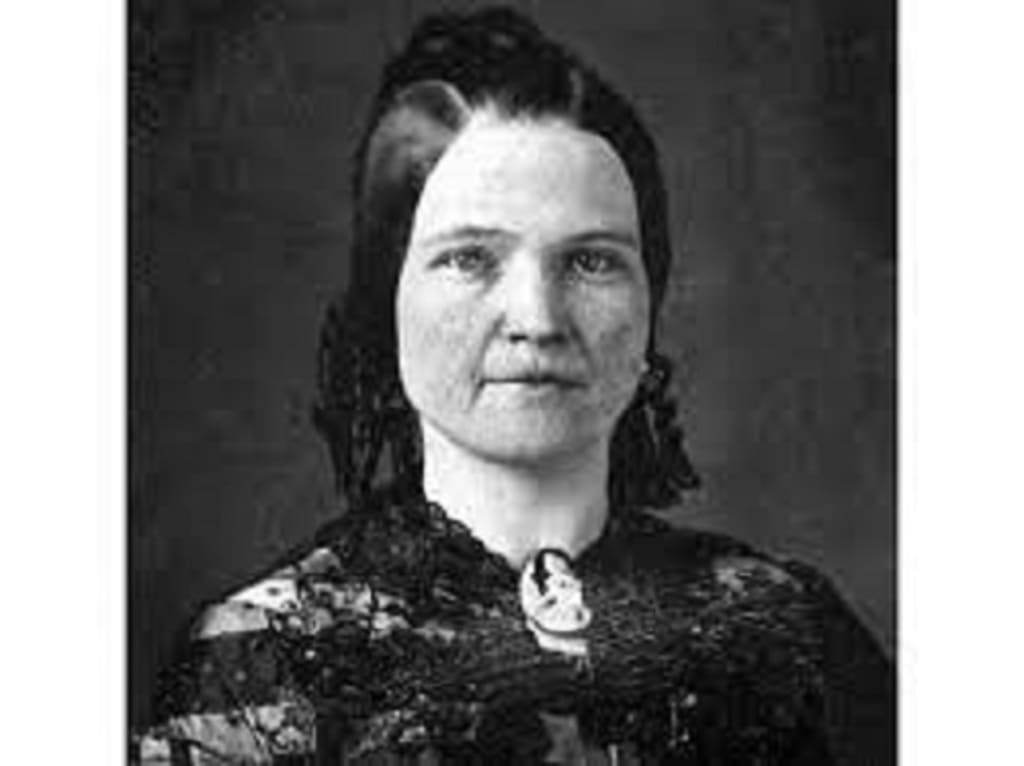
If one more bad thing happened today, Mary Todd Lincoln was going to lose it.
She had invited herself along on Abraham Lincoln’s trip to Union army headquarters at City Point, Virginia. Julia Grant, wife of commanding general Ulysses S. Grant, had suggested to her husband that he invite the President to come visit. She had been “struck by constant newspaper reports of the exhausted appearance of the President” and thought a break from Washington would do him good. Grant worried about the protocol involved in sending an invitation when the President could go where he liked whenever he wanted, but he sent a note to Lincoln in March, 1865 suggesting that “the rest would do you good.”
Lincoln jumped at the chance and asked the Navy to outfit a ship that could carry him to Grant’s headquarters. The Assistant Secretary of the Navy was reluctant, concerned about the risk of the journey to the President, but outfitted the Bat, a fast gunboat, for the “personal comfort of the President as long as he desired to make the Bat his home.” Lincoln only asked for simple accommodations, telling the Bat’s Captain Barnes that whatever was good enough for the captain would be good enough for the President. Workers nonetheless toiled around the clock to make the warship suitable for the Commander in Chief.
Lincoln soon had to ask Captain Barnes back to the White House to explain that Mrs. Lincoln had decided to go with him and asked if the Bat could accommodate her and her maid servant. The captain knew that was impossible on an austere gunboat.
It was time for plan B.
Mary Todd was a bit of a handful. She was born into an upper-class, slave-owning family in Lexington, Kentucky and spent her early years living a life of comfort. Her mother died when she was six and her father remarried a woman who Mary (to put it diplomatically) did not get along with. Nine more children were born to the Todds, and Mary got away from that crowded house as soon as she could.
She attended finishing school, where she learned French, dance, music, social graces, and drama. She took a serious interest in politics as well. At a time when women didn’t display their knowledge about subjects traditionally reserved to men or speak their minds in public, Mary Todd did both, holding her own with the men in their political strategizing sessions. Her knowledge of politics was so great that when she moved to Illinois she was courted by two political giants (and lifelong rivals) Stephen Douglas and Abraham Lincoln.
Abe Lincoln, tall, disheveled, ungainly, and unsophisticated, should have been the last choice as a husband for elegant and gregarious Mary, but she had an eye for greatness and saw it in the plain, homely fellow. And she had political ambitions of her own. When she turned down Senator Stephen Douglas’s marriage proposal, she told him that “I shall become Mrs. President…but it will not be as Mrs. Douglas.” (Lincoln, having lost the Senate seat to Douglas, beat him in the presidential election of 1860). Most people who saw Lincoln from afar didn’t think much of him; but those who knew him personally were soon convinced that he was extraordinary and destined for greatness. Even though they were ten years apart in age, came from vastly different backgrounds, and were more than a foot different in height, they hit it off from the beginning. Upon meeting her, Abe told her that he wanted to “dance with her in the worst way.” After their dance Mary informed him that he had indeed danced with her in the worst way possible.
Despite his infatuation with her, Lincoln impetuously broke up with Mary in 1841 after a New Years’ Day argument. Shortly after that Lincoln wrote a friend that he was “the most miserable man living.” Mary missed him too and the two reconciled and married in November, 1842. Four children came along and she was their sole caretaker while her husband built his law practice. Mary took charge of everything, even naming the children. Years later when Lincoln was asked to name a cannon during the Civil War, he said, “I could never name anything. Mary had to name all the children.”
With Lincoln’s legal and political career on the rise, Mary became more socially active, working behind the scenes to advance his fortunes. Theirs was a political partnership as well as a matrimonial one. When Lincoln won the presidency, he rushed home to tell her, “Mary, Mary, we are elected!”
But while most political wives remained silent and in the background, Mary continued to be both knowledgeable and outspoken, which offended the public as well as the politicians Lincoln had to deal with. While Lincoln was gracious in defeat or when confronted with disloyalty, Mary held grudges and acted upon them.
Unlike previous first ladies, Mary sought out the public eye and got lots of media attention. She also availed herself of the $20,000 appropriated by Congress for White House decoration and remodeling for each presidential four-year term. Every First Family for the last twenty years had had access to the money; Mary Lincoln was the first to take it, and she spent it all in the first year. When the money ran out, she incurred huge debts to the point where her husband threatened to pay them off out of his presidential salary. Mary then berated her husband’s assistants, demanding they go to Congress and get more money. When they informed her that wasn’t possible, she went to Lincoln to have them fired. They kept their jobs.
Mary stayed defiantly involved in politics, and wasn’t cowed by any politician. She once petitioned Edwin Stanton, Lincoln’s Secretary of War, for an appointment for a friend of hers. Stanton scolded her for imposing upon him. Shortly after his tirade, he received a packet of newspaper clippings in the mail pointing out his inadequacies as war secretary. Many feel that Mary was the sender.
The First Lady also dove into the war effort and became a regular at the hospitals set up in Washington for wounded soldiers coming in from the nearby front. It was said that she was one of the few women who could stand the blood and gore of the hospitals, and she provided a great deal of comfort to the Union wounded, despite having family members actively fighting for the Confederacy.
Mary was prone to depression, like her husband. The couple suffered the losses of two of their children, Eddie dying in 1850 at age four and Willie dying at the White House of typhoid fever in 1862. She and her husband drifted apart in the wake of this latest tragedy, but grew closer as it seemed the war was coming to an end. When Mary found out about the presidential excursion to Grant’s headquarters in 1865, she was eager to go.
Once it became clear that the First Lady was joining the president on his trip to the front, the alterations to the gunboat Bat were scrapped and a steamer, River Queen, was outfitted for the First Family. The change of plans was unwelcome news to the Navy, as the President was now planning to sail through potentially dangerous waters in an “unarmed, fragile river-boat.” Captain Barnes and the Bat were sent along as a guard.
Right after the ship set sail, a storm of hurricane force hit Washington, DC, sending the already tense Navy Department into a tizzy. But Lincoln was having the time of his life, out of reach of the storm (and those worry-warts at Navy Headquarters), watching the city from the top deck until it disappeared from view.
The Civil War was nearly at an end. Lincoln’s cheerfulness on this voyage was helped by being away from the office and his optimism at the war’s successful conclusion. Mary remembered him being “free from care, surrounded by those he loved so well.” They were met at the dock by their son, Captain Robert Lincoln, who had been assigned to General Grant’s headquarters.
A number of troop reviews by the President and commanding general were planned. The first was set for March 25th. The President and General Grant rode ahead on horseback, while Mrs. Lincoln and Julia Grant followed in an ambulance—the only transportation available in a military camp. There had been some rebel action that day, which postponed the review. Mary Lincoln was told that all the military wives had been sent to the rear except the wife of General Griffin, who had obtained a special pass from the President.
Mary steamed, “Do you mean to say that she saw the President alone? Do you know that I never allow the President to see any woman alone?” The listeners were struck by how jealous the First Lady was of her ugly husband, who, when accused of being two-faced by Stephen Douglas during their famous debates replied, “If I had another face, do you think I’d wear this one?” No one mentioned that Mrs. Griffin and the President were far from alone, surrounded as they were by tens of thousands of soldiers and the command staff of the Union army.
But Mary would not be pacified. “Let me out of this carriage at once,” she ordered. “I will ask the President if he saw that woman alone.” She reached past the officer at the front of the ambulance who was their escort and grabbed the driver to get him to stop. She was persuaded with some difficulty to wait until they got to their destination. Once there, General Meade took the First Lady aside and told her that the pretty Mrs. Griffin’s special pass had come from the Secretary of War, not the President.
First Lady Safety Tip: No other woman should ride next to President Lincoln.
Someone should maybe have written that down or something.
Another troop review was scheduled for the next day. Lincoln and Grant rode ahead on their horses and the women followed in their trusty ambulance, this time over a rough corduroy road. The women were pummeled every time the wheels hit one of the logs the road was made of, bouncing them all over the inside of the carriage. Mary demanded to be let out so she could walk the rest of the way, but was told that the mud was too deep and they had best stick to the wagon.
The President and the General arrived at the parade ground well ahead of the ladies and decided to proceed without them since the troops had been waiting all day and had missed their midday meal. Lincoln invited Mary Ord, wife of General Ord, to ride next to him. Mrs. Ord asked if it would be proper for her to do so without waiting for the First Lady or Julia Grant.
“Of course,” she was told. “Come along!”
Oh boy.
When Mary got to the parade ground (after hitting her head a few times on the ride over) and found out about it, she went nuclear.
“What does the woman mean by riding by the side of the President and ahead of me? Does she suppose that he wants her by the side of him?” Julia Grant did her best to calm the First Lady down, which did not go well.
“I suppose you think you’ll get to the White House yourself, don’t you?” Mary demanded of the general’s wife, who calmly replied that she was quite satisfied with her current position, which was far more than she had ever hoped.
“You had better take it if you can get it,” Mary snapped. “Tis very nice.” Then she went back on the attack about the general’s wife riding alongside her husband. A cavalry major rode up and, trying to be funny, said, “The President’s horse is very gallant. He insists on riding by the side of Mrs. Ord.”
The First Lady exploded. “What do you mean by THAT, sir?” The major suddenly realized that his horse needed to be somewhere else, and went with him as fast as they could go. The historical record doesn’t mention it, but THAT guy probably finished out his military service in the new territory of Alaska.
When they reached the President’s party, Mary went after Mrs. Ord, calling her “vile names” in front of the generals and demanding to know what she meant by riding up next to the President. Mrs. Ord was reduced to tears, asking the First Lady what she had done wrong. Mary railed at the poor woman until she got tired.
That night at dinner with the President and the Grants, Mary said that General Ord was unfit for his position and demanded that he be removed. General Grant defended his officer, who ultimately kept his job. Mary kept after her husband, berating him about the incidents with Mrs. Griffin and Mrs. Ord, which he bore with the limitless patience he always reserved for his wife, trying his best to talk her down off the ledge.
Julia Grant could have told him how that was going to go. During the dinner, she had been sitting down when the First Lady came into the room. Mary said, “How dare you be seated until I invite you?”
Mrs. Grant was getting a crash course in how not to be First Lady, which would one day come in handy.
A few weeks later, Ellen Stanton, the wife of the Secretary of War, received an invitation to join the Lincolns at the theatre. She went to see Julia Grant, since the general and his wife had also been invited, to find out if they were going. She told the Mrs. Grant that “unless you accept the invitation, I shall refuse. I will not sit without you in the box with Mrs. Lincoln.” Julia, still worn out from the First Lady’s tirade the month before, declined.
Mary Lincoln’s hissy fit at City Point meant that the Lincolns went to Ford’s Theatre alone.
Can a temper tantrum change the course of history? While it’s never a good idea to play “what-if” with history, it’s not implausible to think that a larger crowd in the President’s box at the theatre might have slowed John Wilkes Booth down, or that General Grant would likely have brought more and better trained guards with him than the ones that came with Lincoln.
On the flip side, both Grant and Secretary of War Edwin Stanton were on the hit list of the conspirators who assassinated President Lincoln and attacked Secretary of State Seward that same night. Having the President, the commanding general of the army, and the Secretary of War sitting within a few feet of each other might have given Booth the chance to completely decapitate the Northern government, as he had planned.
Either way, it seems safe to say that the night would have gone differently if Mary Todd Lincoln hadn’t lost her temper.
About the Creator
Stacey Roberts
Stacey Roberts is an author and history nerd who delights in the stories we never learned about in school. He is the author of the Trailer Trash With a Girl's Name series of books and the creator of the History's Trainwrecks podcast.
Keep reading
More stories from Stacey Roberts and writers in FYI and other communities.
I'll Go When I'm Good And Ready
General George McClellan was outnumbered. At age thirty-four, he was an internationally-respected military thinker and strategist (except where the cavalry was concerned; he only wanted them for guards and advance patrols. However, his invention—the McClellan saddle--was in continuous use from 1859 until the horse cavalry was disbanded in World War II. The Confederate cavalry made widespread use of it after 1863. Thanks, George).
By Stacey Roberts5 years ago in FYI
TUS NUA - ch 53
TUS NUA – ch 53 New Beginnings – Mia and Midnight (*)(*)(*) Finola knew Ali’s brother-in-law needed to put his mind at rest. She fed her arm through his and led him outside. “We’ll sit here. If you like, I can put a block around us so our conversation will be private.”
By Margaret Brennan6 days ago in Fiction


Comments
There are no comments for this story
Be the first to respond and start the conversation.