
SOME FACTS ABOUT PLANETS OF SOLAR SYSTEM
Our Achievement About Universe

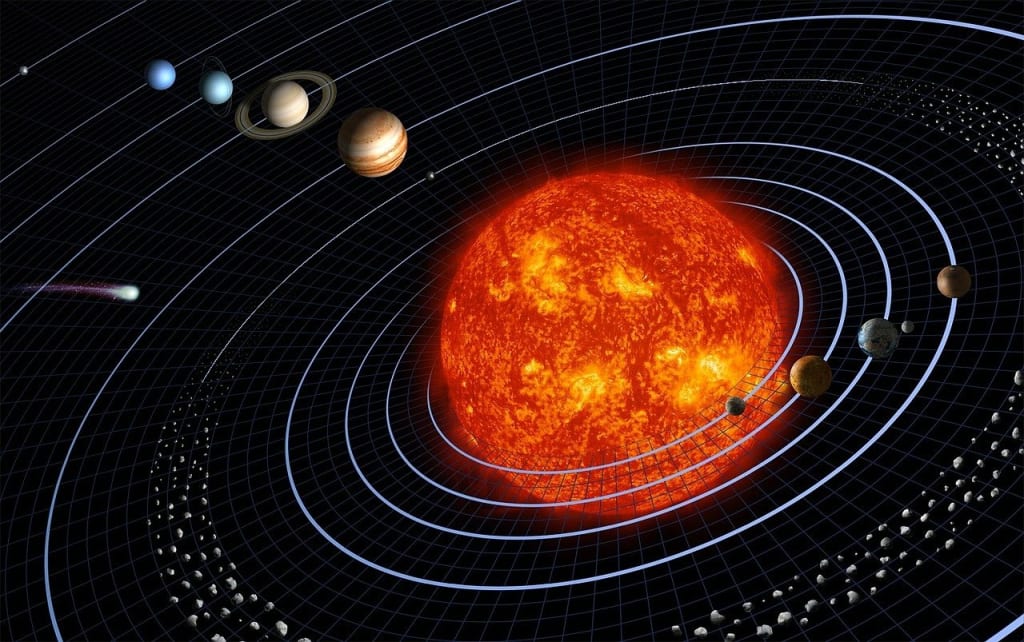
“Planet” the word planet is the ancient Greek word that has the meaning of “wanderer” but the modern definition of planet is “Large bodies that revolve around the Sun in the solar system”.
In our history of study on “Astronomy”, our scientist totally
explore 13 planets in our solar system, in which only 8 planets are totally discovered remaining 5 planets are recognized by Astronomy organizations. First four planets that revolve around the sun are Mercury,Venus,Earth,Mars and they all are called inner planets, other four planets are Jupiter,Saturn, Uranus,Neptune and these are called outer planets. The other 5 planets are not explored more than others, they are just recognized because they are a planet's time ago but passing of time they are supposed to be asteroids that are located between Mars and Jupiter that’s why they are called dwarf planets. These all planets are also characterized by sizes and their specifications.
All planets have different surface,atmosphere and diameter or distance.
“Really! They all are the great creation of God”
Let's get information about these planets and their wonders.
JUPITER(Largest Planet)
Jupiter is the largest planet in the solar system, if it were a hollow shell,1,000 Earths could fit inside it. It is also the oldest planet that is made from dust and gases but it has the shortest day in the solar system around 10.5 hours. Jupiter’s signature stripes and swirls are actually cold,windy clouds of ammonia and water, floating in an atmosphere of hydrogen and helium. Jupiter also has the Great Red Spot and Pearls. Jupiter’s environment is probably not conducive to life. Characteristics like temperatures,pressure and materials are extreme and volatile. Jupiter is 11 times bigger than the Earth; it has an area around 43,440.7 miles (69,911 kilometers) and sunlight travels in 43 minutes to Jupiter. Jupiter has 95 moons in which four are big and others are small. Jupiter also has rings that were discovered in 1979 by NASA’s Voyager 1 spacecraft. Jupiter took shape along with the rest of the solar system about 4.6 billion years ago. About 4 billion years ago, Jupiter settled into its current position in the outer solar system, where it is the fifth planet from the Sun. The structure of Jupiter is similar to the Sun because of its elements and atmosphere. Due to great research of scientists, Jupiter has a homogeneous mix of gases, a small solid core of heavier elements and rocks. Jupiter
also has cyclonic storms that is the true evidence of no life.
SATURN (Second largest planet)
Saturn is the second largest planet in our solar system. Saturn is also a giant planet that is mostly made up of hydrogen and helium. It also isn't conducive to life. The temperature,pressure and environment are too extreme and volatile. It covered a diameter of about 74,897 miles (120,500 kilometers). Saturn is also nine times bigger than Earth, it receives sunlight in 80 minutes. Saturn has the second shortest day which takes 10.7 hours. IAU(International Astronomical Union) 2023 research declared that Saturn has 146 moons in its orbit. Saturn has the rings that are thought to be pieces of comets, asteroids, or shattered moons that broke up before they reached the planet, torn apart by Saturn’s powerful gravity. Saturn has a structure as compared to Jupiter. At Saturn’s center is a dense core of metals like iron and nickel surrounded by rocky material and other compounds solidified by intense pressure and heat. It's hard to imagine, but Saturn is the only planet in our solar system with an average density that is less than water. Saturn is blanketed with clouds that appear as faint stripes, jet streams, and storms. The planet is many different shades of yellow,brown and gray. It is also a great place for hurricanes and other atmospheric changes. There is no weather feature like it anywhere else in the solar system. Saturn’s magnetic field is smaller than Jupiter’s but still 578 times as powerful as Earth’s.
URANUS(Third Largest Planet)
Uranus is a cold and windy planet that is surrounded by 13 faint rings. Uranus also has no way to live because of its environment that is very harsh for humans. It has a giant area about 51,118 kilometers and it is four times wider than Earth. Uranus has 17 hours a day. Uranus also has the ability to rotate in the opposite direction to the Sun. Uranus has 28 known moons that look like a half iceberg and half rock in the inner part. Uranus has two sets of rings, the inner system has nine rings in which mostly are narrow, dark grey rings.There are two outer rings, in which one is reddish and other is blue. Mostly the 80% of the Uranus area is covered with hot dense fluid of “icy” materials-water, methane, and ammonia-above a small rocky core and it heats up to 9,000 degrees Fahrenheit (4,982 degrees Celsius). Uranus has a blue-green color because of methane gas in the atmosphere. Methane gas absorbs all light that gives it some blue-green color. Uranus also has a great wind system that reaches up to 560 miles per hour (900 kilometers per hour).
NEPTUNE(Fourth Largest Planet)
Neptune is the coldest planet in the solar system because it is 30 times far away from the Sun compared to Earth. Neptune is also known for supersonic winds and ice giants. Our Earth's sunlight is 900 times brighter and warmer as compared to Neptune. Neptune has an icy large area that is approximately 30,775 miles (49,528 kilometers), it is four times wider than the Earth. Neptune’s axis of rotation is tilted 28 degrees with respect to the plane of its orbit around the Sun. Neptune has 16 moons in which Triton is largest that were firstly discovered on 10 October in 1846. Neptune has five prominent and main rings and other four are non-prominent and supposed to be an arc that are visible sometimes because they are very far from Neptune. Its area is also covered with the hot dense fluid of “icy” material, methane,helium and other destructive materials. Neptune has not a solid surface, it has the surface of water. Due to modern research Neptune also has diamond rain because of its unusual weather. It also consists of many storms like snowfall and supersonic winds.
EARTH(Fifth Largest Planet)
Earth is our home. The word Earth means “the ground” and it is the only planet that has life in the solar system. Earth has a diameter of 7926 miles (12,760 kilometers) and the light of the sun travels in 8 minutes from Sun to the Earth. Earth has a day of 23.4 hours and mostly part of Earth is spread on water, a maximum of 71 percent and other 29 percent are land that is home for us. Earth has a single moon. It has no rings. The Earth is composed of four main layers, starting with an inner core at the planet’s center, enveloped by the outer core, mantle and crust. Like Mars and Venus,Earth has volcanoes,valleys and mountains.Earth has a great atmosphere that helps us to survive on it. The Earth's atmosphere is composed of 78% nitrogen, 21%oxygen and 1% other gases like argon,carbon dioxide and neon. Earth also has an ozone layer that protects us from UV rays (Ultraviolet rays) it is also known as the cover of Earth.
VENUS(Sixth Largest Planet)
Venus is the hot planet and also the neighbor of earth that’s why it is called Earth evil.Venus also hasn’t the potential of life because of its dangerous aspects like temperature that range is 86 to 158 Fahrenheit (30 to 70 Celsius). It also has volcanoes and mountains. Sunlight travels in 6 minutes on Venus. It has a diameter of 7,521 miles (12,104 kilometers) Venus is the brightest object in the night sky after our own Moon. Venus has no moons and rings. It has the surface like a barren, dim and rocky landscape, and a sky that is likely some shade of sulfur yellow. Venus has an extreme and hot atmosphere. It has hot high pressure carbon dioxide that behaves in a corrosive fashion.
MARS(Seventh Largest Planet)
Mars is the seventh largest planet in the solar system that looks like a “Red Planet” because of iron minerals, rust and Martian dirt oxidizing. Mars has an area of 2,106 miles (3,390) kilometers, Mars is about half the size of Earth. It has 24.6 hours a day. Mars has two moons Phobos and Deimos. It has no rings. Mars has a dense core at its center between 930 and 1,300 miles (1,500 to 2,100 kilometers) in radius. Its crust is composed of aluminum, calcium and potassium.Mars has a thin atmosphere made up mostly of carbon dioxide, nitrogen, and argon gases.Mars has no global magnetic field today, but areas of the Martian crust in the southern hemisphere are highly magnetized, indicating traces of a magnetic field from 4 billion years ago.
Mercury(Smallest Planet)
Mercury is the smallest planet in the solar system and nearest planet to the Sun. Mercury is slightly bigger than our Earth moons. Mercury is not the hottest planet. This title is going to Venus but Mercury is the fastest planet in our solar system, it’s one rotation around the Sun is about Earth 88 days. The environment of Mercury is not conducive to life because of its temperature, it has the temperature of 430 Celsius at day and -180 Celsius at night. It has an area of about 1,516 miles (2,440 kilometers), and it achieves sunlight in 3.2 minutes. Mercury has no moons and rings. Mercury’s exosphere is composed mostly of oxygen, sodium, hydrogen, helium and potassium. Mercury's magnetic field is offset relative to the planet's equator.
THANKS FOR READING ❤️🌎😇
About the Creator
Binary Beast
I am 16 year old boy. I belongs to middle class family and i am also the good thinker and noble boy. My English is also better. It is my humble request to all "Please support me". THANKS
Reader insights
Outstanding
Excellent work. Looking forward to reading more!
Top insight
Easy to read and follow
Well-structured & engaging content
Keep reading
More stories from Binary Beast and writers in FYI and other communities.
MIRACLES OF HI-TECH IN 2024 🤖
“HI-TECH”, The meaning of the word Hi-tech is that it is a new version of advanced devices which is used in a new way or which took some time for people to understand or to comprehend, which becomes the center of their attention. Today the hi-tech devices are also our need and source of entertainment.
By Binary Beastabout a year ago in FYI
Iran Is Next! Here's Why
This week, global attention has been hijacked by one foreign-policy story—and no, for once it isn’t Venezuela. It’s Iran, and by every available indicator, the country is teetering on the edge of a crisis unlike anything it has faced in decades.
By Lawrence Lease7 days ago in FYI



Comments
There are no comments for this story
Be the first to respond and start the conversation.