
Some Cool Facts About AI - It's Advancements, Discoveries In Major Fields
Interesting facts you didn't know about AI


Artificial Intelligence and Machine Learning are now considered some of the most significant innovations. AI and ML used to be a fictional concept from science fiction, but now it's becoming a daily reality.
The growth of less expensive and more powerful processing, data storage capacity, and the nearly limitless quantity of available data has propelled AI development.
Now let's see some exciting facts about AI, and let's see how these facts are interesting?
AI Can Heal Itself
For a long time, self-healing is limited to living organisms, but Artificial Intelligence has now taken it to another level.
Robots that work side-by-side with humans must be able to work with dexterity to ensure human safety. They often also are built from materials more flexible than typical robotic materials.

But, this also makes the robots susceptible to cracks and other damage, and repairs can be lengthy and costly.
To solve this problem, scientists have developed polymers that can heal themselves, creating new bonds after being damaged in as little as 40 minutes. Embedding functional material will soon let robots use artificial intelligence to sense and actuate the self-healing process without the need for human intervention.
Researchers have even suggested that these robots will play a significant role in essential industries like medical, research, food, transportation, etc.
AI Is Gaining Popularity With Robo-Journalism
AI Robo-journalism is becoming popular, and you would be surprised to know there has already been a robot that wrote an article on the earthquake in California for the Los Angeles Times.
It has seen outstanding progress since 2014, with three main techniques emerging as tried-and-tested implementations of Robo-journalism.

The three primary techniques are:
• Natural Language Processing (NLP) using Editorial Templates
• Trend detection and NLP using Editorial Templates
• Voice conversion
The algorithm-based robot outshined in writing abilities. That is why the next decade could have more robots writing crime stories with human editors to decide which piece of information needs more attention than the other.
Robo-journalism is sometimes seen as an opportunity to free journalists from routine reporting, providing them with more time for complex tasks. It also allows efficiency and cost-cutting, alleviating some financial burden that many news organizations face.
Robo-journalism is also perceived as a threat to the authorship, news quality and a threat to the livelihoods of human journalists.
Nautilus - The Future Teller
Nautilus is a supercomputer that can make predictions based on the news articles that feeds into it.
The machine's 1024 Intel Nehalem cores have a total processing power of 8.2 teraflops (trillion floating-point operations per second), making it powerful enough to run the original Wolfenstein 3D at a hell of a frame rate and foretell significant world events.
Nautilus is more like a self-learning machine that came into the limelight when it could locate one of the biggest terrorists of all time, Osama Bin Laden, within 200km.
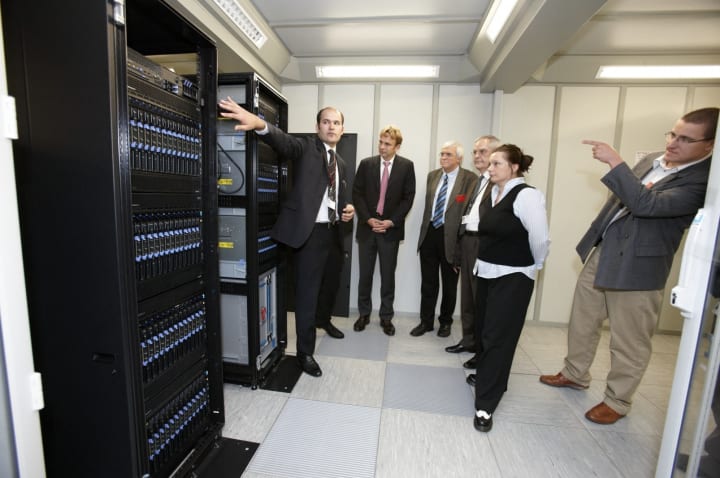
Nautilus works by spotting the frequency of emotive words like terrible and awful in news articles, then cross-references them geographically to chart a sudden plunge in goodwill in a specific region. That's how it predicted the Egyptian revolution.
Currently, scientists are working on this supercomputer to see if it can predict more actual future events instead of the ones that have already occurred. This AI device is the most prominent example of technology advancement and usage.
AI Can Detect Depression
In a paper presented at the Interspeech conference, MIT researchers detail a neural network model that can unleash raw text and audio data from interviews to discover speech patterns indicative of depression.
Given a new subject, it can accurately predict if the individual is depressed without needing any other information about the questions and answers.

The researchers hope this method can develop tools to detect signs of depression in natural conversation.
In the future, the model could, for instance, power mobile apps that monitor a user's text and voice for mental distress and send alerts. It could be beneficial for those who can't get to a clinician for an initial diagnosis due to distance, cost, or a lack of awareness that something may be wrong.
There Are More Male Employees In AI - Related Jobs Than Female
Diversity in AI has always been pretty poor, and the field has attempted to fix this.
Many different support groups like Women in Machine Learning (WiML), AI4ALL, and Black in AI have popped up to increase outreach. But it's still heavily dominated by men.
Recent studies have shown that AI-related jobs in America were more likely to be made by men, as they made up about 71 percent of the application pool.

There Is some good news for women. Workshops help by WiML to support women in AI saw a 600 percent increase in attendance from 2014 to 2018.
AI4ALL, a non-profit focused on helping young people from less represented backgrounds break into AI, increased 900 percent for its educational program compared to 2015.
Resources
1. Automated Journalism article from wikipedia.
2. scientists develop self-repairing machines from theguardian.com.
3. What is Artificial Intelligence and why it matters?
4. Model can more naturally detect depression in conversations form MIT News.
5. Supercomputer predicts revolution from BBC News.
About the Creator
Keep reading
More stories from M V Ramarao and writers in FYI and other communities.
The Rise of Mohammed Siraj From Tolichowki To Gabba
Mohammed Siraj's story is what dreams are made of, as it is an inspiring rags to riches tale. From being an auto driver's son to taking 5 wickets in a series decider match in Border-Gavaskar Trophy, Siraj has seen it all.
By M V Ramarao5 years ago in Motivation
A Failed Artist, A Disillusioned Poet, An Underpaid Game Show Host
I took my son and niece to Gori, a small town in Georgia where Joseph Stalin was born. They talked me into visiting the Stalin's Museum, the largest in the post-Soviet space. I had resisted going there because I just can't stand the monster and know enough about him, or so I thought.
By Lana V Lynx6 days ago in FYI



Comments
There are no comments for this story
Be the first to respond and start the conversation.