
Should Male Doctors Be Allowed to Treat Women?
Medical misogyny isn’t rare — it’s routine. And women are paying for it with their lives.


If men stopped killing women, maybe we’d trust them with our bodies. But they haven’t. So why do we?
It sounds extreme, but think about it. We are told to trust doctors. To strip down, to open up, to let them see, touch, and decide what happens next. We sign forms, follow orders, and call it care.
But when the men in medicine harm women, it’s never called violence — it’s called a “breach of professionalism,” a “failure of judgement,” or a “tragedy.”
We call it what it is: betrayal.
When “Doctor” Stops Meaning Safe
In the UK, breast surgeon Ian Paterson was convicted after performing unnecessary mastectomies and operations on more than a thousand women. He exaggerated cancer risks, cut into healthy bodies, and left women scarred for life.
Hospitals, insurance companies, and colleagues ignored warnings for years.
Then there’s Manish Shah, a GP who carried out fake “check-ups” so he could assault female patients. He was found guilty of over a hundred sexual offences. His victims were as young as fifteen.
Across the Atlantic, Robert Hadden, an obstetrician in New York, sexually assaulted women for decades under the guise of pelvic exams. His conviction listed hundreds of victims.
And in 2025, Zhi Alan Cheng, a hospital doctor in Queens, was sentenced for abusing sedated patients and filming himself doing it.
These men weren’t strangers in alleyways. They were the men women were told to trust. They used medicine as a weapon — and they got away with it for years because institutions protected them, not us.
The Everyday Version
Most women will never meet a monster like that. But almost every woman has met a doctor who made her feel small, silly, or invisible.

We are told it’s normal for pain to be dismissed. Normal to wait years for a diagnosis. Normal to cry in the car after an appointment.
That’s what makes this culture so dangerous — the everyday version of the same contempt that lets abusers hide in plain sight.

My Story
I had endometrial hyperplasia — a condition where the lining of the uterus becomes abnormally thick. It isn’t “just bad periods.” It feels like your womb is trying to tear itself apart.
The pain comes in waves, like contractions, so intense you can’t speak through them. You bleed until you’re dizzy, until your clothes are soaked through, until you start to wonder how much blood you can lose before you pass out.
It drains you — physically, emotionally, completely.
When I went to my GP, I could barely stand from blood loss. I explained the pain, the exhaustion, the panic. He didn’t examine me. He didn’t ask questions. He said, “Women get painful periods. Go home and take paracetamol.”

Three days later, a woman doctor looked at my notes and found something shocking: an ultrasound from the previous year had already shown the problem. The result was never shared with me. I should have been on medication months earlier.
Instead, I was left anaemic, weak, and scared — not because my body failed me, but because my doctor did.

It wasn’t the first time a male doctor had ignored my boundaries. When I was in hospital with sepsis, a nurse was attaching ECG pads to my chest behind a closed curtain. A doctor pulled it open and walked straight in, exposing my bare breasts to the entire ward.
The nurse told him, gently but firmly, that you ask before entering when the curtain is closed. It shouldn’t need to be said.
The Stories Keep Coming
After I started talking about my experience, other women shared theirs.
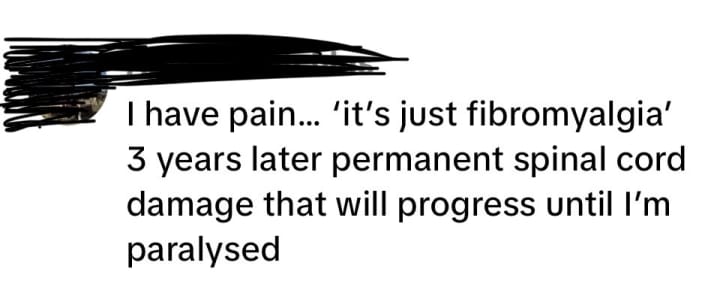
One told me she’d gone to her GP with abnormal bleeding and was told to lose weight. Months later, she was diagnosed with ovarian cancer.
A female doctor told me about her training rotation where a patient complained of fatigue and pain. Her senior male colleague wrote “WW” in the notes. When she asked what it meant, he said, “Whining woman.” Then he sent the patient home.
These stories sound old-fashioned, but they aren’t. They’re now. They’re happening in surgeries, hospitals, and clinics across the country.

A System Built by Men, for Men
Medicine was built around the male body.
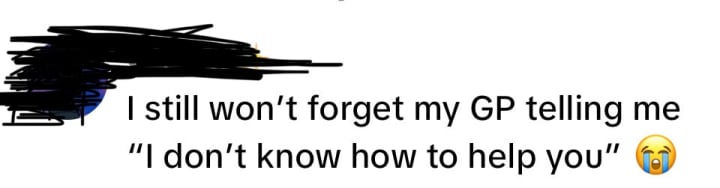
Clinical trials historically excluded women. Textbooks were written using male anatomy as the default. Even the word hysteria comes from hystera — Greek for uterus — because men once believed women’s emotions were caused by wandering wombs.
Fast-forward to today, and the consequences are still fatal.
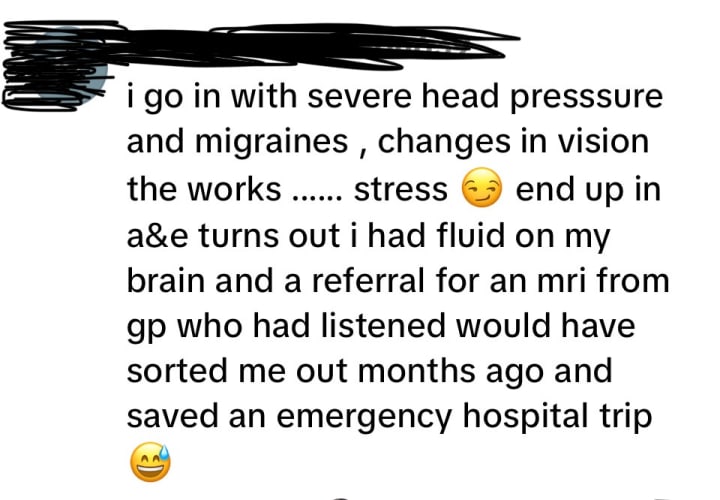
Studies show women wait longer for pain relief in A&E. We’re more likely to be told our symptoms are “psychological.” We’re diagnosed later for almost every condition, from heart disease to autoimmune disorders.
A 2025 study found that women across multiple health systems faced longer diagnostic delays than men. Another found that women treated by female doctors had lower death rates than those treated by men.
It’s not coincidence; it’s culture.

Dear Male Doctors: If You’re Offended, Ask Why
If you’re a male doctor reading this and you’re angry, that’s fine. Sit with it.
No one’s accusing all male doctors of harm. But if you feel personally attacked, ask yourself why you recognise something of yourself in this criticism.
Being a good man in medicine isn’t about insisting you’re not one of the bad ones. It’s about calling out the ones who are.
It’s about noticing when a nurse looks uncomfortable, or when a colleague dismisses a patient’s pain.

Trust isn’t your right. It’s something you earn. Every time you listen without interrupting, you earn it. Every time you pause before touching a patient, you earn it. Every time you believe a woman the first time she tells you something’s wrong, you earn it.
We Don’t Owe You Our Obedience
The most dangerous thing women do in healthcare is stay polite.
We apologise for asking questions. We worry about being “difficult.” We accept answers we know are wrong because we don’t want to cause a scene.

That politeness is what predators rely on, and it’s what dismissive doctors hide behind.
So here’s the truth: we don’t owe male doctors our trust. We don’t owe them our bodies. We owe ourselves safety and care that doesn’t require silence.
If men in medicine want to treat women, they need to prove they’re safe to do so. That starts with listening, humility, and accountability.

This Isn’t About Hating Men — It’s About Survival
Every woman who dies because she wasn’t believed is proof that the system is working exactly as designed.
A system where men built the rules, wrote the textbooks, and still tell us what our pain means.
But every woman who speaks up cracks that system open. Every story forces someone to look twice at what they thought was “normal.”

So no — this isn’t about hating men. It’s about survival. It’s about demanding that the people holding our lives in their hands actually value them.
Let’s Talk About It
If you’ve ever been dismissed, ignored, or touched without consent, tell your story.
If you’re a male doctor who thinks this is unfair, explain why. Then listen before you defend yourself.
Medicine should heal, not humiliate. It should make women feel safe, not small.
In my opinion, male doctors should only be allowed to treat women when they’ve proved they deserve the privilege.
———————————-
If this made you angry, good.
That means you care.
I write about that kind of anger — the kind that comes from being dismissed, overlooked, or underestimated.
About the Creator
No One’s Daughter
Writer. Survivor. Chronic illness overachiever. I write soft things with sharp edges—trauma, tech, recovery, and resilience with a side of dark humour.
Keep reading
More stories from No One’s Daughter and writers in FYI and other communities.
"They Took One for the Team": Why Loving the Attack on Bonnie Blue Says More about Us Than Her
On the night of 19 September 2025, South Yorkshire Police were called to Onyx Nightclub in Sheffield after reports of a disturbance. Adult content creator Bonnie Blue, who was appearing there as part of her “Bang Bus Freshers Tour,” was punched in the face by a woman in the crowd. Witnesses say the blow landed squarely on her jaw after she had been inside the club for about forty minutes. Although Bonnie reportedly did not suffer lasting injuries, the incident was serious enough that police detained a woman before releasing her. The nightclub had marketed the event as a safe space where no sexual behaviour would take place, and yet Bonnie left with a violent reminder of how fragile women’s safety really is.
By No One’s Daughter4 months ago in FYI
A Failed Artist, A Disillusioned Poet, An Underpaid Game Show Host
I took my son and niece to Gori, a small town in Georgia where Joseph Stalin was born. They talked me into visiting the Stalin's Museum, the largest in the post-Soviet space. I had resisted going there because I just can't stand the monster and know enough about him, or so I thought.
By Lana V Lynx6 days ago in FYI


Comments (1)
While I've had some good male doctors, two out of those doctors accused me of making my symptoms up when I went to see them in full-blown period pain and tearful moods. They accused me of attention seeking, so I became stubborn and requested a female doctor, which I had to press for. It turned out I had PMT, which was made worse by endometriosis and my PTSD. I am a little better today, because I know how to treat it, thanks to that female doctor.