
See this on your plant leaves, don't touch it!
See this on your plant leaves, don't touch it!


It belongs to a creature called "Mourning Cloak".

Mourning cloak butterfly egg.
Gardening and taking care of plants is still a hobby for many people. However, to create a healthy ecosystem, the caretaker also needs to have certain knowledge.
If one day you find your houseplants covered with these small, complex, black geometric shapes that look quite scary, it's best NOT TOUCH IT.
Because according to experts, this mysterious thing is the egg of the Nymphalis Antiopa butterfly. Why do they advise us not to touch the eggs of the Nymphalis Antiopa butterfly? Let's find out.
In North America, this butterfly is called the Mourning Cloak because of its distinctive dark velvet wings that appear every winter and spring.

Close-up of the strangely colored wings of the mourning cloak butterfly.
Native to Eurasia and North America, widely distributed in the Northern Hemisphere, Nymphalis Antiopa is a fascinating insect with a unique life cycle and some rather interesting habits.
The habitat of this species is also very diverse. They occupy sunny open areas, forest edges, parks, gardens, woodlands and groves. During hibernation, Nymphalis Antiopa can be found under eaves, in cellars, cracks and wall holes.
Perfect geometric wonder
Next, let's talk about the eggs of this butterfly. The photo we see is a close-up of the eggs of the Nymphalis Antiopa butterfly on a leaf.
They look almost like a thin layer of black lace stretched across their surface. Once you get over the initial fear, they are actually quite beautiful. The eggs are laid in clusters, and each tiny egg is a perfect geometric wonder. The pale eggs are 0.9 x 0.7 mm in size and turn black before hatching.
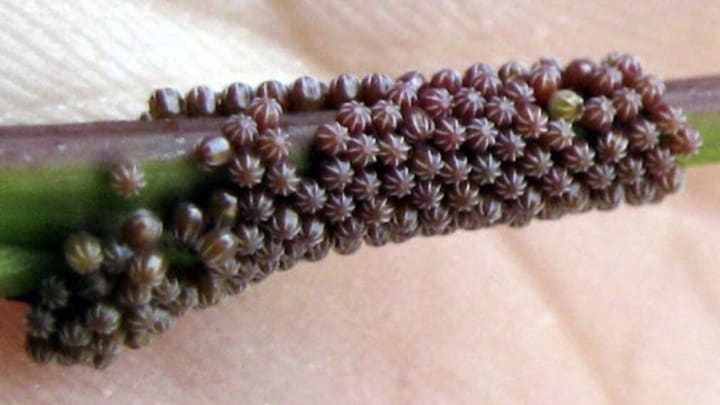
Mourning Cloak Eggs.
So, are Antiopa Nymphalis eggs dangerous to people or your garden?
The good news is that the Nymphalis Antiopa butterfly is actually quite beneficial. The larvae, or caterpillars, eat leaves, but they generally prefer shrubs like willows, elms, and poplars. So if you have a garden full of flowers and vegetables, yours should be safe. In fact, these butterflies can actually be quite beneficial, as they also eat rotting fruit and help with the decomposition process.
Watching the life cycle of these butterflies is fascinating. After hatching from these strange, intricate eggs, caterpillars emerge. They are black with small white spots and have spiny, hard bodies. They go through several stages, growing larger each time. An adult caterpillar has gone through five stages.
Once fully grown, the caterpillars find a safe place to pupate. They spin a cocoon, which is like a small sleeping bag, where they undergo metamorphosis. This stage can last from a few weeks to a few months, depending on the climate and time of year. They are then beautiful Nymphalis Antiopa butterflies with dark velvet wings edged in bright yellow and adorned with blue/purple spots.
One of the most interesting things about the mourning cloak butterfly is its behavior. Unlike many other butterflies, the Nymphalis Antiopa hibernates during the winter. They find a cozy spot under cracked bark, in a woodpile, or even in an old barn to hibernate.

Unlike other butterflies, the Mourning Cloak butterfly hibernates.
When spring arrives, they are among the first butterflies to be seen, often before flowers begin to bloom. This early appearance is part of the reason why they are called Mourning Cloaks – their dark, somber wings cast against the stark landscape of early spring, like a sheet of mourning.
As gardeners, we often focus on the immediate impact insects have on our plants. We see caterpillars and think, “They’re going to eat everything!” , but it’s important to step back and look at the big picture.
The Antiopa Nymphalis butterfly is a perfect example of how nature balances itself . Yes, the caterpillars will eat some leaves, but they won't destroy your garden. In fact, by providing a habitat for these butterflies, you're contributing to a healthier ecosystem.
So what should we do if we find these eggs or caterpillars in our garden? The advice is to leave them alone, do not touch them or do anything bad to them. Enjoy the process and watch the transformation of the Nymphalis Antiopa butterfly.
About the Creator
HK Decor
Telling stories my heart needs to tell <3 life is a journey, not a competition
If you like what you read, feel free to leave a tip,I would love some feedback
https://s.shopee.vn/7fFUMxnnBx?share_channel_code=8


Comments
There are no comments for this story
Be the first to respond and start the conversation.