
Point Cloud vs. BIM: What Is the Difference?
What is difference between point cloud vs BIM?
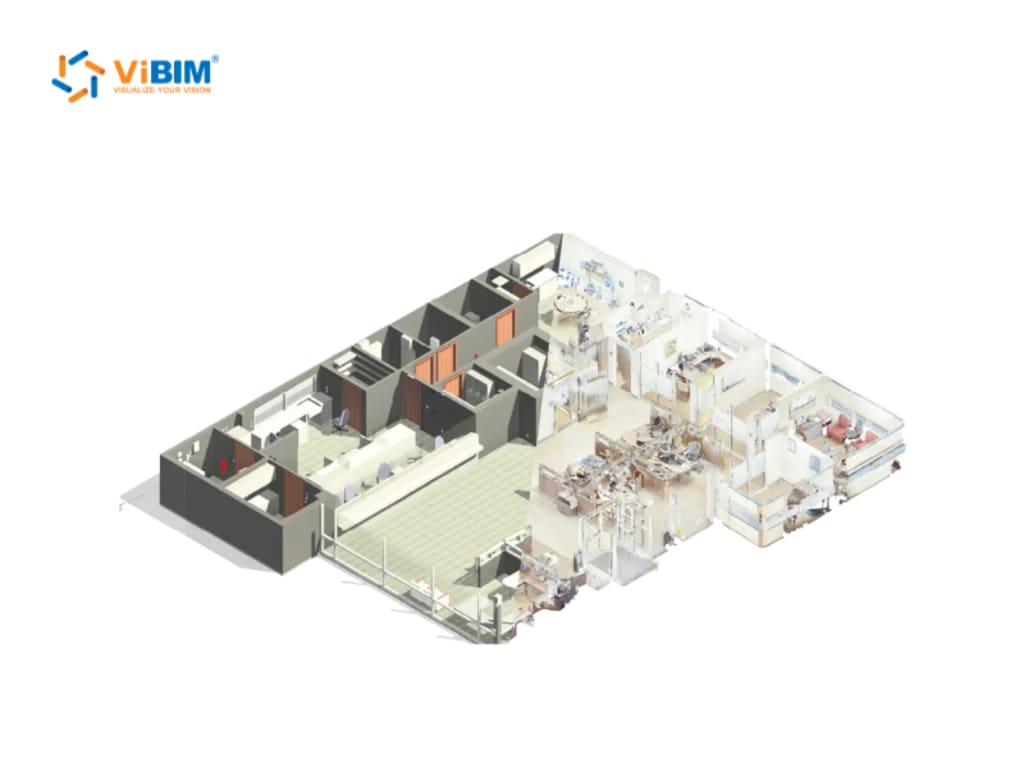
A Point Cloud is a comprehensive collection of millions of individual 3D data points captured via laser scanning, representing the exact physical geometry and surface of a structure. In contrast, Building Information Modeling (BIM) is an intelligent, data-rich process that uses parametric objects to create digital representations of building components. The relationship between these two is foundational: Point Clouds provide the precise as-built data that serves as the raw material for creating high-fidelity BIM models, bridging the gap between the physical site and the digital design environment.
In this article, we will define both technologies in detail, examine their key differences, and explore the "Scan to BIM" process that connects them. We will also discuss the technical challenges involved in converting raw data and how ViBIM transforms complex point clouds into accurate, actionable BIM models.
What is a Point Cloud?
A Point Cloud is a collection of millions of individual data points plotted in a three-dimensional coordinate system (X, Y, and Z). These points represent the external surfaces of an object or building. You generate these datasets using 3D laser scanners that emit laser beams to measure the distance between the scanner and the physical environment.
Each point in the cloud captures precise geometric information, and often color (RGB) and intensity data, providing a highly accurate "digital snapshot" of existing conditions. Point clouds are primarily used for:
- Surveying site conditions: Capturing the current state of a building with millimeter-level accuracy.
- As-built documentation: Providing a reliable record of a structure as it currently exists, rather than relying on outdated 2D paper drawings.
- Quality control: Comparing the physical construction progress against the original design intent.
What is BIM (Building Information Modeling)?
BIM is a modeling technology and an associated set of processes used to produce, communicate, and analyze building models throughout their entire lifecycle. Unlike traditional 2D drawings, BIM uses parametric objects—intelligent digital representations of building components like walls, doors, and windows—that carry computable data and behavioral rules.
BIM provides a single, reliable source of information that facilitates collaboration between owners, designers, and contractors. Key characteristics of BIM include:
- Data-rich objects: Components contain information about their material, cost, thermal performance, and maintenance requirements.
- Automatic updates: Parametric rules ensure that if you change a door’s size in one view, the change is automatically reflected in all other views and schedules.
- Lifecycle management: BIM supports a building from initial concept and feasibility studies through construction and into facility operations.
Point Cloud vs. BIM: Key Differences
While both technologies represent three-dimensional data, they differ fundamentally in their structure, intelligence, and application:
- Data Composition: A Point Cloud consists of millions of unstructured "dumb" points, each defined by X, Y, and Z coordinates. In contrast, BIM is composed of "intelligent" parametric objects such as walls, beams, and windows.
- Information Depth: Point Clouds capture only the external geometry and surface color of an object. BIM models are data-rich, containing embedded metadata such as material specifications, structural properties, costs, and maintenance schedules.
- Intelligence and Relationships: Point Clouds have no inherent knowledge of what the points represent (e.g., it cannot distinguish a pipe from a wall). BIM objects are governed by rules and relationships, "knowing" how they interact with other components in the building system.
- Primary Function: Point Clouds are used primarily for high-precision visualization and capturing "as-built" conditions. BIM is utilized for advanced simulations, clash detection, structural analysis, and lifecycle management.
- Creation Method: Point Clouds are generated through 3D laser scanning or photogrammetry of physical spaces. BIM models are authored by architects and engineers using specialized design software (like Autodesk Revit).
- Lifecycle Stage: A Point Cloud is a static "snapshot" of a building at a specific moment in time. A BIM model is a dynamic digital twin that evolves and accumulates data from the design phase through to facility operations.
How to Convert point cloud data into BIM model?
The relationship between these two technologies is most evident in the Scan to BIM process. This workflow involves converting the raw, unstructured data of a point cloud into a structured, intelligent BIM model. This is the industry-standard method for renovation and retrofit projects where accurate as-built information is missing.
The Scan to BIM process follows 3 essential stages:
Laser Scanning: You scan the physical site to generate a comprehensive point cloud.
Point Cloud Processing: You register and clean the data to create a unified 3D dataset.
BIM Modeling: BIM experts use the point cloud as a precise geometric template to "trace" or model parametric building elements, turning the "dots" into intelligent walls, pipes, and structural beams.
Challenges in Converting Point Cloud to BIM
Converting point clouds into accurate BIM models is a complex task that presents several technical challenges:
- Data Density and Noise: Point clouds often contain millions of points and "noise" (like furniture or people) that modelers must manually filter to identify the true building structure.
- Geometric Complexity: Older buildings often feature irregular surfaces, non-perpendicular walls, or sagging floors that are difficult to represent using standard parametric objects.
- High Processing Power: Managing multi-gigabyte point cloud files requires high-performance workstations and specialized software to avoid system performance issues.
- Human Expertise: Automatic conversion tools are not yet perfect. Skilled BIM modelers are required to interpret the point cloud correctly and assign the right data to each object.
How ViBIM Transforms Point Clouds into Accurate BIM Models
At ViBIM, we specialize in bridging the gap between raw field data and intelligent building models. Our team uses advanced Scan to BIM workflows to ensure your project starts with 100% accurate as-built documentation.
We deliver value through:
- Precision Modeling: We transform your point clouds into high-LOD (Level of Development) models that meet strict international standards.
- Discipline-Specific Expertise: Whether you need architectural, structural, or MEP (Mechanical, Electrical, and Plumbing) models, we ensure every component is modeled with the correct parametric intelligence.
- Optimized Workflows: By leveraging the latest BIM platforms and custom parametric libraries, we reduce the time and cost associated with as-built documentation.
Using Point Cloud to BIM solutions at ViBIM allows you to minimize design errors, reduce field rework, and establish a robust foundation for the entire lifecycle of your facility. Contact ViBIM today to transform your site data into a high-performance digital asset.
About the Creator
ViBIM - BIM Modeling Service
Founded in 2014, 3D Revit BIM Modeling outsourcing services at ViBIM based in Vietnam, dedicated to helping architects, engineers, and contractors transform complex laser scan data into precise, high-quality Revit models.
Keep reading
More stories from ViBIM - BIM Modeling Service and writers in FYI and other communities.
What is CDE in construction? A comprehensive guide
Three years ago, I sat in a meeting room in Ho Chi Minh City while a contractor and an architect screamed at each other. The contractor had built from an outdated drawing. The architect insisted the updated version was "somewhere in the email chain." It took our team eleven days to sort through the mess. The rework cost $2.1 million.
By ViBIM - BIM Modeling Serviceabout a month ago in FYI


Comments
There are no comments for this story
Be the first to respond and start the conversation.