
Pharmacy Vs Drug Store
Is there a difference between a pharmacy and a drug store?

Some people think the words "pharmacy" and "drug store" should be used interchangeably. That's not true because there are several differences between the two.
What's a Pharmacy?
A pharmacy is a place where medications are dispensed and sold. Typically, a pharmacy is a separate section inside a drug store, department store, or in major supermarkets such as Kroger and Walmart. A pharmacy is also part of most hospitals and health clinics.
A pharmacy provides medical products over the counter. However, if you have one or two drug store items when you pay for your medicine, the cashier will accept them.
Workers in a pharmacy must be trained and licensed to dispense medicine and give flu, pneumonia, and other shots to customers. Those workers are different from other workers in a drug store that serves customers with other items.
A pharmacy may not typically carry items that you can purchase in a drugstore, such as paperback books, cosmetics, electronics, batteries, snacks, and drinks. Some drug stores develop photos.
Most of the time, a pharmacy is located in a designated area of a main facility, such as in the back of the store, away from customers who have no need for anything in the pharmacy.
Pharmacies in the United States
There is no shortage of pharmacies in the United States because there are approximately 88,000 of them. Almost half of them are located in drug stores, grocery stores, hospitals, department stores, medical clinics, surgery clinics, universities, nursing homes, prisons, and other facilities. The other half is independent or privately owned.
Some states have an abundance of pharmacies. In some communities, there is a drug store with a pharmacy on almost every corner. There are 13,184 pharmacies in California as of May 5, 2025. That tops the list with the most. Texas, New York, Florida, and Pennsylvania make up the other top five states with the most pharmacies.
The "Big Three" Pharmacies in the US
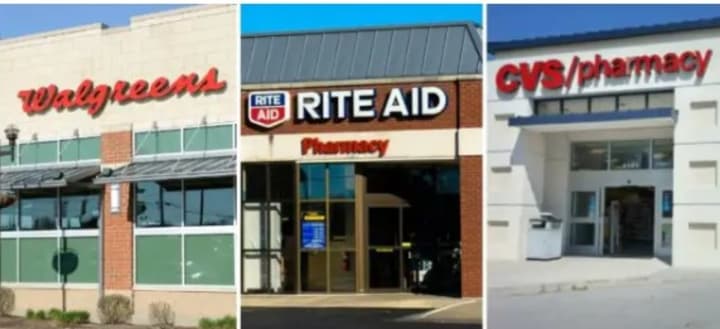
CVS is the leading chain in the United States based on the number of locations and sales. CVS, which stands for Consumer Value Store, has about $153.3 billion in revenue. When the store opened on May 8, 1963, it had only 17 stores. Five years later, CVS was in 40 locations. Today, there are 9,967 locations with 203,000 employees and $134.128 billion in sales.
CVS has the word "pharmacy" in its name, but technically, it is a drug store because it not only fills prescriptions, but it also sells merchandise.
Behind CVS Health is Walgreens. It is much older than CVS, but its growth has not been as fast. Walgreens was launched in 1901. It started out with just one store. By 1913, it had grown to only four stores. Two years later, Walgreens had just five stores. By 1919, there were 20 stores in the chain. Even though the growth of Walgreens was extremely slow, today it has 9,277 locations with 230,000 employees and a revenue of $136.9 billion.
Rite Aid Corporation is the third pharmacy chain in the United States, behind CVS and Walgreens. It is the youngest and has the fewest locations and employees. It was founded on September 12, 1962. As of July 15, 2025, Rite Aid has 764 pharmacies in the United States with 31,000 employees, and $21.64 billion in sales.
What's a Drug Store?
Drug store can be written as two words or as one. Both are correct. A drug store is a retail facility for selling prescription medications and other products not related to medicine and medical supplies. A drug store may sell the same things as a convenience store. Drug stores may sell cosmetics, toiletry items, first-aid supplies, and over-the-counter medications, such as non-prescription cold remedies and other health care products.
A drug store sells a wide range of products, such as paperback books, electronics, batteries, greeting cards, gift cards, magazines, food, drinks, and even small clothing items such as scarves and gloves.
Some food and drinks are sold at drug stores, such as breakfast cereal, snacks, and milk. Cigarettes used to be sold at drug stores, but no longer. Some drug stores also have photo-developing services.
Other Pharmacy and Drug Store Facts
- To determine the differences between a pharmacy and a drug store, think of their locations and the products that are sold there.
- Most drug stores have pharmacies, but not all pharmacies are located in drug stores.
- One of the primary differences between pharmacies and drug stores is the range of products they offer.
- More and more non-medical products are in drug stores today than in the past.
- A number of pharmacies inside drug stores have drive-through services for customers to pick up prescriptions only, and no other items.
About the Creator
Margaret Minnicks
Margaret Minnicks has a bachelor's degree in English. She is an ordained minister with two master's degrees in theology and Christian education. She has been an online writer for over 15 years. Thanks for reading and sending TIPS her way.
Keep reading
More stories from Margaret Minnicks and writers in FYI and other communities.
Miss Persephone's Manual to a Seemingly Ordinary Life
Miss Persephone was found at the dining table, her blue eyes swollen, her tears arriving and retreating like the tides of the ocean. Earlier that day, her family had visited her in the retirement home where she had lived for eight years. It was her eightieth birthday.
By Imola Tóth4 days ago in Fiction


Comments
There are no comments for this story
Be the first to respond and start the conversation.