
People Thought It Was the End of the World, but the Red Rain Over India Was Something Even Stranger
This bizarre 2001 weather anomaly looked like an apocalyptic omen — until science revealed the disturbing cause

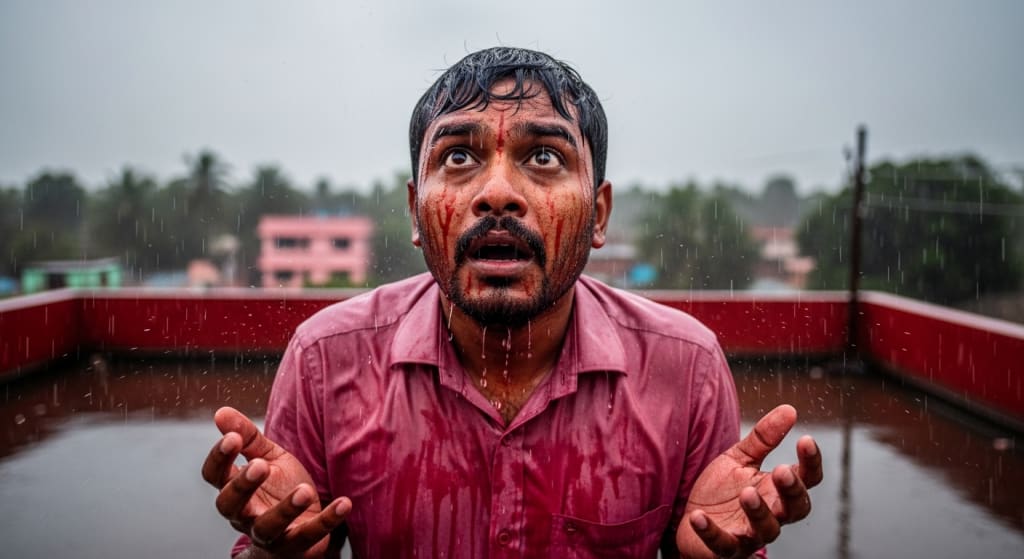
One morning in Kerala, India, the rain turned red. Not a soft pink or a dusty hue — a deep, chilling crimson. It splattered rooftops, soaked clothes, and painted the streets as if the clouds themselves had opened up with blood. No warning. No explanation. Just red liquid falling from the sky.
It didn’t feel like weather. It felt like a message. People ran indoors. Some whispered about the end of the world. Others just stood frozen, staring at the sky, completely stunned. For over two months, the red rain kept coming back — again and again — as if nature was repeating something no one could understand.
📌 This happened in July 2001, across more than 100 locations in Kerala. The red rain wasn’t a one-time splash — it drenched the region repeatedly, leaving stains on homes, clothes, and minds.
What made this even more disturbing was what scientists discovered inside those rain samples. At first, officials guessed it was just desert dust blown in from faraway lands. But when they looked closer, things didn’t add up. It wasn’t sand. It wasn’t ash. And it definitely wasn’t rust.
🔍 Under a microscope, the rainwater revealed something no one expected — living cells.

Tiny, red-colored particles that looked like biological cells. They measured around 4 to 10 microns in size and showed no signs of being chemical contaminants. These weren’t just harmless pigments. They behaved like living matter, but no DNA could be detected inside them using standard testing methods. They didn’t die when boiled. They didn’t break apart when frozen. They were resilient, stubborn, and totally alien to the region.
A physicist named Dr. Godfrey Louis stepped into the spotlight, not because he wanted fame, but because he had questions no one else could answer. His research suggested something most experts would never dare to say out loud. He believed these red particles could be extraterrestrial spores. Cells from beyond Earth. Dropped into our skies by a passing meteor that exploded in the atmosphere just days before the red rain began.
💥 Satellite data did in fact register a sonic boom near the area on July 25, 2001 — right before the rain started.
Not everyone agreed with his theory, of course. Some scientists proposed a more grounded explanation. They said the rain carried airborne algae spores — particularly Trentepohlia, a type of lichen that has a reddish pigment. But even that didn’t fully explain the extreme heat resistance of the particles or why DNA was undetectable.
🧪 Tests showed the red cells could survive up to 300°C — a temperature that would destroy most known biological life.
That’s what kept the mystery alive. This wasn’t a prank. It wasn’t some local legend blown out of proportion. This was documented, tested, and written about in scientific journals. It happened in broad daylight, witnessed by thousands, and investigated for years.
What makes it unforgettable isn’t just the visual shock of red rain pouring from the sky. It’s the possibility that Earth was touched — maybe even seeded — by something from far beyond our atmosphere. And whether those cells were alien in origin or just part of an unexplained terrestrial process, one thing is clear. That rain changed people.
Locals who lived through it still talk about it. Journalists who covered it still remember the panic. Scientists who studied it are still divided. Even after more than two decades, it remains one of the most bizarre weather phenomena ever recorded.
🔴 More than 50,000 liters of red rain fell across Kerala during that stretch. The stains washed away, but the questions never did.
Today, people search for answers. Not just out of curiosity, but because events like this remind us how much we still don’t know about our skies, our planet, and the strange forces that move around us. They drive scientists to dig deeper. They keep researchers up at night. And they make regular people, like you and me, wonder what else might fall from above.
This is not just some weird blip in history. It’s a wake-up call. Nature has secrets it’s still holding back. That red rain wasn’t just a mystery. It was a moment when logic and belief collided — and left a trail we’re still chasing.
About the Creator
Ojo
🔍 I explore anything that matters—because the best discoveries don’t fit into a box...



Comments (1)
That red rain in Kerala is wild. I remember a time when we had a strange weather event here. Turned out it was just a rare mix of elements, but this red rain with living cells? That's a whole new level of mystery.