
Operation Bunyān Marsūs: Pakistan's Strategic Missile Response to Indian Airstrikes
Unveiling the Fateh-1 Missile: Pakistan’s Powerful Answer in the Wake of Cross-Border Tensions
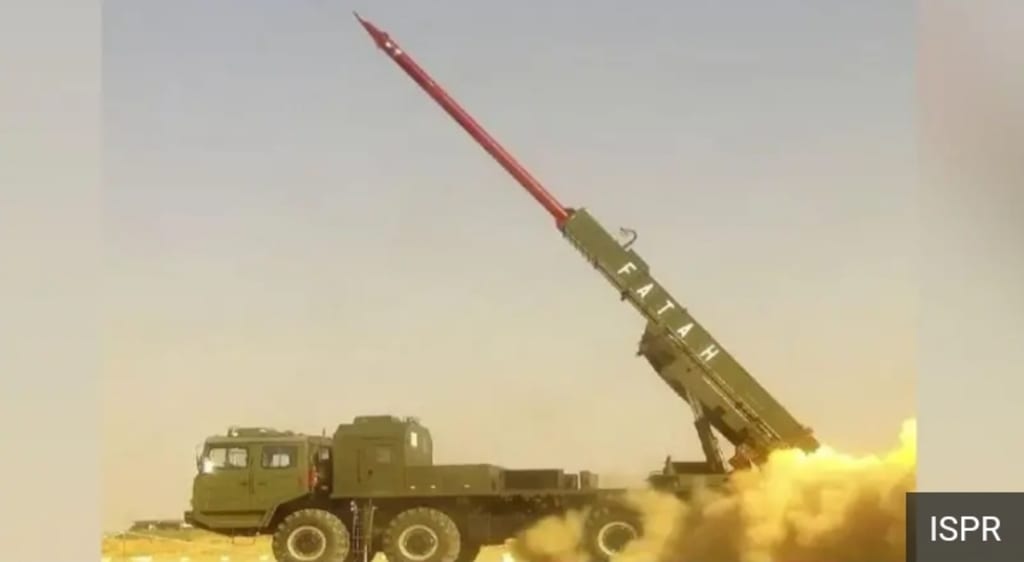
What Do We Know About the 'Fateh Missile' That Initiated Operation Bunyān Marsūs?
The government of Pakistan has announced that in the early hours of Saturday morning, it launched a retaliatory operation against India, named Operation Bunyān Marsūs.
It is worth recalling that on the previous night, explosions were heard in several areas, including Rawalpindi in Punjab province. Shortly thereafter, Director General of the Inter-Services Public Relations (ISPR), Lt. Gen. Ahmed Sharif Chaudhry, claimed that during Indian airstrikes between Friday and Saturday night, missiles were launched targeting Noor Khan Airbase in Rawalpindi, Shorkot Airbase, and Murid Airbase. However, according to him, all air force assets remained safe.
Soon after this information was shared, the launch of Operation Bunyān Marsūs was officially announced.
According to ISPR, the operation began with Pakistan launching its Fateh-1 missile. ISPR also shared videos of the launch with BBC.
According to the Pakistani military, “This operation is dedicated to the Pakistani children who were martyred as a result of India’s aggression against Pakistan.” It added, “Pakistan has not and will never forget the martyrdom of these innocent children.”
What Does “Bunyān Marsūs” Mean?
The term Bunyān Marsūs is derived from a verse in the Holy Quran and translates to “a solidly cemented wall.”
This phrase appears in Surah As-Saff, verse 4, which states:
> “Indeed, Allah loves those who fight in His cause in a row as though they are a solid structure.”
According to ISPR, Bunyān Marsūs represents people who struggle in the path of Allah, standing firm like an iron wall — the most beloved to God. This spiritual sentiment inspired the naming of the operation.
What Is the Fateh-1 Missile?
According to ISPR, the operation began with the launch of the Fateh-1 missile. The public relations wing of the military also released videos of the launch, which have since gone viral on social media. The term “Fateh-1” has become one of the top trends in Pakistan.
Fateh-1 is a modern, short-range, surface-to-surface guided missile developed by Pakistan with a range of up to 140 kilometers. On August 24, 2021, Pakistan successfully tested this locally developed rocket system.
Fateh-1 is part of the “Fateh series,” which also includes Fateh-2. The Fateh-2 missile can reach targets up to 400 kilometers away and has precise targeting capabilities. The missile can carry a warhead weighing between 300–500 kg.
Dr. Mansoor Ahmed, a lecturer in Strategic and Defence Studies at the National University of Canberra, notes that the Fateh missile represents a sophisticated addition to Pakistan’s long-range artillery rocket systems. These missiles can precisely strike high-value targets such as airbases, command and control centers, ammunition depots, logistic lines, and forward artillery.
Dr. Ahmed explains that the key feature of these missiles is their stand-off capability — they can be launched from beyond the enemy's defensive perimeter. They also possess a “shoot-and-scoot” ability, meaning the launcher can relocate immediately after firing, reducing the risk of counter-strike.
He likens them to the U.S.-made HIMARS system, currently used effectively in Ukraine.
Since the Fateh series is locally produced, Pakistan is not dependent on external suppliers and can continue missile production independently. According to Dr. Ahmed, the Fateh series includes Fateh-1, Fateh-2 (both operational), and upcoming models like Fateh-3 and Fateh-4, with Fateh-4 expected to have a range of 700 km.
Supersonic Accuracy and Tactical Maneuverability
Defense analyst Syed Muhammad Ali, based in Islamabad, highlights that the Fateh missile series offers exceptional accuracy and operates at supersonic speeds. Its most significant feature is its terminal maneuverability — the ability to change direction during the final phase of flight.
He draws a cricket analogy: just as Waqar Younis's late swing confused batters, the Fateh missile’s final-stage maneuvering confuses enemy defense systems, rendering interception nearly impossible.
According to him, India has a three-layered defense system — the outermost being the Russian-made S-400 (range 300–400 km), followed by Israel’s Barak-8 surface-to-air missile, and the indigenous Akash system. He claims Fateh-1’s terminal-stage agility allows it to bypass all these layers, making it a vital tool in Pakistan’s full-spectrum deterrence strategy.
Impact of the Fateh-1 on Airbases
Targeting airbases with Fateh-1 yields strategic advantages. The missile can release hundreds of bomblets, destroying runways and creating craters that ground aircraft. Until runways are repaired, all air operations are effectively halted.
Public Reaction and Naming Praise
Many Pakistani social media users have praised the naming of the operation as Bunyān Marsūs. One user, Faraz, wrote on X (formerly Twitter): “I usually don’t favor naming military operations in any language other than Urdu, but considering the nature of our current adversary, Bunyān Marsūs is the perfect name.”
About the Creator
Keep reading
More stories from Ikram Ullah and writers in FYI and other communities.
Rafale vs J-10C: The Dogfight Between India and Pakistan That Captivated the World
Islamabad, May 7 – In what could become one of the most significant aerial confrontations in modern military history, Pakistan has claimed that its air force downed five Indian Air Force (IAF) jets during an overnight engagement on May 6–7. The claimed kills reportedly include three Rafale jets — France’s pride in aerial warfare.
By Ikram Ullah8 months ago in FYI



Comments
There are no comments for this story
Be the first to respond and start the conversation.