
Let’s Delve into the Best of the Lockheed F-16 in Detail
By AirPra

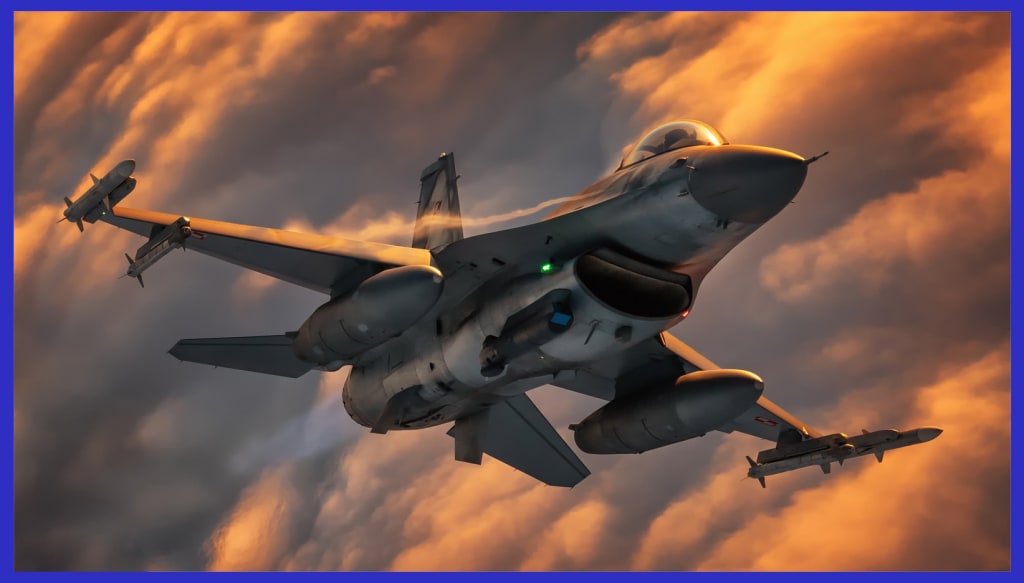
The F-16, the most advanced 4th-generation fighter ever built, brings a new level of capability to air forces around the world. So, Let’s Delve into the Best of the Lockheed F-16 in Detail. A highly agile and versatile multirole fighter aircraft with a sleek and streamlined design, it was built by General Dynamics. The F-16 Fighting Falcon was made for the USAF in 1974 and remains an enduring symbol of aerial prowess and combat effectiveness, with a legacy that spans decades of service in air forces around the world.
Its combination of agility, versatility, and continuous improvement has solidified its place as one of the most successful and respected fighter aircraft in aviation history as of 2023. With its continuous improvements and modernization efforts, the F-16 continues to maintain its reputation as a cutting-edge platform that serves multiple nations’ air forces globally.
Since its production approval in 1976, more than 4,600 aircraft have been manufactured. Recently, in 2022, the USAF announced plans to continue operating the F-16 for an additional two decades. Interestingly, there are ongoing efforts to develop improved versions tailored for export customers. Notably, back in 1993, General Dynamics made a significant move by selling its aircraft manufacturing business to the Lockheed Corporation, and subsequently, the latter merged with Martin Marietta in 1995, forming the renowned Lockheed Martin.
The manoeuvrability and fighting radius of the F-16 is superior to those of all possible threat fighter aircraft in the air combat role. It has the ability to find targets in any weather and detect low-flying aircraft amid radar ground clutter. In an air-to-surface role, the F-16 can fly more than 860 km (500 mi), deliver its missile with exceptional accuracy while defending itself from opposing aircraft, and then return to base.
The aircraft can deliver munitions properly when bombing without visibility, thanks to its all-weather capability. Apart from its primary role in the U.S. Air Force, the F-16 finds utility in the Air Force Reserve Command and Air National Guard units. Furthermore, this versatile aircraft has been sought after by 25 other nations’ air forces, making it an internationally adopted platform.
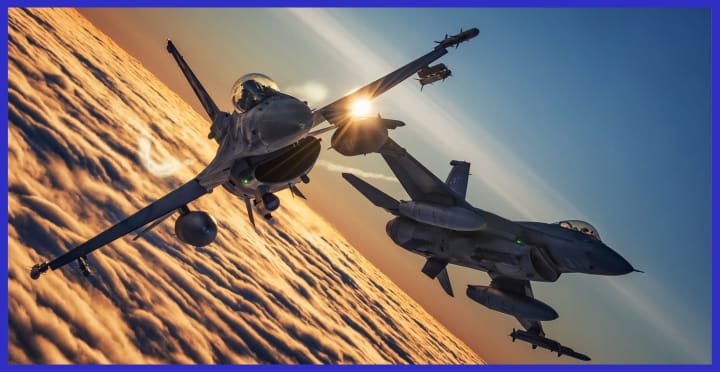
Development story of the General Dynamics F-16 Fighting Falcon
The General Dynamics F-16 Fighting Falcon’s development, presently manufactured by Lockheed Martin, unfolds as a captivating narrative of innovation and steadfast determination. Its inception dates back to the early 1970s, a direct outcome of the United States Air Force’s (USAF) Lightweight Fighter (LWF) program. The primary objective of this program was to conceive a budget-friendly and exceptionally agile air-to-air combat aircraft. The realization of such a need became evident after the Vietnam War experience, prompting the quest for advanced air superiority fighters, culminating in the remarkable F-16 Fighting Falcon.
Origins and Prototype (YF-16): In 1972, the USAF selected two prototypes for the LWF program, one of which was the YF-16, designed by General Dynamics (now part of Lockheed Martin). The YF-16 was a radical departure from traditional fighter designs, featuring a highly unstable blended-wing body balanced by advanced fly-by-wire controls, with a single-engine configuration. This innovative approach aimed to reduce weight, increase agility, and enhance performance.
First Flight and Competition: On January 20, 1974, the YF-16 embarked on its inaugural flight with General Dynamics test pilot Phil Oestricher at the controls. Subsequently, the YF-16 achieved its first supersonic flight on 5 February 1974, followed by the first flight of the second YF-16 prototype on 9 May 1974. Throughout the fly-off competition, the YF-16 completed an impressive 330 sorties, accumulating a total of 417 flight hours.
During the Lightweight Fighter (LWF) fly-off contest against the Northrop YF-17, the YF-16 showcased remarkable agility and outstanding performance, leading to its selection as the winner in April 1975, designated solely for the USAF. Although the F-15 was concurrently undergoing continuous development during that era, the USAF acknowledged that fulfilling the requirement for an air superiority fighter with a twin-engine large-sized aircraft would incur significantly higher costs than anticipated. Consequently, they also opted for the single-engine fighter.
The aircraft was officially designated as the F-16 and full-scale development (FSD) F-16s were manufactured by General Dynamics in Fort Worth, Texas, at the United States Air Force Plant 4, commencing in late 1975.
Please "Dive In and Explore the Complete Article"
About the Creator
Prajesh Majumdar
Hi there, I'm Prajesh, the creator of airpra.com
The site is dedicated to nurturing a community of individuals with a keen interest in exploring the intricate aspects of defence equipment and related news.
Keep reading
More stories from Prajesh Majumdar and writers in FYI and other communities.
Unveiling the Supreme Might: Exploring the Pinnacle of Power with B61 and B83 Nuclear Bombs
During the peak of the Cold War era, spanning from 1963 to 1970, the United States designed a compact-sized thermonuclear gravity bomb that continues to be in active service as of 2023 and beyond, incorporating the latest modifications. So, let’s explore the best of the B61 and B83 Nuclear Bombs, which were developed as low to intermediate-yield strategic and tactical nuclear weapons, boasting a remarkable two-stage radiation implosion design. The overall concept aimed to create a highly adaptable and reliable weapon that could effectively deter potential threats and provide military options in various operational scenarios.
By Prajesh Majumdar3 years ago in FYI
Rachel Reviews: The Spiral Archive by Pieter Hendrik
It's difficult for me to know where to start with a review of this book as it was, for me, an entirely unique experience and one that I'll probably never have again. I don't want that to be interpreted as unenjoyable but it has left me scratching my head a little and ruminating on its content, its themes and its characters.
By Rachel Deeming2 days ago in BookClub


Comments
There are no comments for this story
Be the first to respond and start the conversation.