
Inventory of the world's 7 most special "extreme" laboratories
7 Most Special "Extreme" Labs

As we all know, the laboratory is the experimental place for scientists to study the earth, science, biology, geology, and space, etc. The laboratory in my impression should be quite satisfactory, but there are some very "extreme" experiments in the world. These laboratories will do some very unique experiments, some can study the origin of the universe, and some laboratories are even in space. Below is an inventory of the 7 most "extreme" laboratories in the world!
Brookhaven National Laboratory has a "super machine" called the Relativistic Heavy Ion Collider (RHIC). In February 2010, it created the highest man-made temperature: 4 trillion degrees Celsius, 250,000 times the temperature of the Sun's core. RHIC has a 3.8-kilometer-long circular tunnel where two colliding particles travel in two directions and are accelerated by coils on the device. When gold ions collide face-to-face at nearly the speed of light, hot high-density plasma quarks and gluons can form, or more precisely, fluid-like matter. Physicists can use it to observe the "near-perfect liquid" form of matter in the very short time it created the Big Bang.
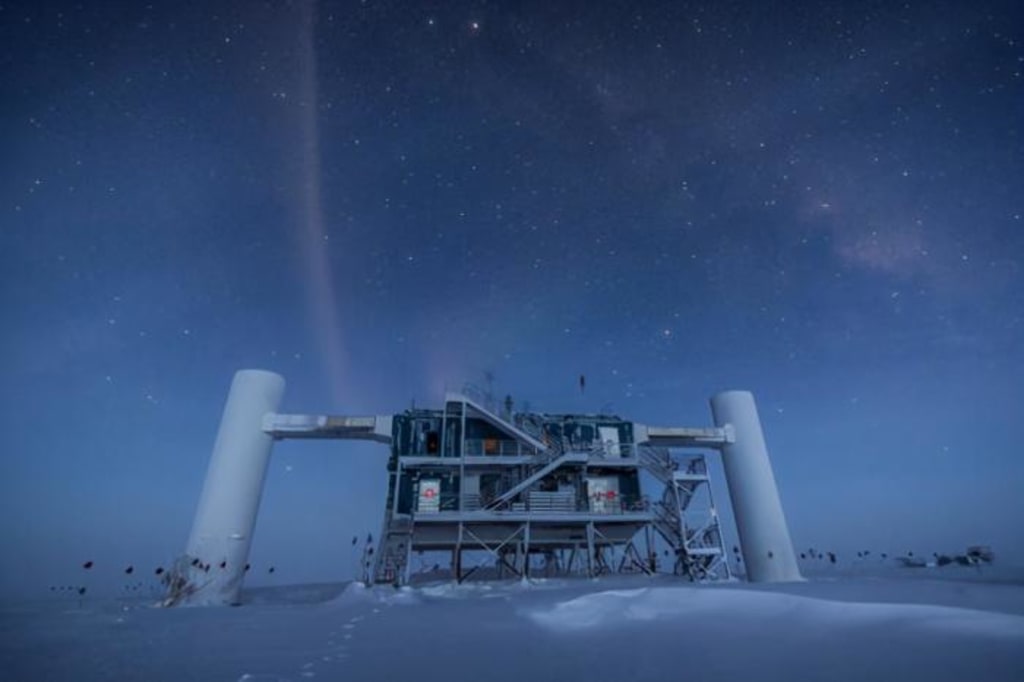
Antarctica has an extreme and unique environment. Many countries in the world have established scientific research stations in Antarctica. In order to capture dark matter particles from distant celestial bodies, scientists in the United States and other countries have built an "IceCube Neutrino Observatory" to capture cosmic particles under the thick ice layer of the Antarctic. Neutrinos are one of the most fundamental particles in nature. They are lightweight and move at close to the speed of light. Because they are uncharged, they won't be distracted by magnetic fields while flying. This way, if the trajectories of neutrinos are detected, their origin can be traced. While the source of neutrinos is not well understood, black holes, neutron stars and dark matter may be their sources. When dark matter interferes with other stars and produces neutrinos, those neutrinos can be detected by IceCube. Therefore, it is possible to search for clues to dark matter by following the trajectory recorded by IceCube.
The laboratory is located at a depth of 15-18 meters in the Case National Marine Sanctuary in Florida. It is the only underwater laboratory in the world where scientists work and live. The laboratory was established by the US National Oceanic and Atmospheric Administration and opened in 1993 to better monitor the marine environment and observe the growth of coral reefs and marine life. The lab is about the size of a school bus or two and can hold six researchers for up to two weeks. NASA is also here to train astronauts to survive in outer space or simulate future asteroid landings.
At an altitude of 5,050 meters, the "Pyramid" laboratory is the highest land laboratory in the world. The pyramid-shaped building is three stories high and the roof is covered with solar panels. Since the 1990s, a growing number of scientists have pointed to an increase in polluting dust particles from the Indian subcontinent. These dust particles mainly come from anthropogenic sources. The atmospheric brown clouds they form cover the Ganges Plain, extending thousands of kilometers south, covering the Indian Ocean. But in the north, there is a clear border: the Himalayas. So it is considered a good place to study brown clouds in the atmosphere. In order to better observe the pollution in the southern Himalayas, the Nepal Meteorological Observatory has established this observatory in the Khumbu Valley. Currently, it has become an international research laboratory involving scientific projects such as geology, climate, environment, and human physiology.
CERN is the largest particle physics laboratory in the world. It houses the largest and most powerful particle accelerator in the world, the Large Hadron Collider (LHC). Since the first successful "collision" on March 30, 2010, scientists have long discovered the Higgs boson, the so-called "God particle." The discovery of particles, thought to be the source of mass in matter, may help us solve the mystery of the origin of the universe.
The International Space Station is the most "extreme" laboratory in the world in terms of altitude, speed and space environment. Its orbit is about 360 kilometers away from the earth, and the average speed is 27,700 kilometers per hour. Since the International Space Station has been manned for a long time, in order to avoid the strong radiation belt around the earth, the height is generally not more than 400 kilometers, which cannot be completely separated from the atmosphere. Because the space station is also affected by air resistance, it is not completely weightless in the strict sense, but it can be considered a state of complete weightlessness. Many space experiments can be performed in this environment.
The sun releases large amounts of neutrinos in thermonuclear reactions. When scientists observed neutrinos arriving at Earth in the early days, they found that the number of neutrinos observed was much smaller than the theoretical value, which is the "mystery of the disappearance of solar neutrinos". In order to solve the "mystery of the disappearance of solar neutrinos", in 1999, scientists from Canada, the United States and the United Kingdom built a "Sudbury Neutrino Observatory" in a nickel mine near Sudbury, Ontario. "(SnO) neutrino detector. Located 2,000 meters underground, the observatory is the deepest underground laboratory in the world. It uses 1,000 tons of ultrapure heavy water to detect the number of solar electron neutrinos reaching the earth by observing the process of neutrinos reacting with heavy water and converting them into protons. At present, the solar neutrino experiment project has been completed, and the laboratory is transforming the "SnO+" experiment to use liquids to study low-energy neutrinos.
About the Creator
witty lukas
The doubts held by human beings are the germs of science
Keep reading
More stories from witty lukas and writers in FYI and other communities.
Michael Collins dies: The man who didn't set foot on the moon on the first mission to the moon
"One small step for me, one giant leap for mankind" This sentence comes from the first American astronaut Armstrong to land on the moon. A classic famous saying after landing on the moon is also the most well-known astronaut on the moon. Aldrin, who stepped on the moon with him, also said something more poetic:
By witty lukas3 years ago in FYI
Smart phones, Humans and Aliens.
WARNING. I will be tapping into one of your favorite creative tensions: The absurdity of humans worshipping their glowing rectangles as if they were tiny oracles. There’s something deliciously poetic about that contradiction, and it lends itself beautifully to an instructive proviso.
By Novel Allen4 days ago in Poets


Comments
There are no comments for this story
Be the first to respond and start the conversation.