
Inside a Modern Shipyard: How Today’s Vessels Are Really Built
2025 Update

Step inside any modern shipyard and you’ll witness one of the most impressive engineering processes on Earth.
Whether it’s a 90-metre offshore support vessel, a patrol boat, a workboat or a complex hybrid craft designed for renewables, the workflow that turns raw steel into a fully functioning vessel is a masterclass in precision, planning and teamwork.
While shipbuilding might look like a world of sparks, cranes and colossal metal sections, today’s yards blend traditional craftsmanship with cutting-edge digital technology.
This behind-the-scenes look explores how a modern vessel truly comes to life, from the first steel cut to the day it sails out on sea trials.
The journey begins long before anything physical is built.
Modern shipbuilding starts in design offices filled with naval architects, structural engineers, systems engineers and software specialists.
Using advanced 3D modelling tools, the entire vessel is constructed virtually first. Every beam, bulkhead, pipe, cable and control system is defined in detail. Digital twins allow the team to test stability, optimise hydrodynamics, plan maintenance access and model fuel consumption under different operating conditions.
This digital vessel becomes the blueprint for every stage that follows, helping reduce costly design changes once physical work begins.
Once the design has been approved and tested digitally, attention shifts to the materials that will form the vessel’s skeleton.
Steel procurement plays a major role, with specific grades selected depending on the vessel’s purpose.
Offshore vessels often require high-strength, corrosion-resistant steel capable of withstanding harsh sea conditions. Every plate is documented, inspected and logged into the shipyard’s production management system.
This ensures complete traceability—a crucial requirement for classification and long-term maintenance.
The first dramatic moment in the physical build is steel cutting. In older shipyards this was done manually with torches, but now most yards rely on highly automated CNC plasma or laser cutting tables. These machines work off the digital model, slicing plates with millimetre accuracy.
Robotic cutting arms mark weld lines, identification numbers and instructions directly on the steel, ensuring that every component fits perfectly during assembly. This level of precision reduces waste, speeds up production and improves overall structural integrity.
After cutting comes forming and machining. Not every piece of steel is a flat panel; ship sections often require curves, bends or bevelled edges.
Hydraulic presses shape large plates, while rolling machines create curved forms for bow sections and hull chines.
Complex parts may go through multiple forming stages to achieve the required geometry. The accuracy here is essential: even a small deviation can cause alignment issues when hundreds of tonnes of steel are joined together later in the build.
With components prepared, the next phase is sub-assembly. Modern shipbuilding uses a block construction approach.
Instead of building from the keel upward in a single location, yards fabricate large sections—known as blocks—in dedicated bays.
A block might include parts of the hull, internal decks, bulkheads and even early outfitting elements like cable trays or piping brackets.
This modular approach allows multiple teams to work simultaneously, significantly speeding up production.
Once blocks are complete, they move into the grand assembly area. Here, massive gantry cranes lift the blocks into place with astonishing precision.
Blocks weighing hundreds of tonnes are manoeuvred to join perfectly with their neighbours.
Welders then secure the seams both inside and out, ensuring structural strength and watertight integrity. Non-destructive testing methods, such as ultrasonic scanning and radiography, verify the quality of these welds.
At this stage, the vessel’s skeleton truly begins to resemble a ship.
Outfitting is perhaps the longest and most intricate phase of shipbuilding.
As soon as a block is structurally complete, technicians and engineers swarm inside to begin installing the ship’s essential systems.
Electrical teams run kilometres of cabling, connecting switchboards, sensors, lighting and communication networks. Marine engineers install engines, generators, propulsion systems, gearboxes and thrusters.
Pipefitters lay out the vessel’s plumbing, from cooling and fuel lines to sewage and fire suppression systems.
HVAC specialists set up climate control, while electronics technicians integrate navigation systems, radar, DP controls and bridge equipment.
Modern shipyards often begin outfitting before blocks are even joined, a technique known as pre-outfitting.
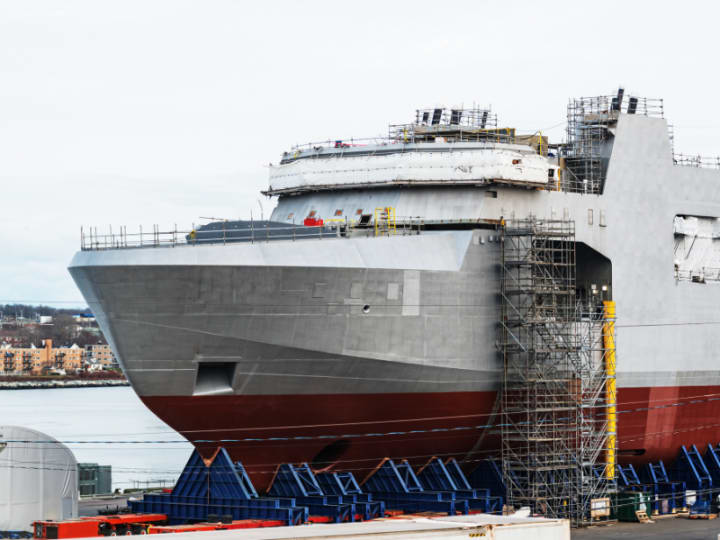
By installing heavy or complex components in easily accessible block sections, yards reduce the need for difficult manoeuvring inside the narrow confines of a completed hull.
This approach saves time, reduces labour hours and improves safety.
Once the blocks are fully assembled and outfitting is well underway, the vessel moves to the painting and coating stage.
Maritime coatings are critical for corrosion protection, especially for vessels working in saltwater, ice-prone regions or high-wear environments like offshore construction.
Specialist teams carefully grit-blast surfaces, apply primers and lay down advanced anti-fouling coatings designed to reduce drag and improve fuel efficiency. Each layer is inspected to ensure correct thickness and adhesion, meeting strict standards set by classification societies.
With the hull complete and major systems installed, the vessel is ready for launch. Shipyards use various methods depending on location and facilities.
Some use a traditional slipway, allowing the vessel to glide into the water. Others rely on a syncrolift or massive floating dock that lowers the vessel into the sea. Regardless of the method, the first time a vessel touches water is a major milestone—a moment of celebration for everyone who has worked on the project.
Once afloat, attention turns to commissioning. This phase involves extensive testing of all systems. Engineers run the propulsion setup at different loads, test electrical distribution, verify safety systems, and calibrate navigation and communication equipment.
The fire and bilge systems undergo rigorous checks, and the vessel’s stability is tested against modelling predictions.
Software is fine-tuned, sensors aligned and performance logged. Any issues found are corrected while the vessel remains at the yard or alongside a dedicated commissioning berth.
After successful dockside tests, the vessel heads out for sea trials. This is where the ship proves itself in the real world.
During sea trials, the crew—usually a mix of yard engineers, classification surveyors and specialist technicians—puts the vessel through a comprehensive schedule.
They test maximum speed, crash stops, turning circles, fuel consumption, DP performance, noise and vibration levels, and emergency procedures.
Sea trials may last several days, and every reading is carefully compared with the original design specifications.
If the vessel passes all tests, it’s returned to the yard for final adjustments before handover.
Interiors are completed, crew spaces furnished, and final touches such as signage, safety markings and bridge configuration are completed.
The client then carries out an acceptance inspection. Once satisfied, they officially take ownership of the vessel. For shipyard teams, this is a proud moment—the culmination of months or even years of work.
Today’s shipyards combine age-old craftsmanship with advanced digital workflows, sustainability principles and highly specialised engineering.
The industry is evolving fast, with hybrid propulsion, automation, new materials and greener fabrication processes becoming the norm. Yet, despite these innovations, the heart of shipbuilding remains the same: dedicated people working together to bring a vessel from concept to reality.
Building a modern vessel is an extraordinary achievement. It is the result of thousands of coordinated tasks, world-class engineering and an unwavering commitment to quality and safety.
Whether it’s destined for offshore wind, marine construction, aquaculture, towing, defence or oil and gas, every vessel that sails out on sea trials carries with it the expertise and pride of the yard that created it.
AI Has been used to help create parts of this post.
About the Creator
Keep reading
More stories from writers in FYI and other communities.
A Failed Artist, A Disillusioned Poet, An Underpaid Game Show Host
I took my son and niece to Gori, a small town in Georgia where Joseph Stalin was born. They talked me into visiting the Stalin's Museum, the largest in the post-Soviet space. I had resisted going there because I just can't stand the monster and know enough about him, or so I thought.
By Lana V Lynx19 days ago in FYI
On National Cheese Lover’s Day, Don’t Feel Bleu—Celebrate the Curds That Bind Us
January 20th rolls around every year with a simple but powerful message: don’t feel bleu, throw a feta, and absolutely act capriciously if cheese is involved. National Cheese Lover’s Day is the perfect excuse to lean into one of humanity’s oldest and most beloved foods. Whether you’re reaching for cheddar, asiago, fontina, or something that smells questionable but tastes incredible, this is a gouda day to celebrate it all.
By Lawrence Lease5 days ago in FYI
🅼🅸🅳🅽🅸🅶🅷🆃 🆂🅽🅰🅲🅺🆂
"It's 10 in Tuscon! We all know what that means... It's Time for Midnight Snacks with your man, Gerald Gee! Ready to spend the night together? Me too! I'm full of snacks and can't wait to regurgitate them all back into your hungry ears. Crack a brew! Pop some corn! Anything to get ready for one hell of a show where the talk maybe cheap but the words cut deep...
By Lamar Wiggins2 days ago in Fiction
Thoughts on Vocal and the way the world is
"Death cannot stop true love, only delay it." – Wesley in The Princess Bride. I decided to come back to Vocal on a very cold and dark night at the end of December. I had been, and still am, convalescing from a horrible staph infection that had gone misdiagnosed for months. This, paired with the increasing challenges of being healthy, making the best choices for my co-parented child, being a wife, and being a director at a new job, was a lot to manage.
By Jazzy 6 days ago in Confessions


Comments
There are no comments for this story
Be the first to respond and start the conversation.