
India Furniture Market Size and Forecast 2025–2033
India’s Furniture Industry Gears Up for a Decade of Design, Digitalization, and Demand-Led Growth

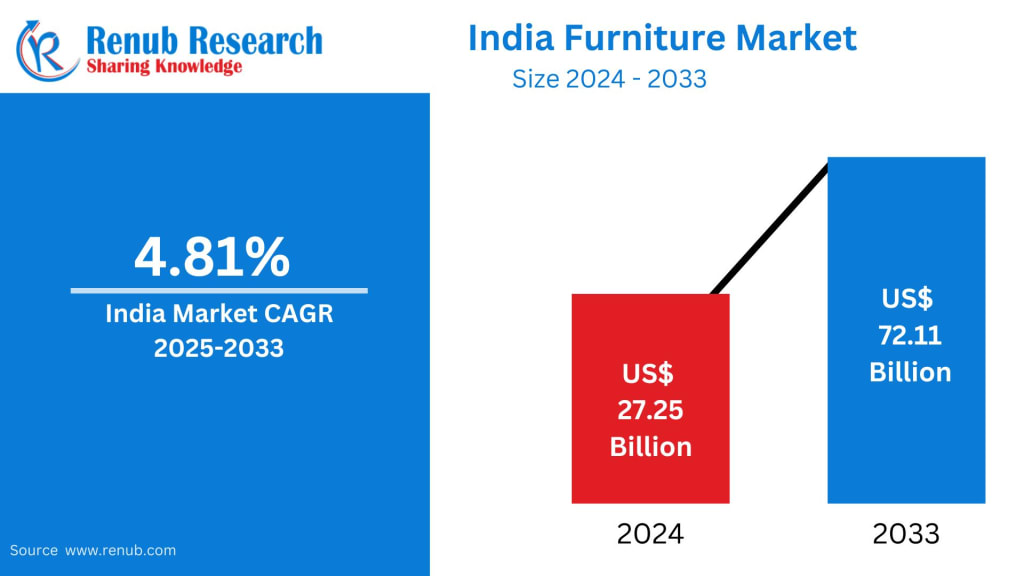
India Furniture Market Outlook at a Glance
The India Furniture Market is entering a transformative growth phase, supported by urbanization, rising incomes, evolving lifestyles, and a rapidly expanding real estate sector. According to Renub Research, the India Furniture Market is expected to grow from US$ 27.25 billion in 2024 to US$ 72.11 billion by 2033, registering a strong compound annual growth rate (CAGR) of 11.42% during 2025–2033.
Government initiatives promoting affordable housing, increased investments in infrastructure, and rising adoption of modular, space-saving, and ready-to-assemble furniture are significantly reshaping market dynamics. At the same time, the emergence of e-commerce and omnichannel retail models is redefining how Indian consumers discover, evaluate, and purchase furniture.
India Furniture Industry Overview
India’s furniture industry is undergoing a structural shift from an unorganized, carpentry-driven market to a more organized, brand-led ecosystem. While the unorganized sector still holds a considerable share, organized players are steadily gaining ground through better quality assurance, standardized designs, financing options, and superior after-sales service.
Policy support has played a crucial role in this transition. The Indian government’s decision to allow 51% foreign direct investment (FDI) in multi-brand retail has opened doors for global furniture manufacturers and design-led brands. This has intensified competition, introduced international aesthetics, and elevated customer expectations—particularly in metropolitan and Tier-1 cities.
Online furniture platforms have also transformed buying behavior. Average basket values for online furniture purchases typically range between INR 15,000 and INR 20,000, highlighting growing consumer confidence in digital furniture shopping. Leading platforms such as Pepperfry and Urban Ladder have collectively attracted over USD 300 million in investments, reflecting strong investor belief in the sector’s long-term potential.
To overcome the traditional “touch-and-feel” challenge, online-first brands have established experience centers, blending physical showrooms with digital convenience. This omnichannel approach has been instrumental in building trust and accelerating adoption.
Material Preferences and Manufacturing Trends
Despite the growing availability of alternative materials, wood remains the dominant material, accounting for over 62% of furniture produced in India. However, the industry is witnessing a gradual shift toward engineered wood, especially in urban markets such as Bengaluru, Mumbai, Delhi, and Hyderabad.
Engineered wood offers advantages such as cost efficiency, consistency, and compatibility with modular and ready-to-assemble furniture formats. Meanwhile, metal and plastic furniture are gaining traction in commercial spaces, offices, outdoor settings, and budget-conscious households.
Urbanization, shrinking living spaces, and increased rental housing have fueled demand for compact, multifunctional, and customizable furniture, pushing manufacturers to innovate in both materials and design.
Key Growth Drivers of the India Furniture Market
1. Rapid Population Growth and Urbanization
India’s accelerating urban population is a major catalyst for furniture demand. As millions migrate to cities in search of better employment and lifestyles, the need for residential housing, offices, retail spaces, and hospitality infrastructure continues to rise.
Urban consumers increasingly seek modern, space-efficient, and aesthetically pleasing furniture that aligns with contemporary living. Additionally, population growth results in the formation of new households, directly expanding the addressable furniture market.
2. Changing Lifestyles and Consumer Preferences
Indian consumers are becoming more design-conscious than ever before. Exposure to social media, home décor platforms, and global interior trends has reshaped expectations, with furniture now seen as a reflection of personal identity rather than just a functional necessity.
There is also a noticeable shift toward eco-friendly and sustainable furniture. Environmentally aware buyers are actively seeking products made from renewable resources, recycled materials, and low-impact manufacturing processes. This trend has encouraged manufacturers to adopt green practices, circular economy models, and sustainable sourcing, further strengthening market credibility.
3. Rising Disposable Incomes and Aspirational Spending
The steady rise in disposable incomes, particularly among the expanding middle class and young professionals, has significantly boosted furniture spending. Consumers are increasingly willing to invest in premium designs, branded products, customization, and long-lasting quality.
Furniture is now perceived as a lifestyle upgrade, driving demand for modular kitchens, ergonomic bedroom furniture, stylish living room sets, and smart storage solutions. This aspirational mindset continues to fuel sustained market expansion.
Challenges Facing the India Furniture Market
Limited Penetration in Rural Areas
Despite strong urban demand, rural penetration remains limited. Lower purchasing power, preference for locally made low-cost furniture, limited awareness of branded options, and lack of organized retail infrastructure restrict growth in these regions.
Logistical hurdles and high delivery costs further discourage organized players from aggressively expanding into rural markets. Bridging this urban–rural divide will be essential for unlocking the next phase of market growth.
Logistics and Supply Chain Constraints
Furniture logistics pose unique challenges due to product size, weight, and fragility. Poor road infrastructure, inefficient warehousing, last-mile delivery issues, and complex reverse logistics increase costs and impact customer satisfaction—especially for online retailers.
Addressing these issues through technology-enabled supply chains, improved infrastructure, and streamlined delivery networks remains a priority for industry stakeholders.
Regional Insights: India Furniture Market
North & Central India Furniture Market
North and Central India represent one of the fastest-growing furniture markets in the country. Cities such as Delhi, Jaipur, Chandigarh, and Greater Noida are witnessing robust demand driven by urban expansion, real estate development, and rising incomes.
Delhi’s Kirti Nagar furniture hub continues to attract both traditional and modern furniture buyers, while new residential and commercial projects across NCR fuel consistent demand.
Southern India Furniture Market
Southern India plays a pivotal role in both furniture manufacturing and consumption. Tamil Nadu and Kerala are notable contributors, blending industrial-scale production with traditional craftsmanship.
Government initiatives such as the International Furniture Park in Tuticorin, along with the presence of global companies like Haworth, have strengthened Tamil Nadu’s manufacturing ecosystem. Meanwhile, urban centers such as Bengaluru, Chennai, and Hyderabad are driving demand for modular, contemporary furniture suited to compact living spaces.
Western India Furniture Market
Western India, encompassing Maharashtra, Gujarat, and Rajasthan, showcases a dynamic mix of traditional artistry and modern design. Cities like Mumbai and Pune lead demand due to rapid urbanization and high purchasing power.
Renowned markets such as Chor Bazaar and Oshiwara coexist with premium showrooms and online platforms. Events like Design Mumbai highlight the region’s openness to global trends and innovation, reinforcing its role as a key growth engine.
India Furniture Market Segmentation
By Industry Type
Organized
Unorganized
By Ordering Method
Online
Offline
By Material Type
Wood
Metal
Plastic
Others
By Segment
Bedroom Furniture
Kitchen Furniture
Living Room / Dining Room Furniture
Others
By Region
North & Central India
Southern India
Western India
Eastern India
Company Analysis: Key Players
Nilkamal
A market leader in plastic furniture, Nilkamal has diversified into molded furniture, mattresses, and material handling solutions. Its wide distribution network and brand trust give it a strong competitive edge.
Parin Furniture
Known for contemporary designs and affordability, Parin Furniture caters to both residential and institutional customers, with a growing presence in organized retail channels.
Century Plyboards India
A dominant player in engineered wood and panels, Century Plyboards supports modular furniture growth by supplying high-quality raw materials to manufacturers and retailers.
Godrej Industries
Through its furniture division, Godrej offers innovative, ergonomic, and sustainable solutions across home and office segments, supported by strong brand equity and R&D capabilities.
Each of these players is analyzed across key leadership, business overview, revenue performance, and recent strategic developments, reflecting a competitive yet opportunity-rich landscape.
Final Thoughts
The India Furniture Market is poised for remarkable growth through 2033, driven by urbanization, rising incomes, lifestyle upgrades, and digital transformation. With the market projected to reach US$ 72.11 billion by 2033, furniture is evolving into a core component of India’s consumer and real estate economy.
As organized players expand, sustainability gains prominence, and omnichannel strategies mature, the industry stands at the intersection of design, technology, and aspiration. For manufacturers, retailers, investors, and policymakers alike, the coming decade presents an exceptional opportunity to shape the future of living spaces across India.
About the Creator
jaiklin Fanandish
Jaiklin Fanandish, a passionate storyteller with 10 years of experience, crafts engaging narratives that blend creativity, emotion, and imagination to inspire and connect with readers worldwide.
Keep reading
More stories from jaiklin Fanandish and writers in FYI and other communities.
Europe Paper Packaging Market Size & Forecast 2025–2033
The Europe Paper Packaging Market is undergoing a powerful transformation driven by environmental awareness, government regulations, and tightening sustainability standards across industries. According to Renub Research, the market is projected to grow from US$ 110.88 billion in 2024 to US$ 158.23 billion by 2033, expanding at a CAGR of 4.03% from 2025 to 2033. With consumers, governments, and corporations now aligned toward reducing plastic usage, paper packaging has emerged as one of the most rapidly growing and future-ready segments of the packaging industry.
By jaiklin Fanandishabout a month ago in FYI
A Failed Artist, A Disillusioned Poet, An Underpaid Game Show Host
I took my son and niece to Gori, a small town in Georgia where Joseph Stalin was born. They talked me into visiting the Stalin's Museum, the largest in the post-Soviet space. I had resisted going there because I just can't stand the monster and know enough about him, or so I thought.
By Lana V Lynx6 days ago in FYI
Is Human Levitation Real? The Viral Russian Forest Mystery
With superhero movies dominating our screens, it’s only natural that we spend a little too much time thinking about superpowers. But I’m not talking about those bizarre, "niche" talents you see on talent shows, like the guy who can pull a literal airplane with his eyelids.
By Areeba Umairabout 7 hours ago in FYI
The Ritual of Winter Challenge Winners
Welcome to the Winners Announcement for The Ritual of Winter challenge. This prompt focused on winter rituals and the meaning that settles into them over time. The top pieces stay grounded in ordinary acts and repeated routines, letting winter shape the work through pace, attention, and restraint.
By Vocal Curation Team3 days ago in Resources




Comments
There are no comments for this story
Be the first to respond and start the conversation.