
Hurt People, Hurt People
Why are we mean and judgmental when we can be kind and understanding?


"You didn't plan for COVID...you failed."
This was the comment I received this week on a video discussing the ongoing unemployment crisis for students graduating from universities.
You can watch the video here:
Now, over the years on the internet, I have, like you, received many hateful comments. It's something I feel we, chronically online people, are quite accustomed to at this point. Sometimes, we expect hate to come flooding in, and we even occasionally relish it.
Sometimes, when we don't expect the hate but do receive it, it can catch us off guard. There could be thousands of comments, 99% of which are positive and supportive interactions, but there's, of course, always one. And naturally, that is where all your attention goes.
What's worse is you don't know who is who. Who is human and who isn't? The internet is a graveyard that blooms no matter the season. As time goes on, it's getting harder to decipher what is genuine and what is false.
Could it be that we are wasting our time on falsehoods and distortions created by pixelated trolls, energy vampires, and NPCs? Feeding off the negative emotions and attention?
Why are we so quick to hate, I wonder? What compels an individual to judge so harshly based on the circumstances only they have lived? It is perplexing to me. Bewildering even.
Does it not cost you more of your time, your energy? Is it not more mentally exhausting to project nothing but hate? Perhaps that's why they say hate ages you.
So why do we hate more than we love? Why are we mean and judgmental when we can be kind and understanding?

Turns out, it's in our instincts. Studies show that human beings are more susceptible to negativity than positivity, purely based on survival.
Even when we are making a decision, human beings tend to focus more on the negatives rather than the positives - it's always the worst-case scenario, never the best outcome.
Our brains register negativity as a threat, activating our fight-or-flight response. So when someone expresses hate, it triggers a stronger emotional reaction because your brain sees it as a potential danger.
This is known as negativity bias. A subconscious defence that evolution hasn't decided to let go of. This is why our media is so hyper-focused on tragedies and horror, instead of wholesome and uplifting news. Rather than phasing out this instinct, we have, in turn, fed it.
But why does it feel like there is so much of it? Everywhere you turn, it feels like everyone is unhappy, judgmental and mean. Surely the constant negativity, triggering our fight-or-flight, can't be healthy?
Well, shock and horror, it is not. Constant exposure to negativity can be physically exhausting and can render our survival instincts obsolete.
Constant negativity can cause chronic stress, fatigue, weakened immune systems, disrupt concentration and contribute to memory loss.
To make matters worse, ongoing hate and negative attention can induce: high blood pressure, autoimmune diseases and ulcers. It can also affect your heart and digestive system.
Negativity can also isolate you, putting strains on relationships, making it harder to communicate with others, thus furthering isolationism, consequently making you more susceptible to anxiety and depression.
So yeah, hate does actually age you, no matter how much sun cream you put on.
Which brings me back to the original comment 'You didn't plan for COVID...you failed."
Yes. I failed. I failed to come up with an alternative. I could have anticipated that things wouldn't work out. But, then again, I am no mind reader. I don't own a crystal ball; otherwise, I would have warned us all.
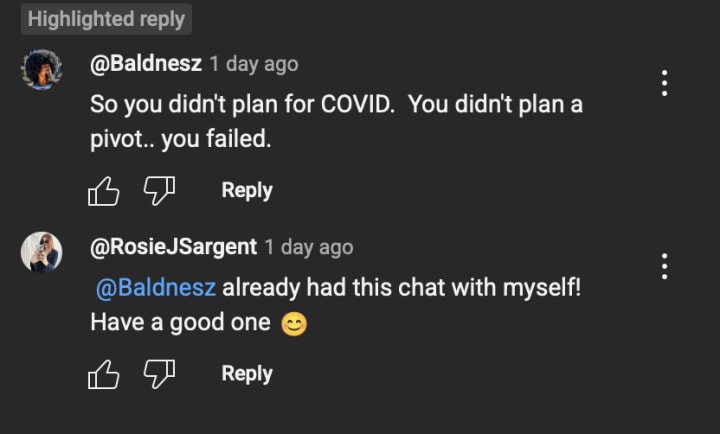
I say unto you, give these people, bot or otherwise, the benefit of the doubt. Kill them with kindness. Because it is true when people say comments like this say more about the person than it does you.
Be Kind isn't just some slogan; it is literally rewriting your basic instinct. The only way we can stop things feeling so shitty is to recognise this hate within ourselves and our communities and replace it with kindness and compassion, which I know can be done; we just have to choose to.
And when there's hate, ground yourself, don't feed into it. Separate yourself from toxicity by setting boundaries. Learn when the battle must be fought versus when it pays to be diplomatic.
Ask yourself, do I wish to inform or inflame?
On that note, thank you, now fuck off.
_____________________________________________
Thank you for taking the time out of your day to read my work. If you like my work, don't forget to give a like, comment, and subscribe!
Take care of yourself out there. I hope to see you around!
About the Creator
Keep reading
More stories from Rosie J. Sargent and writers in FYI and other communities.
A Failed Artist, A Disillusioned Poet, An Underpaid Game Show Host
I took my son and niece to Gori, a small town in Georgia where Joseph Stalin was born. They talked me into visiting the Stalin's Museum, the largest in the post-Soviet space. I had resisted going there because I just can't stand the monster and know enough about him, or so I thought.
By Lana V Lynx7 days ago in FYI


Comments (2)
Thanks
I liked your take on this concept. I admit I overact to perceived haters of certain vulnerable groups in society, especially those who target the LGBTQA+ community or judging people by their ethnicity or skin colour. I pounce before giving them the benefit of the doubt or taking time to give them a chance to speak. Hate is draining and with what's happening socio-politically, especially in the USA there seems to be plenty of it going around right now. This made m reflect, "do I wish to inform or inflame?" ~ good read!