
How is Russia's geography its worst enemy?
For Putin, Russia's geography is a crucial issue that he is not ready to abandon anytime soon. But where does that problem originate? And what does Russia's vast history tell us about the country today? Get a take on this amazing narrative! ❕🛑⚠⚠🛑❕

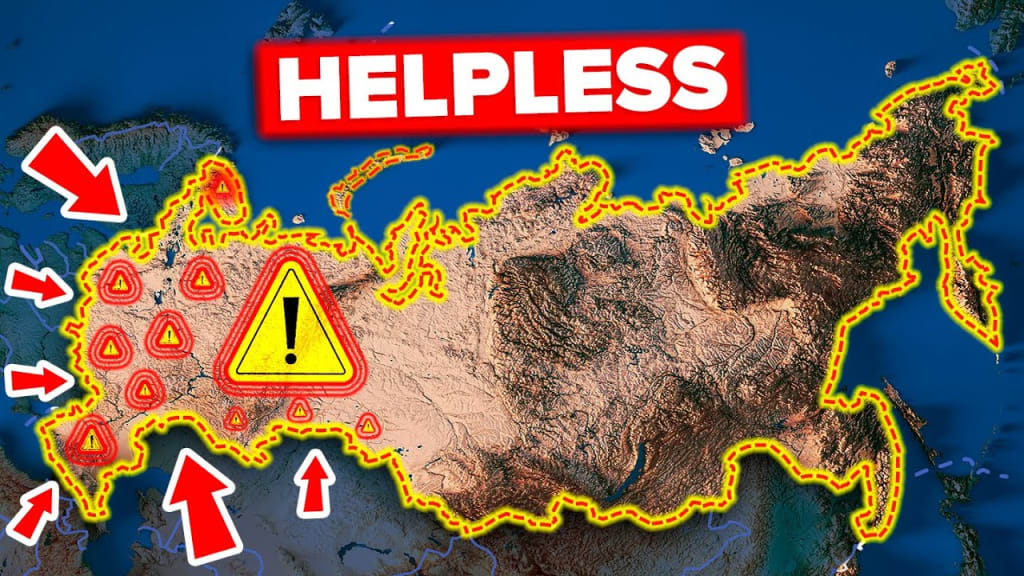
For Putin, Russia's geography is a crucial issue that he is not ready to abandon anytime soon. But where does that problem originate? And what does Russia's vast history tell us about the country today? Get a take on this amazing narrative! ❕🛑⚠⚠🛑❕
From Syria to Ukraine, Vladimir Putin's violent and unsettling actions are constantly making international headlines, but his reasons for doing so are somewhat mysterious. However, the geography of Russia itself may be a factor in explaining some of Putin's apparent irrationality. Why? Because Russia's geographic location makes it its own worst enemy. Every Russian leader has made some effort to address this problem, with the majority turning to violence in the process. Putin also has a big issue with Russia's geography, which he isn't about to give up on any time soon. But where exactly does that issue originate from, and what can its lengthy history teach us about the Russia of today? Russia's geographic curse predates the nation itself. It was first established in what is now Ukraine during the 9th century, when the Kievan Rus, an alliance of East Slavic tribes, was founded.
The Rus were the first people to create a distinctive cultural identity that would later become Russian, and they were centered on the city of Kiev. But geography was already posing a challenge by the 1200s. The Mongol Empire conquered the region because it was simple to march an army across the flat terrain surrounding Kiev. The early Russian civilization moved north after the Mongol conquest and founded the Grand Principality of Moscow. However, geography once more proved to be a problem. Since there aren't any mountains, deserts, or significant rivers to defend Moscow, it is even less defendable than Kyiv. Russian policy changed as a result of the realization of this weakness, which stated that a potent offense is the best form of defense.
Throughout Ivan the Terrible's rule as Russia's first tsar, this tactic was consistently employed. While his grandfather had only slightly increased Russian territory, Ivan took it to a new level by implementing a foreign policy approach that is still used in Putin's Russia today. The Ural Mountains in the east, the Caspian and Black Seas in the south, and the Arctic Circle in the north were all conquered by Ivan after he had solidified his support at home. In addition to the untamed Caucasus Mountains, this gave him access to two significant bodies of water. These offered access to ports that wouldn't freeze in the winter as well as a natural defense against invasions from the east. Ivan went a step further and built a military outpost in Chechnya, providing the best possible defense against formidable adversaries like the Mongols, Ottomans, or Persians.
Later Russian leaders regarded his expansion strategy as a success because it created a safe haven for the expanding nation. Nobody could attack Moscow from the Arctic or over the Ural Mountains, and Russian forces now occupied a position that was very easy to defend. The western part of Russia was still vulnerable to enemy attack as a result, and this would repeatedly come back to haunt the nation. Peter the Great established the Russian Empire formally in 1721, but the dominant country was still troubled by fears about its undefended west. These worries prompted Peter and later Empress Catherine the Great to maintain their expansionist policies. Additionally, the capital was transferred to St. Petersburg, in part because it allowed for some sea access and offered significantly more security than Moscow.
The Russian Empire grew more westward under Catherine, all the way to the Carpathian Mountains in Europe. As a result, it ate up the territory of modern-day Lithuania, Latvia, and Estonia so that it could protect itself from attacks from the Baltic Sea. This resulted in the formation of a vast ring of land that provided protection, extending from the Arctic all the way through the Baltics, Ukraine, the Carpathian Mountains, the Black Sea, the Caucasus, and the Caspian Sea, and all the way east to the Urals. This vast protective zone worked well and kept invaders at bay for many years. Everything was altered in 1812. Napoleon, the French Emperor, began his extensive land invasion of Russia in that year. Napoleon's invasion, one of the deadliest military campaigns in history, was also the worst nightmare of every Russian leader.
Moving swiftly in the direction of Moscow, 500,000 French soldiers entered Russia from the west. Napoleon exposed Russia's geographic weakness, despite the fact that he famously lost half of his men to illness and extreme cold in just six weeks. Moscow was burned behind Russian troops as they were forced to flee the city in order to avoid being massacred. Even though Napoleon's campaign was a disaster, Russia would not soon forget the threat of a western invasion. Even after the 1917 Russian Revolution, which brought an end to the Russian Empire, people continued to be fixated on expanding westward. The Soviet Union may have inherited a sizable portion of the Russian empire's land, but it also carried the curse of its location.
The Soviet government returned Moscow as its capital against a backdrop of famine, civil war, and world war. In order to partly avert another western land invasion, it also succeeded in establishing friendly governments in the newly independent territories of the former empire. The USSR's sphere of influence once again encompassed Eastern Europe and Central Asia by the 1920s, giving the impression that this strategy had been successful.
Russia's geographic curse, however, resurfaced during World War II. Hitler's troops were able to swiftly advance across the European Plain when Nazi Germany invaded the Soviet Union in 1941. Even though he was ultimately victorious, the USSR suffered a terrible toll in the process, losing more people than any other nation in the war—approximately 27 million—during the conflict.
About the Creator
A Failed Artist, A Disillusioned Poet, An Underpaid Game Show Host
I took my son and niece to Gori, a small town in Georgia where Joseph Stalin was born. They talked me into visiting the Stalin's Museum, the largest in the post-Soviet space. I had resisted going there because I just can't stand the monster and know enough about him, or so I thought.
By Lana V Lynx8 days ago in FYI
If You Love Me, You'll Do It
I met Jason when I was five years old. I could say that I loved him from the moment I saw him. He was so handsome to me and I felt in awe by his presence. When they introduced him as the new kid in school, I wanted to be his friend right away. I remember it like it was yesterday. I remember his smile and how he didn't seem shy. He appeared confident and ready to learn. I waved at him and said "hello," before anyone else could even say a word. He sat next to me, and I asked him if he wanted to be friends. He looked so happy as he said, "Yes!"
By Sidney Smith (Sid Smith)8 days ago in Fiction


Comments
There are no comments for this story
Be the first to respond and start the conversation.