
How is it that Australia, a barbaric land, can become a highly developed country?
Australia is one of the world's top ten exporters of agricultural products and one of the top six exporters of mineral resources

01. Australia's geographic location, how remote, how barbaric?
The geographic location of the Australian continent is like an "island" in the Pacific Ocean, although today's geographers would rigorously define it as the smallest continent on Earth, and all those smaller than it is called islands.
Although some scientists have shown that the Australian continent may have been connected to other continents hundreds of millions of years ago. But from the relatively short history of mankind, it can be considered to have been alone above the ocean.
Nevertheless, the Australian continent has been inhabited by humans since ancient times, but how early? Some archaeologists have found remnants of ancestral human existence on the Australian continent as early as 100,000 years ago.
However, it was not discovered until the 17th century during the Age of Sail that it was brought into line with external human societies. Before the arrival of Europeans in Australia, the number of Aboriginal people here is controversial, but it can be estimated to be between 318,000 and 1 million people, with a distribution pattern similar to the current distribution of Australia's population, most of whom live in the southeast, centered on the Murray River.
02. Europeans brought advanced civilization but also brought disaster and death.
The population collapse after European settlement, mainly due to disease, began with the spread of a smallpox epidemic three years after the arrival of Europeans. Massacres and border conflicts involving European settlers also led to population decline. This violence has been characterized by some as genocide.
Australia became a site of British colonization and convict exile beginning in the late 18th century, and later became a hot spot for immigration and investment due to the discovery of valuable mineral deposits here.

Thanks to its isolated location, Australia has not been affected by international wars since it was colonized, and there have been few internal wars and conflicts, except for the northern city of Darwin, which was affected by the fighting in World War II.
Only the northern city of Darwin was affected by the Second World War. However, during both world wars and the Korean War, Australian soldiers went to Europe and the Korean Peninsula to fight in major battles.
03. Australia is where it is today because of a combination of natural strength and the dividends of the Commonwealth system and globalization.
Australia is the most economically advanced country in the southern hemisphere and one of the most economically advanced countries in the world. Australia is one of the world's top ten exporters of agricultural products and one of the top six exporters of mineral resources. It has been called "the country that rides on the back of a sheep, sits on a mine cart, and holds the sheaf of wheat." Australia's financial, commercial and service industries are also highly developed. In addition, Australia's tourism industry is among the highest in the world. Surrounded by sea, Australia's fisheries are extremely rich and have great potential for development, but the country has been limiting the volume of fisheries investment for environmental reasons.
With its resource endowment, the implantation of modern European industrial and agricultural civilization, and the good business regulations brought by Britain, Australia has gradually developed into a developed country with the highest degree of freedom and democracy, socio-economic development, and quality of life in the world since the mid to late 19th century.
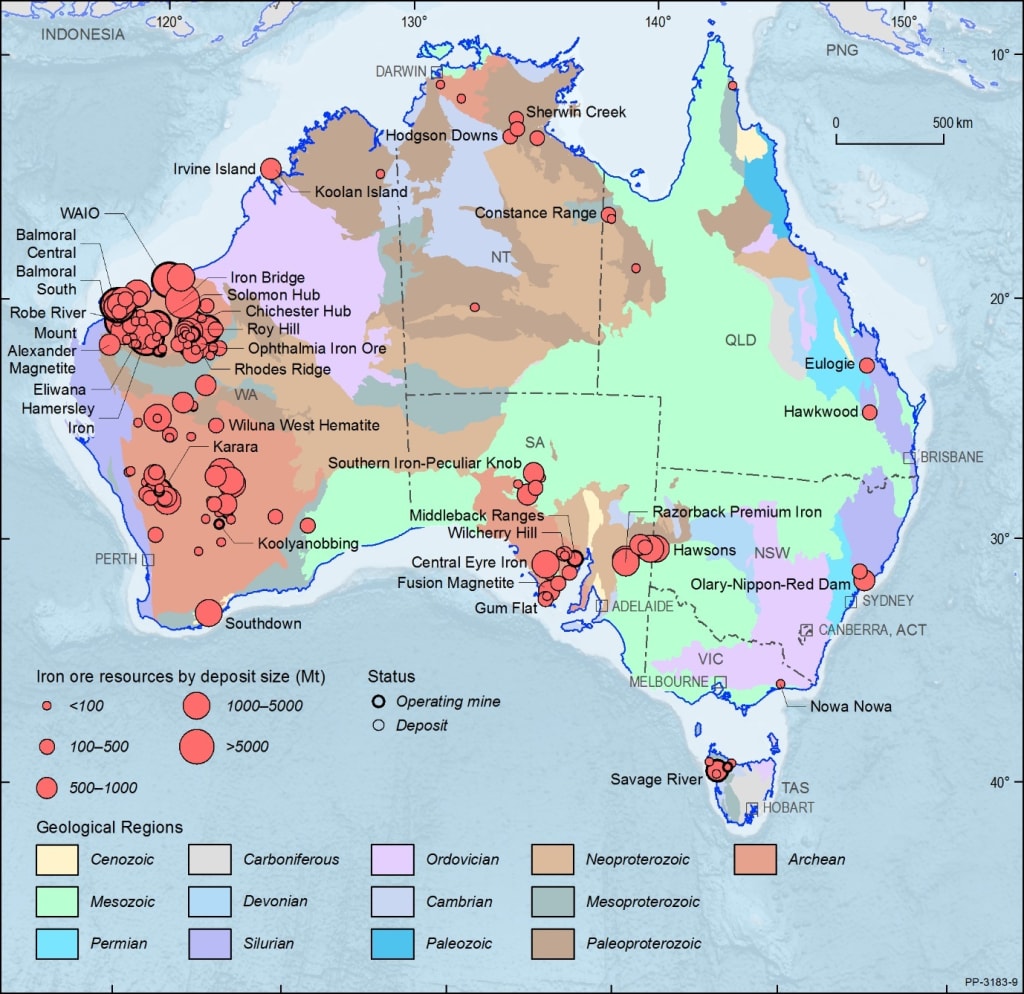
At the end of the 20th century, international trade boomed as a result of globalization, and Australia was blessed with the resources to take its economy to the next level. Australia is one of the world's top ten exporters of agricultural products and one of the top six exporters of mineral resources. Wheat exports are the second highest in the world. The main export commodities include coal, gold, iron ore, crude oil, natural gas, bauxite, beef, wool, wheat, sugar, and beverages. Major imports include aviation equipment, drugs, communication equipment, vehicles, crude oil, refined oil, and auto parts. Australia's major trading partners are China, Japan, the United States, New Zealand, Germany, the United Kingdom, South Africa, Saudi Arabia, India, South Korea, Singapore, Indonesia, and Brazil. Among them, Japan, the United States, New Zealand, China, and Singapore are the most important trading partners in Australia.
However, the Aboriginal people on the Australian continent have suffered in some ways, and the Australian Federal Government has apologized for this and has gradually worked to improve and protect the conditions and rights of the Aboriginal people, and the situation has greatly improved.
Australia's independence movement and process began in 1901 when the original six British colonies (i.e. the present states) formed the Commonwealth of Australia, and from then on Australia gradually separated from Britain and exercised its sovereignty as a nation, until 1986 when it became an independent country by decree. Only the constitutional monarchy has remained unchanged in Australia, and the British monarch is still revered as Australia's head of state.
About the Creator
Mg o
Treat all people with sincerity, live in harmony with the majority, frequent the minority, and be intimate with only one.
A Failed Artist, A Disillusioned Poet, An Underpaid Game Show Host
I took my son and niece to Gori, a small town in Georgia where Joseph Stalin was born. They talked me into visiting the Stalin's Museum, the largest in the post-Soviet space. I had resisted going there because I just can't stand the monster and know enough about him, or so I thought.
By Lana V Lynx22 days ago in FYI
Medjedovic and the Quiet Rise of a Player Few Expected
Every sport has stories that grow slowly, almost unnoticed. They do not arrive with noise or heavy expectations. They move forward through discipline, doubt, and long hours when no one is watching. Medjedovic is one of those stories. For many tennis fans, his name appeared suddenly, but his journey began years earlier on quiet courts and modest stages. His rise speaks to patience rather than spectacle. It speaks to belief shaped through losses, not just wins. Understanding Medjedovic means looking beyond rankings and results. It means seeing the human effort behind each match and why his presence now feels earned, not accidental.
By Muqadas khan7 days ago in FYI




Comments
There are no comments for this story
Be the first to respond and start the conversation.