
HOLOCAUST REMEMBRANCE DAY: WHY MEMORY MATTERS
Take a Week to Remember The Darkest Day in World History


Every year on January 27, the world pauses for Holocaust Remembrance Day—a moment carved into the global calendar to remember one of the darkest chapters in human history. The Holocaust was not an abstract tragedy or a distant myth. It was a systematic, industrialized campaign of persecution and murder carried out by Nazi Germany during World War II, resulting in the deaths of millions of innocent people.
This day is not about statistics alone. It’s about memory, responsibility, and the uncomfortable truth that ordinary systems, governments, and institutions can be turned into tools of unimaginable cruelty when hatred is normalized and left unchecked.
A REGIME BUILT ON DEHUMANIZATION
Nazi Germany stands as one of the most evil regimes to ever exist. In less than four years, it orchestrated the persecution and killing of millions. At the center of this genocide were Jewish people—men, women, and children targeted solely for their faith and identity. An estimated six million Jews were murdered during the Holocaust, wiped out through ghettos, forced labor, starvation, mass shootings, medical experimentation, and extermination camps.
But the Nazis’ campaign of terror extended far beyond the Jewish community.
Genocide, by definition, is the deliberate attempt to destroy a particular ethnic, national, racial, or religious group. The Holocaust fits this definition with chilling precision—and its reach was vast.
THE SCALE OF LOSS
In addition to Jewish victims, Nazi Germany murdered millions of others deemed “undesirable” or politically inconvenient:
- 7 million Soviet civilians
- 3 million Soviet prisoners of war
- 1.8 million Polish civilians
- 312,000 Serb civilians
- Up to 250,000 people with disabilities
- Up to 250,000 Romani (Gypsies)
- Around 1,900 Jehovah’s Witnesses
- Thousands of homosexual men
These numbers represent real lives—families erased, cultures fractured, futures stolen.
Many Jewish victims were deported to concentration and extermination camps. The most infamous of these was Auschwitz-Birkenau, where approximately one million Jews were murdered. Some died from disease or starvation; others were sent directly to gas chambers. Elsewhere, people were confined to ghettos where food, medicine, and hope were systematically denied. In Eastern Europe, entire communities were rounded up, executed, and buried in mass graves.
STORIES THAT SURVIVED
While the Holocaust sought to erase lives, it did not erase voices.
Some of the most powerful reminders of this era come from literature and film—works that preserve testimony, memory, and warning for future generations. One of the most famous is The Diary of a Young Girl, written by Anne Frank. Her diary documents two years spent hiding from Nazi authorities in Amsterdam. Discovered and deported, Anne died of typhus at just 15 years old in a concentration camp.
Other notable works include The Hiding Place by Corrie ten Boom, The Boy in the Striped Pajamas by John Boyne, and Born Survivors by Wendy Holden. Films such as Schindler’s List, The Reader, Denial, and The Devil’s Arithmetic continue to introduce new audiences to the realities of the Holocaust.
Beyond books and movies, countless plays, poems, musical compositions, and artworks—many created by survivors themselves—stand as acts of resistance against forgetting. Others honor the heroes who risked everything to save Jews and other victims from certain death.
HOW THE WORLD REMEMBERS
Holocaust Remembrance Day is marked across the globe with ceremonies and educational events. The United Nations hosts an annual memorial ceremony featuring survivor testimonies, music, and prayers. Museums and institutions organize photographic exhibits, panel discussions, film screenings, and readings designed to confront the past honestly.
This day also serves another purpose: to confront denial.
Despite overwhelming evidence, some continue to deny the Holocaust ever happened. That denial makes remembrance not just symbolic—but necessary. Forgetting history makes it easier for it to repeat.
People are encouraged to mark the day publicly, sharing reflections with #HolocaustRemembranceDay or #NeverForget, not for visibility—but for vigilance.
WHY JANUARY 27 MATTERS
The history of Holocaust Remembrance Day is tied directly to liberation and truth. On January 27, 1945, Soviet troops liberated Auschwitz, revealing the full horror of the Nazi camp system to the world. Decades later, on January 24, 2005, the United Nations General Assembly commemorated the 60th anniversary of that liberation. Later that year, on November 1, the UN formally designated January 27 as the International Day of Commemoration in Memory of the Victims of the Holocaust.
The date is not accidental. It is a reminder of what was uncovered—and what can never be unseen.
NEVER FORGET
Holocaust Remembrance Day is not about dwelling in the past. It’s about understanding the consequences of hatred, silence, and indifference. It’s about honoring victims by refusing to look away, refusing to deny, and refusing to let memory fade.
Because remembrance isn’t passive.
It’s a responsibility.
As a Human Being, I want to offer my condolences to everyone who has been impacted/affected by the Holocaust. I will never know, feel or understand the suffering that those impacted have been dealing with all these years. The only thing I can do is to make sure this never happens again and to speak out.
About the Creator
Lawrence Lease
Alaska born and bred, Washington DC is my home. I'm also a freelance writer. Love politics and history.
Keep reading
More stories from Lawrence Lease and writers in FYI and other communities.
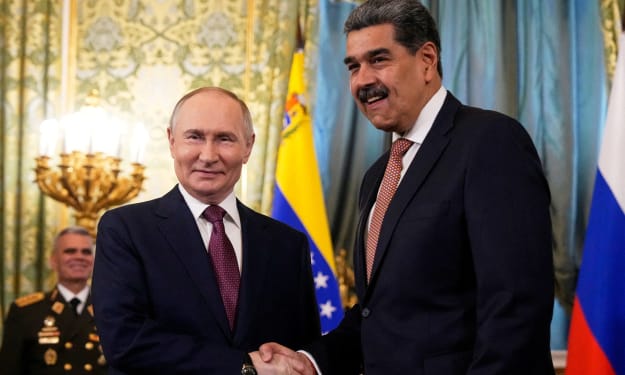
Venezuela Fiasco Could Mean the End of Russia
The U.S. capture of Nicolás Maduro didn’t just redraw Venezuela’s political future. It may have quietly detonated a much larger charge—one aimed straight at the foundations of Vladimir Putin’s Russia. What looked like a regional power play in Caracas has exposed a web of weaknesses that stretch from Russian arms exports to oil markets and global credibility. And once those threads started snapping, the world noticed.
By Lawrence Lease5 days ago in FYI
A Failed Artist, A Disillusioned Poet, An Underpaid Game Show Host
I took my son and niece to Gori, a small town in Georgia where Joseph Stalin was born. They talked me into visiting the Stalin's Museum, the largest in the post-Soviet space. I had resisted going there because I just can't stand the monster and know enough about him, or so I thought.
By Lana V Lynx23 days ago in FYI


Comments
There are no comments for this story
Be the first to respond and start the conversation.