
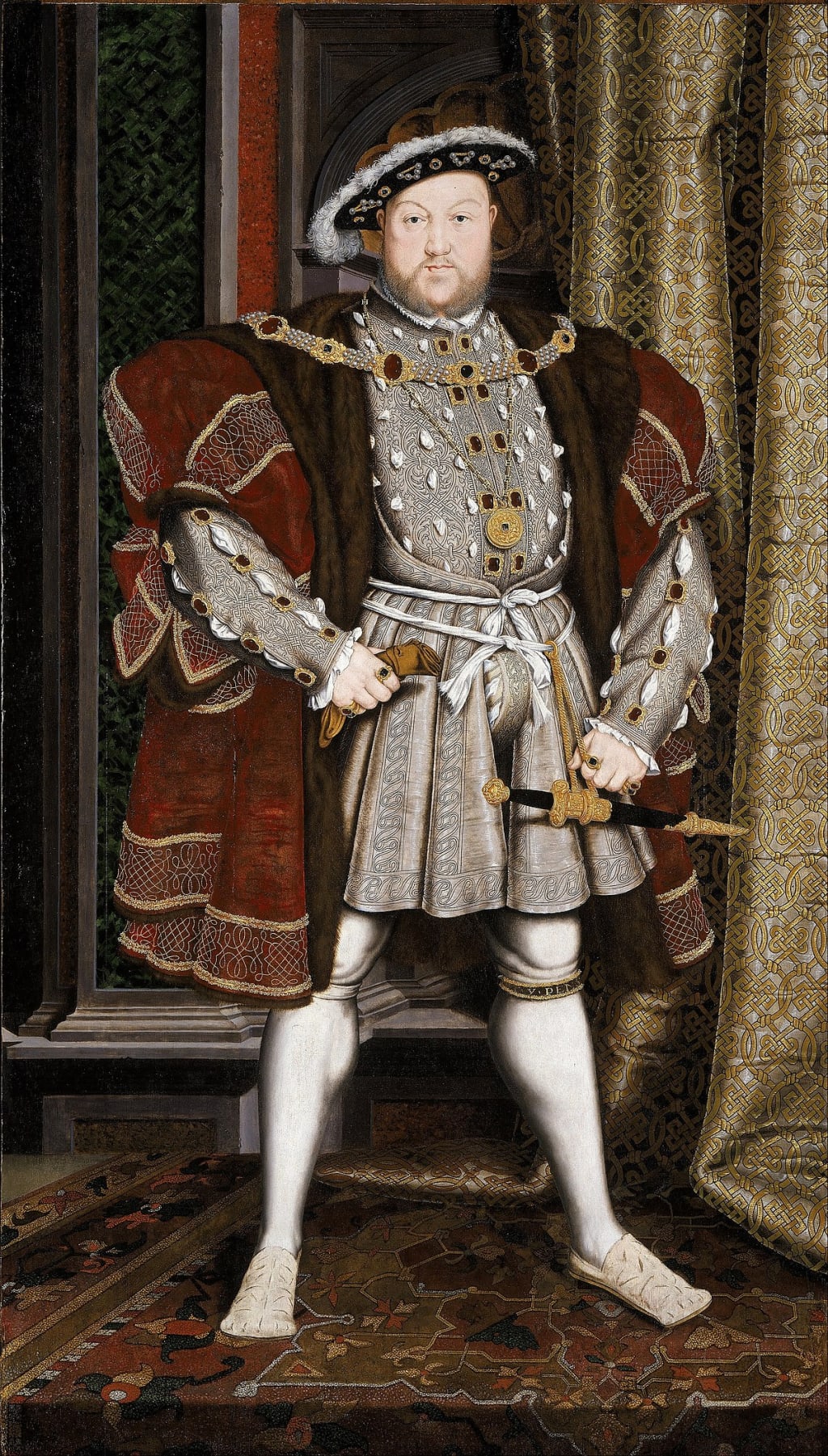
Birth/ family
Henry VIII was born on the 28th June 1491 to his parents King Henry VII and Queen Elizabeth of York. Henry was the third child and second son to be born to the royal couple with his eldest brother Prince Arthur born in September 1486 and elder sister Princess Margret born in November 1489. Henry himself would also become a elder brother to another three siblings, yet only one would survive to adulthood. In 1502 Queen Elizabeth would once again become pregnant however this would prove to be fatal, both mother and baby (a daughter) would die leaving behind her distraught family.
Childhood
Little Prince Henry like his sibling was devastated over his mother’s death, but despite those tragic events Henry would go on to have a very prosperous childhood. Unlike his elder brother who was taken away to be raised in a separate household to his siblings, Henry was raised in a predominately female household along with his sisters and nurses. Unlike his elder brother Arthur, Henry believed his future was to be in the church and his whole education was based around his future in the church, still that didn’t stop the young Prince from excelling in his studies such as Latin, Spanish, French, Italian, Mathematics, Music, and Theology (the study of religion). Henry grew to be a very accomplished musician and knew how to play several instruments such as the lute, the organ, and the harpsichord, not to mention his hobbies that included archery, hunting, wrestling, and jousting.
Henry was in all intense and purposes the Perfect Prince of England. Though his life would once again be struck by tragedy as his elder brother Prince Arthur at the age of 15 would die from a mysterious illness, though many suspected it was the mysterious sweating sickness that was sweeping through the nation. Henry had now suffered two great losses and had also become the future king of England.
Marriages
Catherine of Aragon
Soon after ascending to the throne of England after his father death, The now king Henry VIII aged 18 wedded Catherine of Aragon, the widow of his brother Arthur. The pair would be be married for 24 years, though despite several pregnancy Catherine and Henry would only boast one living child, Princess Mary. Their once happy Marriage would sour, with Henry believing Catherine’s failure of producing a male heir was a sign from god the marriage was not blessed, and he would begin a six year long quest to get a divorce.
Anne Boleyn
After Henry was granted his divorce he would go on to marry his second wife Anne Boleyn in a official ceremony 25th January 1533, though their are historical documents that prove Anne and Henry had secretly married on 14th November 1532 in a private ceremony. Yet despite their joy the marriage was not favourable in the eye’s of the common folk nor Nobel’s, many of whome still supported Catherine and the now bastardised Mary, believing Catherine was Henry’s real wife and not Anne. Still on the 7th September 1533 Anne and Henry welcomed a Daughter though despite it not being the desired son they wanted the baby was christened as Princess Elizabeth. Anne would go on to become pregnant another 3 times however each would end in a miscarriage. After 3 years of marriage and her failure to give Henry a son, Anne found herself falling out of favour with king Henry who’s eyes had once again began to wonder. Henry would have Anne imprisoned in the tower and found guilty of multiple charges which included adultery, witchcraft, incest and plotting to kill the king. As punishment Anne would be executed on the 19th May 1536 by decapitation along with those men who had been accused, one of which was her brother George Boleyn.
Jane Seymour
King Henry would marry his sweetheart Jane Seymour on the 30th May 1536, eleven days after his previous wife’s execution. Unlike her predecessor many of the courtiers and common people cam to like the new queen, given her known sympathy for the late queen Cathrine and the lady Mary. However she was never officially crowned queen unlike Anne or Catherine due to the outbreak of plague in London, not to mention the rumours that spread through the court about Henry’s reluctance to have her crowned until she produced his long desired son. Which she would accomplish on 12 October 1537 when she would birth a son. The now Prince Edward was christened on the 15th of the same month yet the joy of a future king would soon be replaced by tragedy. Queen Jane died on the 24th of October 1537 leaving Henry broken hearted and in mourning for two years after her death. It is said this is when he put on weight to the point of obesity.
Anne of cleves
Henry’s next Marriage would be to the sister of a wealthy German duke named Anne of cleaves. They married on 6th January 1540 however it was not to last, only six months later Henry had the Marriage annulled. However due to her acceptance of the annulment Henry gave Anne a very generous settlement which included Richmond Palace and Hever Castle and bestowed her the title of the kings ‘beloved sister’.
Katherine Howard
The next of Henry’s wives was the young and carefree Katherine Howard, cousin to Anne Boleyn. The pair would marry in 1540 despite Henry being around thirty years Katherine’s senior. Henry referred to her as ‘A rose with no thorns’. However their Blissful Marriage would come crumbling down on the 1st November 1541 when Henry would be given a letter describing allegations against Katherine, which included her having secret relation’s with a favourite courtier of his named Thomas Culpeper. It was also said Catherine was not pure when the king had bedded her, and she had in fact had several dalliances during her time at Lambeth under the supervision of the dowager duchess. Katherine would be stripped of her title as queen on the 23 November 1641 and imprisoned in the new Syon abbey in Middlesex where she remained throughout the winter of 1541. Finally on the 13th February Catherine Howard was executed by decapitation in the Tower of London.
Catherine Parr
The final wife of Henry was a twice widowed Catherine Parr. An ailing and sickly Henry married Catherine on 12th July 1543. During her marriage to the king, Catherine grew close to his three children and was said to of been the one to convince Henry to have his daughters restored into the line of succession behind their brother. Many had suspected Catherine on being a secret Protestant and in 1546 it is said that a warrant for her arrest had been written. However Catherine had been able to reconcile with Henry and was spared from imprisonment. During his final years Catherine became a form of nurse maid to a sickly Henry and remained married to up up until Henry’s death on the 28th January 1547.
Break with Rome.
For the majority of his life and reign Henry had been a devout catholic, he attended mass daily and held the pope in the highest regard, so much so he had defended the pope against the works of the German priest Martin Luther by writing his own book called Assertio Septem Sacramentorum, or as it in know today the Defence of the Seven Sacraments. Because of this the pope gave Henry the title of Fidei Defensor, or Defender of the Faith. However his love and respect for the pope would begin to dwindle when he began courting Anne Boleyn.
It is still unclear to this day if Henry seeking an annulment before or after he met Anne Boleyn, but in 1525 Henry wrote to the pope seeking an annulment of his marriage to Katherine of Aragon. To keep Henry placated Pope Clement VII agreed to let Henry put his marriage on trial in 1529. A representative by the name of Cardinal Campeggio came to England to oversee the trial. Henry and Katherine each gave evidence at the trial, Katherine on why the Marriage was valid and Henry why it wasn’t.
After months of debate and delays, the court did not grant Henry his annulment due to multiple reasons. The reason included a passage from the biblical book of Deuteronomy. Henry tried to argue that he should of never been allowed to marry his brother’s widow, yet in Deuteronomy it states that a man SHOULD marry his brother’s widow. The second reason was If the Pope declared Henry's marriage invalid, he would be going against the papal dispensation of a previous Pope, who had allowed Katherine and Henry to Marry in the first place. Another key reason was to do with Katherine’s Spanish relatives. Katherine’s nephew King Charles V had swept through Italy with his army after the Battle of Pavia, in 1525 and had captured the pope.
Due to the Catholic Church not allowing Henry his annulment and under the influence of Anne Boleyn and her reformist ideas especially the ideas of Martin Luther, Henry began to look see where for his annulment. In 1531 Henry had Protestant thinkers and university academics alike compile historical and religious texts that said a king could make religious decisions in his own kingdom. One such book was called the Collectanea Satis Copiosa, or the Sufficiently Abundant Collections. It stated that Henry should have the power to annul his own marriage in England and instead of the wealth from the monasteries going to Rome, the money would instead would go into the royal vaults and more importantly to Henry, helping him with his financial issues.
With his beliefs now fully focused on reformation, Henry began the process of breaking England away from the influence of Rome and the Catholic Church. In 1534, Henry had Parliament grant him the Act of Supremacy, which allowed him to annul his marriage to Katherine as it stated that the monarch was the head of the English Church.
In 1534 The Treasons Act was but into law. It stated that anyone who questioned Henry’s power over the Church, or even thought badly of him, could be punished by death.
Despite Anne’s fall from grace in 1536, other Protestants that resided in court, a well known one of them was Thomas Cromwell, pushed forward with their plans. They believed that the Church, and in particular the monasteries, weren’t living as humble as was expected of Christian monks, Thomas believed they needed to be reformed.
Henry and Cromwell sent men to strip the monasteries of their treasures, and established the Court of Augmentations. Its job was to organise the selling of the monasteries and their land to noblemen. Any profits went to the king and It was one of the largest changes of land ownership in English history. As one would expect Henry gained immense wealth, and his nobles quickly bought up monasteries and their lands, converting them into grand homes, forever changing England.
Fatal injury
We can’t talk about Henry VIII without dealing with one of his most memorable injury’s, one which some medical studies believe may have forever changed Henry, and been the cause of his descent to become the tyrannical monster we know today.
Henry VIII had always been an athletic man and regularly took part in hunting, fencing, wrestling, archery and of course jousting.
On 24 January 1536, Henry had completed in a jousting tournament at Greenwich palace, The 44 year old king who had been dressed in full armour was thrown from his equally armoured horse, the horse then proceeded to fall on top of him, crushing him.
Historical reports tell that Henry had been unconscious for two hours and was thought to of been fatally inured. Henry survived but his days of jousting and other physical activities came to an end.
Due to the accident Henry suffered serious leg problems which stayed with him for the rest of his life, and may have also caused an undetected brain injury which profoundly affected his personality.
Throughout his life Henry legs would play host to ulcers that would seep puss and cause him great pain limiting it ability to walk.
Due to his lack of physical exercise and his diet that consisted of mainly meat, Henry quickly grew in size. Historical documents disclose that at in his early Twenties Henry was a strapping 6-feet tall, and weighed 210 pounds and had a 32-inch waist, were-as by the end of his life, he weighed 392 pounds and had a 52-inch waist with puss filled ulcers that filled the air around him with a foul stench.
Victims
Throughout his 36 year reign it was estimated that around 57,000 people would become victim to his mood swings paranoia. It did not matter if you were a commoner, Nobel or Queen, no one was safe from the tyrannical king.
We already covered one of Henry’s most infamous executions however there were many other individuals who were dragged to the executioner. Henry’s own right hand man and good friend Thomas More was beheaded in 1535. More had refused to accept Henry as the supremehead of the church and for this crime he paid with his life. Chief minister Thomas Cromwell too was beheaded in 1540, unlike others around Henry, Thomas Cromwell came from humble beginnings and had many enemy’s because of this, he had also been the one to arrange the disastrous Marriage between Henry’s fourth wife Anne of cleaves and he too paid for displeasing henry.
Heretic’s also bore the brunt of Henry’s wrath. A famous execution of a heretic, was that of the Anne Askew who was burned at the stake, but not before being tortured in the Tower of London on the dreaded Rack, leaving her joints completely ripped from their sockets in 1546.
The biggest execution Henry ever ordered was that of the pilgrimage of grace follower’s. The pilgrimage of grace was a spontaneous mass protest and rebellion against the policies of the Crown and the dissolvent of the monasteries. Two hundred and sixteen rebels were executed which included lords, knights and abbots.
Death
King Henry VIII had certainly become a ruler that would be remembered for centuries to come, he had executed two Queens, bankrupted his kingdom, executed thousands and broken from the power house that was Rome. The man who had once been called ‘Virtuous Prince’ died on 28th January 1547 at Whitehall Palace aged 55. The day before his death a bedridden Henry was visited by his confessor and received Holy Communion. Although his death was obviously imminent nobody had the courage to break the news to the King, as it was considered treason to predict the King’s death. In the last moments of his life Henry had finally agreed to allow his Chaplin to enter his apartments however when his personal Chaplin had arrived king Henry had already passed on. Henry was eventually interred in a vault at St George’s chapel at Windsor castle next to His third wife Jane Seymour.
Henry VIII would go down in history to be one of the most famous monarchs in English history, well known for his brutality and ruthlessness be it friend or foe alike.
About the Creator
Keep reading
More stories from Sarah jackson and writers in FYI and other communities.
A Failed Artist, A Disillusioned Poet, An Underpaid Game Show Host
I took my son and niece to Gori, a small town in Georgia where Joseph Stalin was born. They talked me into visiting the Stalin's Museum, the largest in the post-Soviet space. I had resisted going there because I just can't stand the monster and know enough about him, or so I thought.
By Lana V Lynx20 days ago in FYI


Comments
There are no comments for this story
Be the first to respond and start the conversation.