

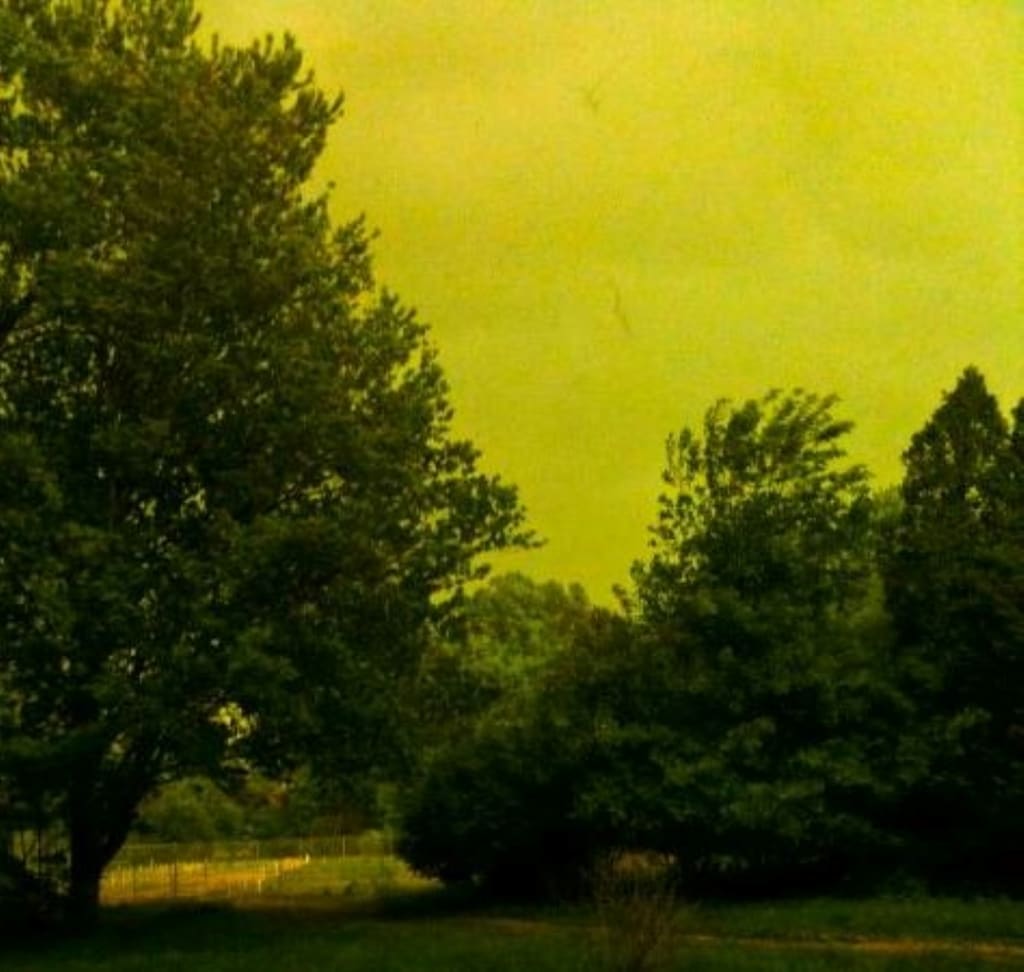
Green Skies over Cincinnati.
By Rick Wasserman.
As a child, I was so terrified by tornadoes that I tried to not even think the word. I was born in Cincinnati, though we moved to Oklahoma for a while in my teens. The irony of that is not lost on me, but strangely enough, the topography of North-Eastern Oklahoma is too mountainous for tornadoes, so we never had one during my stay.
My fear springs from living through the infamous super tornado outbreak of 1974. On the third of April, a storm system spawned 148 tornadoes in a single day. A sprawling mass of cold, dry air dropped down from Canada towards the Mississippi and Ohio River valleys, and an opposite mass of warm, moist air pushed northwards from the Gulf of Mexico. They were set to converge beneath an intense jet stream with 140-mph winds at an altitude of 40,000 ft. I was five years old at the time, and it was terrifying, but not because of the tornadoes. At the time, I didn't know why the sirens were blaring. I remember my terrified mother picking us up early from daycare. Under glowing, green skies shaded like the color that limes really are, but only on the inside. It was a sickly yellow-green, like someone mixed mint green and avocado green. My mother drove like an insane person to get back to our house, and then we spend the next several hours hunkered in the basement. The darkness was only interrupted by candlelight. The radio was a nonstop monotone monolog about things I either didn't understand or didn't care about. All I knew was that my mother was terrified, and there had to be a pretty good reason. Anything that draws out fear in one person that you yourself are truly afraid of must be a force to be reckoned with.
It was in the days and weeks that followed that I learned it was tornadoes. My elementary school practiced weekly "duck and cover" tornadoes drills as the sirens blared. So what if it was nothing more than the recycles tactics of the cold war era of 10 years prior. I was too young to know that. Nevertheless, it had been thoroughly impressed upon me by that time that tornadoes were just as dangerous as the nuclear bombs that I still knew nothing about, and everyone around me had the same fear.
So it had to be real, right?
Fortunately, I was not alone in my dread. Even halfway through the 20th-century, tornadoes were mysterious wind dragons that descended from nowhere, destroyed everything in their path, and then vanished. I have a never-ending series of historical essays about how the many things we take for granted in the 21st century often have their roots in the 19th, and tornadoes are one of those things. These days we know within minutes where one might be forming, where it might be going, and why. The information is at our fingertips, and people drive about in armored vehicles to chase tornadoes for fun… er… I mean research.
But there was a time when weather forecasters were forbidden to even utter the t-word. Research undertaken in the 1880s had created a hypothetical if unproven list of criteria for conditions that might lead to a tornado, but the efforts "fell out of favor," partly because the government was afraid of causing panic. Governments hate panics but love to cut research funding into inconvenient truths. Consequently, the idea was that even uttering the word would risk a needless fear frenzy amongst the public. Until meteorologists developed reliable prediction techniques, the t-word was off the table. My five-year-old self was a true believer in this methodology, but clearly, I am much better now. Now I am more afraid of how familiar the government actions of this last paragraph are, but I digress.
Fortunately for us future folk, on the 25th of March in 1948, research monies into scientific phenomena were all over the place for some reason. You see, a mere five days earlier, on March 20th, a tornado struck Tinker AFB in Oklahoma. The tornado caused over ten million dollars in damage. That is ten million in 1948 dollars, by the way. Adjusted for inflation, $10,000,000 in 1948 is equal to $111,313,675 in 2021 dollars. It was the most damaging tornado ever recorded, up to that date anyway. Though current estimates would have only gauged it as an F3 on the modern Fujita scale of tornado intensity. So people were pissed, especially the Major General of Tinker AFB. "WHAT THE HELL!" he might have said at the time. "Why didn't anyone warns us this was coming?"
Unsurprisingly, an official inquiry was conducted into the meteorological failure to predict the destructive tornado. It wasn't fair. Like arresting geologists for not waring a town in Italy that an earthquake was imminent( Which has happened). Luckily, the Air Force investigators quickly concluded that "due to the nature of the storm, it was not forecastable given the present state of the art."
Maybe, someone ought to look into that, thought the Major General.
With the reckless speed that only an angry Major General can inspire, investigations began almost immediately. This was post WW2, after all, and the bureaucracies of the 1950s were still in their infancy. Tinker's two chief meteorologists Major Ernest J. Fawbush and Captain Robert C. Miller, investigated the mapped surface and upper-air weather data from this recent and other past tornado outbreaks, hoping to identify conditions favorable for tornadoes. Why this had never occurred to anyone else before was anyone's guess. It's not some grand mystery like vanishing Glaciers or such.
So it should come as no surprise that after several furious days of study, minus breaks for coffee and a cruller, they had compiled several possible tornado indicators. They were happy to report that it would be difficult, but entirely possible, to eventually identify large tornado threat areas in the near future. Miller and Fawbush had created composite charts that juxtaposed data from different altitudes and noted wind direction, temperature, and moisture, all to serve as guidelines to future researchers into the field of tornados and their formulation. All in all, a job well done and quite complete.
They say that Nature abhors a vacuum, but Murphy loves to shout out "Look! A Dirigible!" and then wait for everyone to turn and look before kicking them in the butt. Fortunately, post-war, the Unites States military and the rest of "the Greatest Generation" were entirely on to Murphy's shenanigans. Knowing Murphy as we do, it should come as no surprise that the very next morning, March the 25th, the base meteorologists noticed that forecasted weather charts for the day were strikingly similar to those seen before the March 20 tornado. It was ridiculous. It was like lightning striking in the same place twice, and that NEVER happens.
Since they were still forbidden to say the "T-word" without evidence, the two meteorologists cheated and instead issued a warning forecast for "Heavy Thunderstorms" instead. This white lie would allow the Major General to alert base personnel to institute their brand-new tornado-type precautions without actually saying the word.
At 6 PM that day, what we now call a supercell formed just West of the base. Our hero meteorologists bit the bullet as they composed and issued the very first official tornado forecast on the spot. Although they were aware of the slight chance of success, they felt they had no choice since the conditions were so very similar to what had been recorded five days earlier. Everyone on the base promptly hunkered down, and whatever expensive equipment remained from the last time was secured in bomb-proof shelters.
As predicted, the tornado formed and did another six million dollars in damage (or $65 million in today's dollars), but the real damage was done to the reputation of tornadoes. They were no longer mythological creatures, they were now science, and they could be predicted. This tornado prediction proved to be successful, even if its precision mainly was due to chance.
That was how, in 1974, we were able to know in advance that tornadoes were imminent. The modern Fujita scale of tornado intensity had only just been invented in 1971. The techniques codified at the end of the 40s were promulgated in the 50 and consolidated in the 60s. Man had overcome Nature once again, through science. Tornados will never surprise us again.
Until April of 1974.
There were 148 tornadoes in a single 24 hour period, but the storm itself lasted much longer, spawning a total of 319 that could be positively identified across 11 states and one Canadian province. The storm area ran from Ontario, south through Michigan, Illinois, Indiana, and Ohio, to Kentucky, West Virginia, Virginia, Tennessee, and North Carolina. The tail ends down in Alabama and Georgia. Look at it on a map. The scale was immense.
Xenia, Ohio, east of Dayton and birthplace of my Grandmother, got hit by 32 tornadoes. One was an F5. That tornado alone caused an estimated $100 million in damage and the loss of 33 lives. Hamilton County, where I lived at the time, only got hit by 5. Tennessee, where I live now, was struck that day by 45 tornadoes, only two of which were in Knox County, again thanks to the relatively rough terrain. Michigan also got a heavy snow, in addition to two tornadoes. Kentucky and Alabama each got over 70 tornados, but it was Tanner, Alabama, that got hit twice, just like Tinker AFB, except theirs were both F5, the worst of the worst.
Oklahoma, in the heart of Tornado Alley, received not a one.
But every cloud has a silver lining, even a multi-state-sized supercell. Phased array technology can scan an entire storm in less than one minute, allowing forecasters to see signs of developing tornadoes well ahead of the current classical radar technology used in 1974. The NSSL uses a mobile Doppler radar to position close to tornadic storms to scan the entire lifecycle of a tornado from formation to evaporation. In the 21st century, we can watch, on TV or phones in the palm of our hand, the formation of a predicted tornado in real-time (with a bit of lag). We will know where it is going and when it will end. A weather app has replaced the old cold war air raid sirens, and we are warned in advance, just in case conditions are favorable.
Dare we say it?
Man had overcome Nature once again, through science.
Tornados will never surprise us again.
On the night of March 4th of 2020, An EF-4 tornado with winds up to 175 mph tore across the Nashville area, killing two people downtown, according to the National Weather Service. In Putnam County, which was the hardest hit, at least 18 were killed. Another tornado that touched down in Nashville and Wilson Counties that was rated as an EF-3. But it could have been worse. Miles away in Knoxville, we knew it would happen in advance due to a text message warning from the National Weather Service. Every moment of the storm was documented in real-time, and they were forecasting more than double the average of 75 tornadoes for the rest of the month as we all watched it live on TV via the local news radar. It was more entertainment for those of us not in the actual path—disaster porn for all of us in COVID lockdown.
The dragons are more predictable now, but they are growing fiercer.
How long before another super tornado outbreak is anyone's guess.
Maybe I should move.
About the Creator
Rick Wasserman
I am a published author, a verbose philosopher, a genius inventor (in my mind), a robotic technologist (not in my mind),and a borderline burlesqueteer (if such a word exists), among other almost believable things.
Keep reading
More stories from Rick Wasserman and writers in FYI and other communities.
The suspicious package was very suspicious.
It was spring break in the early ‘00s, and the world was a new and more dangerous place. The towers had fallen, and wars were being waged, but nothing stands between college-aged co-eds and their beer. The kids this year were doubling down though. With war in the air and feelings of patriotism at an all-time high, people were “partying like it was 1999,” as we used to say back in the day.
By Rick Wasserman4 years ago in Fiction
Miss Persephone's Manual to a Seemingly Ordinary Life
Miss Persephone was found at the dining table, her blue eyes swollen, her tears arriving and retreating like the tides of the ocean. Earlier that day, her family had visited her in the retirement home where she had lived for eight years. It was her eightieth birthday.
By Imola Tóth5 days ago in Fiction


Comments
There are no comments for this story
Be the first to respond and start the conversation.