
First-Time Flying Guide:
What Neurodivergent, Disabled, and Anxious Travelers Can Expect + Author Insights.


What’s this article about?
So, flying … as you probably figured. We took our first flight on Feb 29, 2024. I know, I know, it's almost October...shhh.
I was quite nervous about flying for the first time, yet when I searched online for “What to Expect…” articles, I found it surprisingly difficult to find what I was looking for; so I decided to write about it. I’ve written two versions of this article.
The first article (this one) remains (mostly) as I wrote it at the moment, taken almost directly from my journal. If you’re looking for a more condensed article, check out my other article Essential Tips for First-Time Flyers: A Guide for Neurodivergent, Disabled, and Anxious Travelers.
Note: I find it easier to read articles that have keywords in bold, so that's what I've done here. Anything I would usually "highlight" I have in bold.
Just a quick disclaimer: Please remember, I am not an expert & I’ve flown exactly twice, at night, using one airline. This means I haven’t experienced all airports or situations. Additionally, I was not flying alone & I did not have a TSA Pre-Check. I had travel companions that helped with parts of the process. As a result, I may have missed some details, that being said I noted any details I was aware of missing. This article was written from my perspective as someone with ADHD, Autism & PTSD/DID, as a result, some of the information is specific to the experience of someone with similar symptoms & support needs.
Alright finally… The actual article.
So how was it?
Honestly, it was A LOT better than I thought it would be to be completely honest.
Step 1: Check in your checked bags
(This is the first step, my travel companion took care of this for me)
Even though I missed it, I have some ideas for this one. So you get a tag for your bag and your boarding pass and then you go to check your bag. I’m not sure how you get the boarding pass or the tag but I believe it is done through a kiosk.
So first off what is checking a bag?
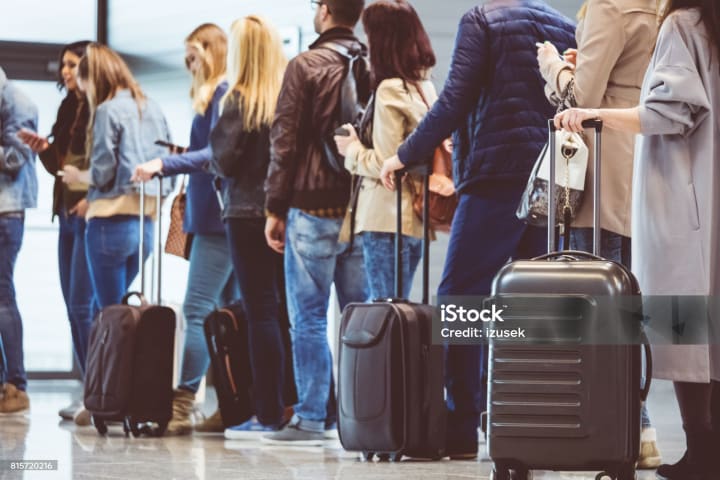
So all that means is that instead of coming onto the plane with you to your seat the bag goes under the plane in the cargo/storage place. You’ll wait in line until you can go up and they’ll weigh your items and then they put them on a conveyor belt. (This is the last time you’ll see this bag until you land).
Some items are not allowed to be in your checked bag for security or safety reasons, thankfully TSA has a full list of items you can bring. This list also tells you whether it needs to be in a checked bag or on your carry-on (the bag you... well you carry it onto the plane). Some items can go in either. To view this list click here
At the end of step one you head over to security, and the first thing you do with that is you go into a line (there is A LOT of waiting in lines, it's why people get there so early). At the end of that line you hand your ID to a person (TSA), who may or may not be in an awful mood (Mine seemed... Tense?) and then you stand in front of a camera. This is to ensure your ID & Face match.
After that, it's time for actual security which is...
Step 2: Security
Man, I was WAY more stressed about this than I needed to be. So security has three steps in total, the first is ID verification. The next step is to search/scan your carry-on bags (each airline has different rules on how big they can be).
So how do they search/scan your bags?
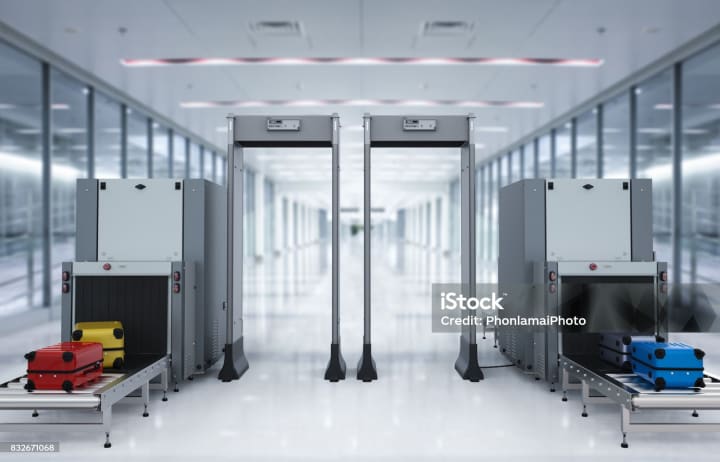
So the agent may or may not be in a good mood again, it seems to vary but to be fair I don’t think I’d be in a great mood if I worked there either…
Anyway, so you take off your shoes & your jacket (if you’re wearing one), then you put them in a bin (the bin will be right by security, at the airport I was at they had a roller belt with the bins stored below). Then you take out all your electronics that are phone-sized or larger and put them in their own bin. So you should have two bins (at least). Then you put your bag on the belt with the bins and they will move forward through a scanner.
Security: What happens if they find a prohibited item?
I didn't have prohibited items so my items went through fine but I believe what happens depends on the prohibited item that is found. For some, like large containers of liquids, I think they are confiscated or thrown away. For any illegal items, they may refer to local law enforcement.
Note: Airports are considered federal property and operate under federal law.
Additional Note about drugs: The TSA “isn’t looking for” personal use amounts of drugs like marijuana, however, if they are found they contact and refer to local law enforcement which are sometimes onsite. (Source: TSA.gov).
What about searching/scanning you?
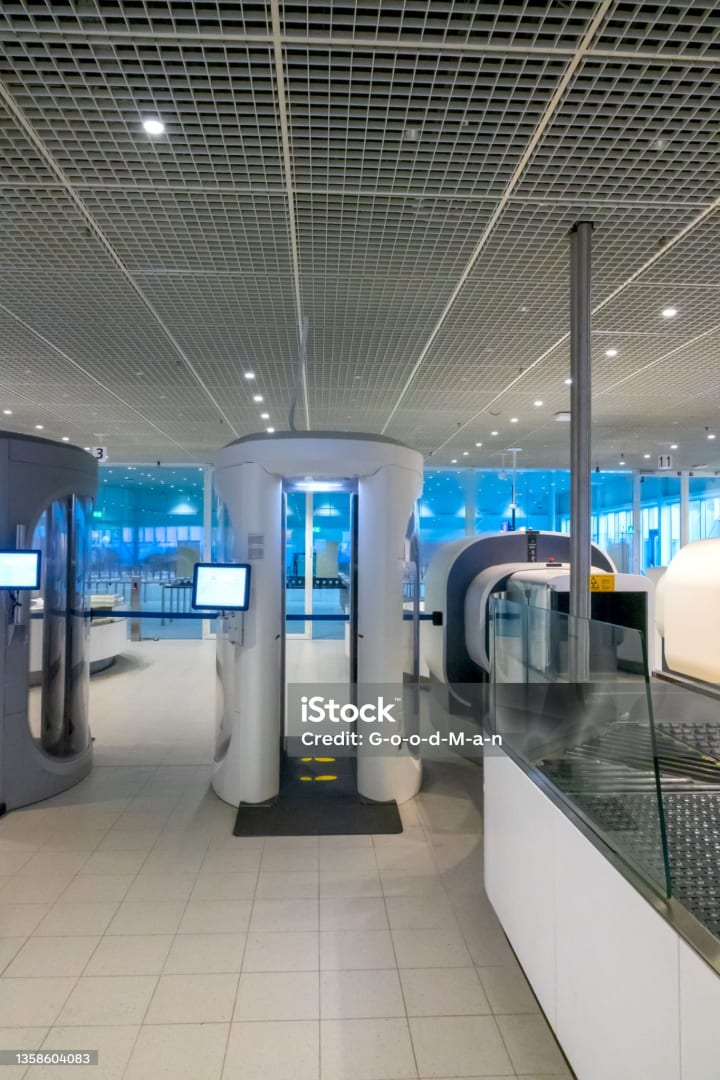
So for me at least departing on my trip I just went through what was a standard metal detector. (See Fig 2). However, on the way back I went through the body scanner (See Fig 3), this is similar to a metal detector but it's enclosed & you have to lift your arms for the scan. It's not super tight, kind of like a small elevator in size. It's a little claustrophobic if you have claustrophobia but it's quick. If you have any metal in your body or medical equipment that you can’t remove you may be required to complete additional screenings.
After you pass through security, collect your items and move to a nearby bench to put your things away & put your shoes back on.
Note: You can also be “randomly” selected for additional screening. While the official reason for this is “to maintain unpredictability & deter potential threats” it is important to note that many people have shared experiences of racial profiling in this “random” process. I did not get selected.
Alright, FINALLY we’re on …
Step 3: Finding your gate
For this, the number on your boarding pass matches a sign in the airport. That sign is to an area that looks like a waiting room. This area is near a labeled door, that’s the gate. You’ll wait there until boarding time (which they announce).
Step 4: Boarding
Your boarding pass will have a group and boarding # on them. At the airport, I was at there were poles with those numbers on them and you just lined up in order after your group was called.
Once it's your turn to get on the plane they’ll let you know. That’s when you’ll walk through the gate down a LONG hallway (at least mine was) to the plane.
Getting on the plane
At the end of the hallway there is a part that has a small gap, kind of like an elevator has a gap and then the plane.
There was a squishy part of the plane here, I think it was like a seal or something, I accidentally stepped on it and the texture was the WORST.
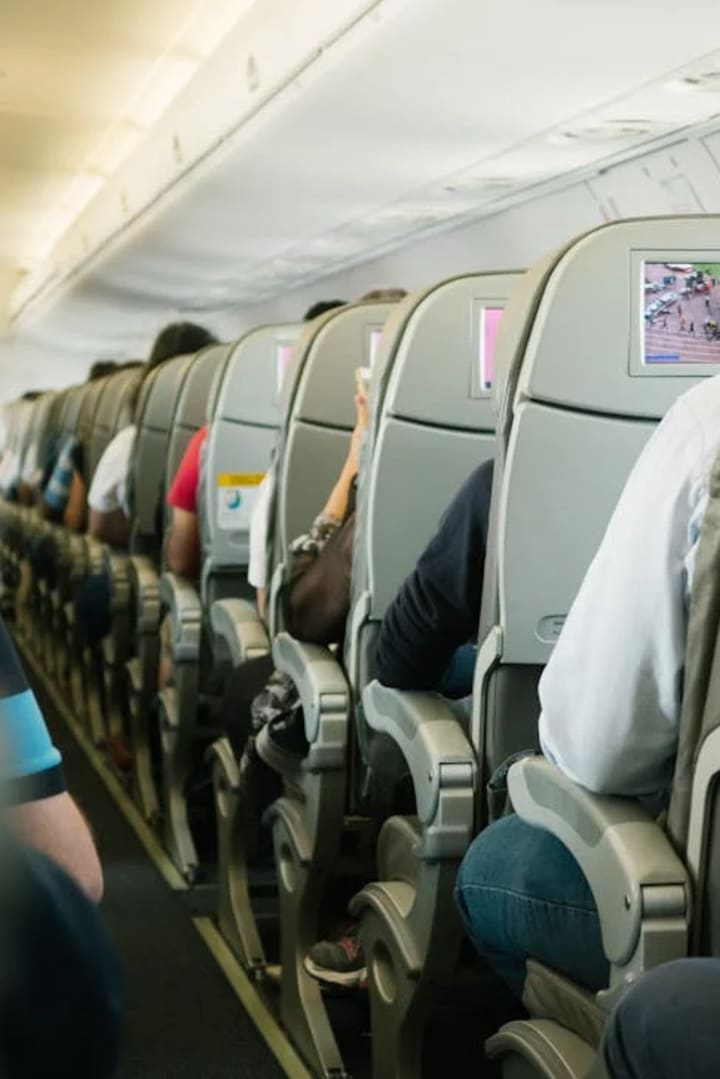
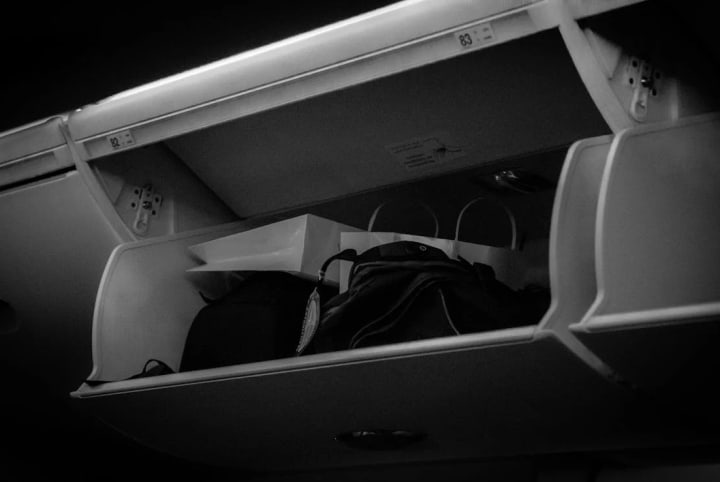
Once you stepped onto the actual plane it was very similar to getting onto a bus. Our flight had “first come, first serve” seating. Once you find your seat you put your bag either above in the storage cubbies or beneath the seat in front of you.
What’s the next step? Waiting...again.
Once everyone has boarded and they are ready the flight attendants will give you the safety brief. For our flight, there was a card with the brief on it as well. This is when they explain where the emergency exists, how to use the life jackets & oxygen masks, flight rules, etc.
After the safety brief, they tell everyone to buckle up and someone comes around to check while someone else shuts and seals the door. That’s also when they have you put your phone on airplane mode.
After some more WAITING, it's time to take off.
Now for most articles I read that’s all they said. For me, take-off is quite a few more steps.
What happens during take-off?
So first the plane moves just a little bit, it feels very similar to taking your foot off the brake of a car after it's been turned off. This is it moving away from the gate (I think). For us this happened during the safety briefing, it was kind of distracting since I wasn’t expecting it.
The second thing that happens is the plane will move backward on the wheels before getting the okay to go on the runway. During this part, they started moving the wings and it was LOUD. It's a loud and metallic mechanical sound.
Once they get the okay to go on the runway the third step of take-off happens, during this step, they go fast. For us, this felt like riding a fast roller coaster but only going up, or like the up part of swinging on the swings. This lasts until the plane gets up high, I’m not sure how high but once you get up there it settles (or at least it did for me). During this time I dissociated for a bit (a lot of sensory stimuli) but it wasn’t too bad.
Oh! Also during this time, your ears will pop, this is hard to describe. For me, it felt like a lot of pressure and my ears went from feeling muffled, like they were full of tissues to everything being too loud. The plane also sounds like white noise the ENTIRE time, during takeoff it's deafening but it continues the entire time and you can feel the sound on the floor.
The last step is just … fly.
So what else might you want to know about flying?
There is a seatbelt sign that tells you when to stay seated or not.
There is a bathroom.
Oh! I thought this was neat, our plane gave us a free snack & drink. I got cranberry juice and the snack we couldn’t choose but it was an airline-branded version of a cheese cracker snack bag. They also come to collect your trash.
What does turbulence feel like?
Turbulence was something I was really worried about before flying for the first time. When I told one of my good friends they explained it in a way that helped me when we hit it on the flight. So they said “When you hit any ‘bumps’ in the air, just think of it as if you were on a bus and it hit a pothole or some bumpy roads. Most of it will be smooth but the air is the road.” After experiencing turbulence first hand that is honestly what it feels like and flying does feel a lot like being in a car. For me the biggest difference was that when I could feel it moving through the floor I couldn’t feel the road under the floor, it just felt like nothing.
What’s it like to look out the window?
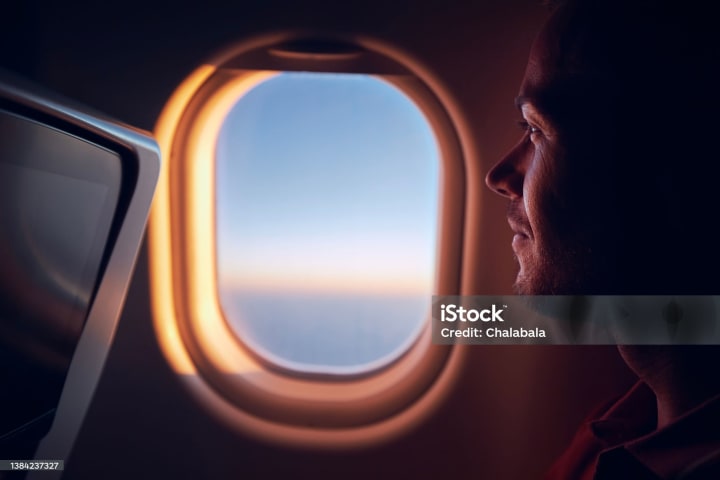
So it was dark for most of my flight BUT when we got over the city the lights were surprisingly beautiful.
Landing
So for us, the plane was dark & they decided to make it painfully bright & move the wings but they didn’t change anything besides that for a while. Landing as a whole takes a while.
During our landing, the plane had to turn in the sky to line up to land and that felt weird. After that, they moved the wings again and then we started landing. Landing is a very bumpy process or at least our landing was very bumpy.
What happens when you land?
By this point, I started to lose some details but if you check luggage you need to find the baggage claim and wait for your luggage. This was such a strange process for me but it was just a very large conveyor belt and the bags came out from the wall onto the belt and you grabbed your bag.
Important Note: If you are physically disabled this may be difficult for you, in my case the belt never stopped moving and went relatively quickly, at least for someone with mobility issues.
Anything else?
Yes, our group had a rental car and we were able to catch a shuttle at the airport to pick it up but that’s the only other detail I remember.
Final thoughts
Flying was a fascinating experience and nowhere near as scary as I thought it was going to be. That being said it was an intense sensory experience and for me was overstimulating.
I heavily recommend wearing the most sensory-friendly/comfortable articles of clothing you own. For shoes don’t wear boots, they will be annoying to take on and off. I’d recommend comfortable shoes with socks that are easy to slip on and off since you have to take your shoes off and if needed bring shoes for on the plane that are more comfortable. I wore two pairs of socks so I could take off the second pair after they touched the airport floor. Also, bring something that will entertain you during the flight and at the airport. There is A LOT of waiting.
Recommendations:
- Wear comfy clothes & easy-to-remove shoes.
- Bring entertainment
- Bring a snack for the airport, airport food is EXPENSIVE.
- Fly with someone if you can
- Bring a tiny blanket for your carry-on, planes can get cold.
- Bring wired headphones as a backup to your wired ones, my Bluetooth wouldn't connect once we were in the air.
Resources for People w/Disabilities (Including Invisible Disabilities)
So as someone flying with multiple invisible disabilities including DID/PTSD & Autism/ADHD, I wanted to know if there were any accommodations I could use for flying. Below are the ones I found based on my searches.
I haven’t used any of these but based on my research generally, airports have:
• Accessible Parking, Transportation, & Bathrooms
• Wheelchair Assistance – I do not know how it works
• Lowered Check-In Counters & Accessible kiosks equipped with braille instructions or tactile buttons for passengers with visual impairments.
• Accessibility Service Desk – A desk where you can find information, assistance, and accommodations for passengers with disabilities.
• Security Screening Assistance – “Specialized assistance and accommodations during the security screening process” (See Below TSA Assisted Screening)
• Visual & Auditory Assistance – Visual paging systems, audio announcements, assistive listening devices, and clear signs.
• Service Animal Relief Areas
• Priority Boarding
TSA Assisted Screening – Passenger Support Specialist (PSS)
In addition to the above TSA also offers screening assistance for people with disabilities. During this screening, you’d be given a TSA Passenger Support Specialist (PSS), who can assist through security screening. This HAS to be requested 72 hours in advance.
Hidden Disabilities – Sunflower
So not all airports have this but a lot do. When you “sign up” for this program (you don’t have to sign anything, I just walked up to a desk and asked about it) you are given a green lanyard with sunflowers on and a green bracelet with sunflowers on it. This serves as a voluntary disclosure that you have a disability and may need extra support, time, or understanding.
While writing this article I looked into the project more and learned that it is a global project, so the lanyard can be used outside of the airport to disclose invisible disabilities in shops, at work, on public transport, or in public spaces.
If this article helped you send it to your friends or Like & Comment
@CailleteCreaitves on FB, Instagram, DeviantArt or TikTok.
About the Creator
Caillete Rose
Writing fueled by the creative alchemy of caffeine, DID/PTSD, Sleep Deprivation, and Trauma.
Life's a complicated, beautiful nightmare. Why not write about it?
If you like the art in my banner, check out my art page @cailletecreatives
Keep reading
More stories from Caillete Rose and writers in FYI and other communities.


Comments
There are no comments for this story
Be the first to respond and start the conversation.