
Einstein and the general theory of relativity, overcoming all the difficulties to create but only two and a half people can understand?
Einstein and General Relativity

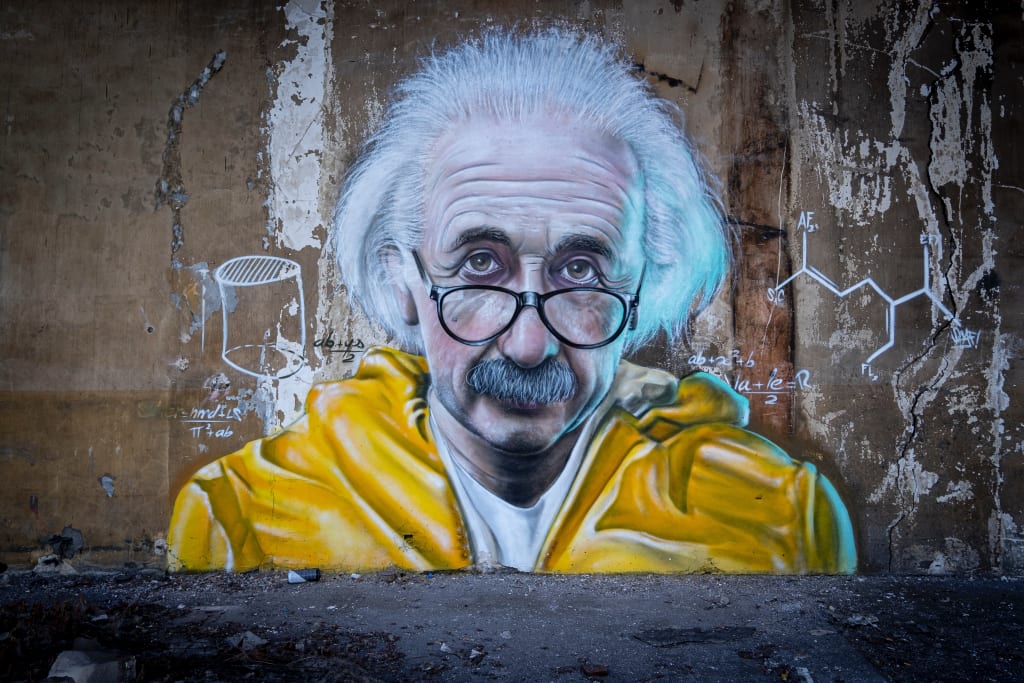
In 1905, Einstein founded the special theory of relativity at the age of 26 and rose from being a clerk in a patent office to a rising star in physics. If Einstein had not discovered special relativity at that time, three or five years later, Lorentz, Mach, and other outstanding physicists would have gotten a glimpse of it. It is the general theory of relativity that put Einstein's stamp on the theory of relativity and made it a god.
After Einstein's small success because of special relativity, he always had a knot in his heart about this "On the Electrodynamics of Moving Bodies". That is, special relativity can only describe the uniform motion and inertial system, but the accelerated motion or non-inertial system can not do anything. However, we live in a real world where uniform motion and inertial systems are almost non-existent. The Earth beneath our feet revolves around the Sun, which in turn carries the eight planets around the center of our galaxy. In this way, special relativity can only be a theory in the books, but can not do anything to solve most practical problems.
The idea of general relativity was then developed, Einstein built up the edifice of general relativity after ten years of hard thinking, encountered many difficulties, but did not give up.
His mathematical skills were weak, so he looked around for "outside help", and mathematicians such as Grossman and Hilbert gave Einstein vital help. When the rain came, Einstein's wife, Mileva, was jealous because they lived apart and Ein had a hazy relationship with his cousin, and Mileva made things difficult for Einstein, even preventing her children from corresponding with him. The pressure on Einstein, who was so focused on his studies at that time, could be imagined. The most fatal impact was the outbreak of the First World War. As a rising star in the field of physics, Einstein refused to cooperate with the German government that started the war and was persecuted and ostracized because of his Jewish identity ......
In 1916, the theory of general relativity was officially published. It consists of the equivalence principle and the general relativity principle as its pillars. General relativity makes up for the deficiencies of special relativity by enabling it to describe the motion of non-inertial systems. By its nature, special relativity describes flat (zero curvature) spacetime in which light travels in a straight line. General relativity, on the other hand, describes curved (non-zero curvature) spacetime, in which light travels along a curve. General relativity is a classic interpretation of gravity - spacetime tells matter how to move, and matter tells spacetime how to bend.
Later, many predictions of general relativity such as black holes, gravitational waves, etc., researchers won the Nobel Prize. People humorously claimed that Einstein was eating the big piece of bread called relativity, and later scientists could win the Nobel Prize by simply picking up the crumbs he dropped. This joke speaks volumes about the importance of relativity. Today, it has become the two pillars of modern physics with quantum mechanics.
However, when general relativity was first published in 1916, the theory was ahead of its time, with obscure mathematical calculations, and the academic community had been resistant to it. The first is its creator, Albert Einstein, the second is Eddington, and the last half is the sum of those who know a little about general relativity around the world.
In 1919, at Eddington's initiative, the Royal Astronomical Organization made field observations of a solar eclipse in tropical Brazil and the island of Principe off the west coast of Africa. This total solar eclipse, which would last six minutes, was the perfect opportunity to test the prediction of general relativity that the sun's strong gravitational force deflects light. After the relentless efforts of the crowd, the final data came out in perfect agreement with what the general theory of relativity predicted. Einstein's theory of relativity finally shone and guided mankind to a scientific peak for more than a century afterward.
Einstein once proudly said: "Without me, the academic community would have discovered special relativity in five years. But without me, no one would have come up with the general theory of relativity for fifty years."
About the Creator
Stajila
The progress of scientific research and its increasingly expanding fields will arouse our hope。
Aquaculture Market Size and Forecast 2025
Aquaculture Market Overview Aquaculture, also known as aquafarming, refers to the controlled cultivation of aquatic organisms such as fish, crustaceans, mollusks, seaweed, and aquatic plants. Conducted across diverse environments including freshwater ponds, coastal lagoons, offshore cages, and recirculating land-based systems, aquaculture has become one of the fastest-growing food production sectors globally. It plays a critical role in meeting the rising demand for protein-rich food while reducing pressure on overexploited wild fisheries.
By Aaina Oberoi3 days ago in FYI



Comments
There are no comments for this story
Be the first to respond and start the conversation.