
Do Black Holes Have Hair? Or Are They the Ultimate Bald?
Unraveling the Black Hole No-Hair Theorem
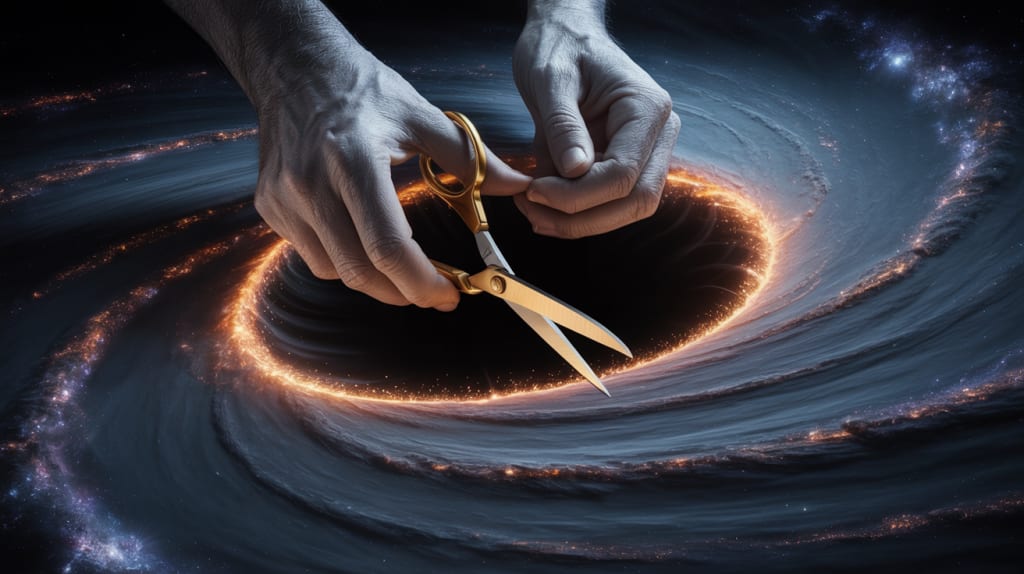
Imagine a glutton, not of cake or fame, but of reality itself. A cosmic vacuum cleaner, devouring light, matter, the very fabric of spacetime. What descriptors could possibly remain for such a creature? Is it truly featureless, a singularity lurking behind an impassable horizon? This brings us to a peculiar question, seemingly frivolous yet deeply profound: do black holes have hair?
The No-Hair Theorem: Bad Hair Days are Forbidden
The answer, delivered with the stern authority of a theoretical physicist, is mostly no. This baldness, however, isn't about follicular absence. It’s a far more intriguing statement about simplicity in the face of utter complexity, a lesson in cosmic minimalism courtesy of the celebrated "No-Hair Theorem."
What exactly constitutes this "no-hair" decree? The theorem posits that black holes, despite their tumultuous origins and ravenous appetites, are remarkably streamlined entities. Forget the intricate details of the star that collapsed to form them, or the eclectic mix of matter they’ve subsequently swallowed. All that remains, all that’s knowable from the outside, can be distilled into a mere three properties: mass, spin (angular momentum), and electric charge. Think of it as a cosmic ID card, reduced to the bare essentials.
The "hair," then, becomes a metaphor for all the information lost when something crosses the event horizon – the car keys you fumbled during your ill-advised black hole diving expedition, the specific chemical composition of a doomed star, the hopes and dreams of a wayward astronaut. All vanish, rendered irrelevant, inaccessible. Poof! It was the inimitable John Archibald Wheeler who popularized this notion, capturing its elegant, if unsettling, simplicity.
The Birth of a Bald Idea: From Uniqueness to Simplicity
The path to this "no-hair" understanding was, ironically, a tangled one. Werner Israel, a Canadian physicist, first planted the seed in 1967, demonstrating the uniqueness of non-rotating black holes. Soon, the idea blossomed, nurtured by the minds of Brandon Carter, Stephen Hawking, and David Robinson, who extended it to encompass charged and spinning behemoths. While Wheeler is credited with the pithy "no-hair" encapsulation, some whisper that Jacob Bekenstein might have been the true originator. Anecdotally, Richard Feynman, never one to shy away from a strong opinion, reportedly found the phrase downright "obscene."
For years, the No-Hair Theorem existed more as a compelling conjecture than a rigorously proven truth. Solidifying it required immense mathematical heavy lifting, confirming its validity for specific types of black holes.
Today, the theorem stands as a cornerstone of our understanding. Astrophysicists find solace in its simplicity. It renders black holes predictable, almost boring in their uniformity. Two black holes with identical mass, spin, and charge are, for all intents and purposes, indistinguishable twins.
Hairless but Not Harmless: Observations and Contradictions
The recent detection of gravitational waves has provided compelling observational support. The "ringdown" signal – the dying echo of a newly merged black hole as it settles into its final form – aligns remarkably well with the no-hair prediction. The event GW150914 was a watershed moment, a resounding victory for "hairless" black holes everywhere. Even when surrounded by the messy accretion disks or locked in binary embraces, black holes maintain their "hairless" facade, at least from a distance.
However, this smooth surface conceals a maelstrom of debate, a veritable cosmic headache. The information paradox looms large, a tangled thicket of theoretical thorns. If information genuinely vanishes into a black hole, as the theorem implies, it clashes head-on with the fundamental quantum mechanical principle that information cannot be destroyed.
Hawking's contribution, the discovery of Hawking radiation (the slow "evaporation" of black holes), only exacerbated the problem. If this radiation is generic, devoid of specific information, where did the original data go? Is it lost forever, a violation of the universe's most sacred laws?
Then there are the theoretical whispers of not-so-bald black holes. In exotic scenarios, beyond the familiar four dimensions or involving unusual fields like scalar fields, black holes could sprout extra "hair." These, however, tend to be unstable, fleeting aberrations. Moreover, the lack of a comprehensive mathematical proof for all general black hole solutions keeps some clinging to the term "no-hair conjecture."
Even with our increasingly sophisticated gravitational wave detectors, distinguishing between a truly "hairless" black hole and one with incredibly subtle "hairs" remains a formidable challenge, pushing the limits of our observational capabilities.
Strands of Possibility: Quantum Hair and the Future of Black Hole Physics
What does the future hold for black hole coiffure? The next generation of gravitational wave observatories, such as LISA and the Einstein Telescope, promise unprecedented sensitivity, allowing us to scrutinize these objects with far greater precision, potentially revealing subtle deviations from the "no-hair" ideal. The rise of multi-messenger astronomy, combining gravitational wave data with observations from X-ray telescopes and the Event Horizon Telescope, offers a holistic view, a chance to see the black hole and its surroundings in their full, multi-spectral glory.
Theoretically, new hairstyles are constantly being proposed. Hawking himself later suggested the existence of ultra-low-energy "soft hair" at the event horizon, a faint imprint that might preserve information. Others posit the existence of "quantum hair," a subtle, non-classical gravitational effect that could resolve the information paradox without violating quantum mechanics. And then there are the radical "fuzzball" proposals from string theory, envisioning black holes not as smooth spheres but as complex, information-bearing structures.
The ultimate goal, of course, is to resolve the information paradox and achieve a unified theory of quantum gravity. Such a breakthrough would revolutionize our understanding of space, time, and the very nature of reality.
Conclusion
While classical black holes may appear to be the ultimate minimalists, the "no-hair theorem" continues to challenge our understanding at the intersection of general relativity and quantum mechanics. Each new observation, each theoretical exploration, pushes the boundaries of our knowledge, bringing us closer to unraveling these profound cosmic enigmas. Perhaps these extreme objects are indeed surprisingly simple. Or perhaps they possess a hairstyle so subtle, so nuanced, that we are only now beginning to glimpse its faint, elusive strands.
About the Creator
Francisco Navarro
A passionate reader with a deep love for science and technology. I am captivated by the intricate mechanisms of the natural world and the endless possibilities that technological advancements offer.
Keep reading
More stories from Francisco Navarro and writers in FYI and other communities.
3I/ATLAS Update - Rumors and Reality
Executive Summary Comet 3I/ATLAS is the third interstellar object ever identified, discovered on July 1, 2025, by NASA-funded ATLAS from Río Hurtado, Chile. Its hyperbolic trajectory confirms it’s not gravitationally bound to the Sun. It poses no threat to Earth, will pass closest to the Sun around October 30, 2025 (~1.4 AU)*, and won’t come closer to Earth than ~1.8 AU (~270 million km). It is active—i.e., a comet with an icy nucleus and coma—and was traveling at roughly 61 km/s upon discovery, accelerating as it approached perihelion. Observationally, it should be visible to ground telescopes until September 2025, then reappear in early December 2025 after passing too near the Sun’s glare.
By Francisco Navarro7 months ago in FYI
The Role of NSN Identification in Aerospace Procurement
The aerospace industry relies heavily on precision, organization, and traceability when sourcing parts and equipment. Aircraft are made up of thousands of individual components, each playing a vital role in the safe and efficient operation of the system. Managing these parts across manufacturers, maintenance teams, and procurement networks can be extremely complex. To simplify this process, standardized identification systems are used to classify and track components throughout their lifecycle.
By Beckett Dowhanabout 9 hours ago in FYI
Hottest in the Office
Dear Rafi, You’re very distracting to work around. For the first second I saw you the other day, I thought you were some type of executive. It took a moment to realize no, you were just the new guy, dressed up for the job he wants. Be still, my heart.
By Gabriel Shames6 days ago in Pride


Comments
There are no comments for this story
Be the first to respond and start the conversation.